Warning: this article discusses the ending of Netflix’s The New Stanford Prison Experiment.
Netflix’s The New Stanford Prison Experiment arrives carrying one of psychology’s most troubling cultural reference points into a six-episode reality-TV format. The basic setup deliberately evokes the 1971 Stanford prison experiment: participants take on prisoner and guard roles inside a controlled prison setting, and the resulting pressure tests how quickly authority, hierarchy and group identity can change behavior.
But the new production is not presented as a straight recreation. Its 30 entrants come from different racial, geographic and economic backgrounds, including three women. Eight participants are guards, split across two shifts, while 22 are prisoners. The action takes place over a planned two weeks in a decommissioned cell block within a working prison. More importantly, the format builds in procedures intended to give people far more support and agency than participants had in the original experiment.
That distinction matters because the 1971 study, led by Stanford professor Philip Zimbardo, has long been regarded as an exceptionally notorious and ethically compromised psychology experiment. It recruited 24 college students—predominantly white men—and assigned them at random to inmate and guard roles for a planned two-week simulation. The situation deteriorated rapidly after a rebellion, with guards imposing increasingly harsh punishments and several participants experiencing mental distress. It ended after only six days.
The new series comes close to echoing that sixth-day breaking point. Yet the experiment does not end there. Its final resolution, in which prisoners leave together arm-in-arm on day 13, shifts the story away from an account of roles swallowing people whole and toward a more complicated picture of coercion, solidarity and choice.
Safeguards change the stakes, but not the tension
The new project uses a number of protections absent from the infamous historical setup. Participants underwent background checks and psychological testing, received informed consent materials, and had medics, psychologists and off-duty guards available around the clock. They could use the safe word “pineapple” if they wanted to leave or speak with a therapist or producer. Regular participant interviews also created opportunities to assess how people were coping as the simulation progressed.
Those measures are not cosmetic details. Informed consent means a participant is given information about what participation involves before agreeing to take part. It does not remove every risk from a stressful environment, but it is a core ethical requirement in research and in unscripted production involving potentially difficult material. Likewise, a safe word offers an explicit route out rather than requiring a person to negotiate with the same authority structure that may be causing distress.
Three observers brought distinct perspectives to the project: Harvard Business School behavioral scientist Alison Wood Brooks; journalist Trymaine Lee; and former federal corrections officer Michael Cantrell. Their presence also underlines an important limit on what viewers should take away from the series. This is reality television set in a simulated prison environment, not a replication that can resolve debates about psychology, incarceration or social identity. Its strongest value may be in putting power dynamics in public view—and encouraging viewers to ask why particular rules, roles and rewards produce the behavior they do.
Related coverage includes The New Stanford Prison Experiment Ends With an Unplanned Show of Unity.
The cast’s experiences make the exit options feel immediately necessary. Larry Foy, known as “Scary Larry,” is a former convict and is the first of five people to leave. Being back in a prison-like setting proves deeply triggering for him. His departure is painful, but it also demonstrates the practical purpose of a voluntary off-ramp: no reality-TV premise should require someone to remain in a situation that is doing them harm.
Day six again becomes the danger point
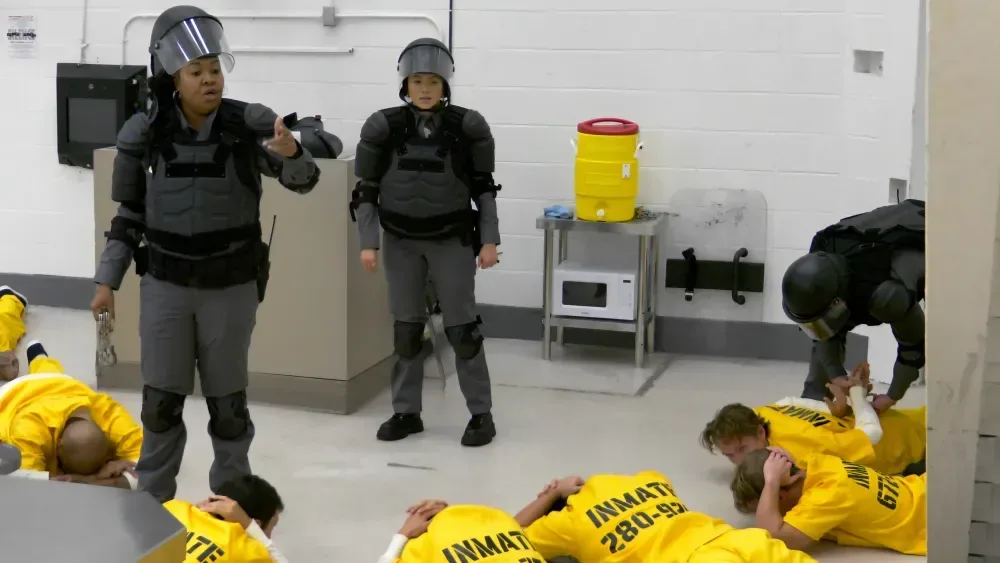
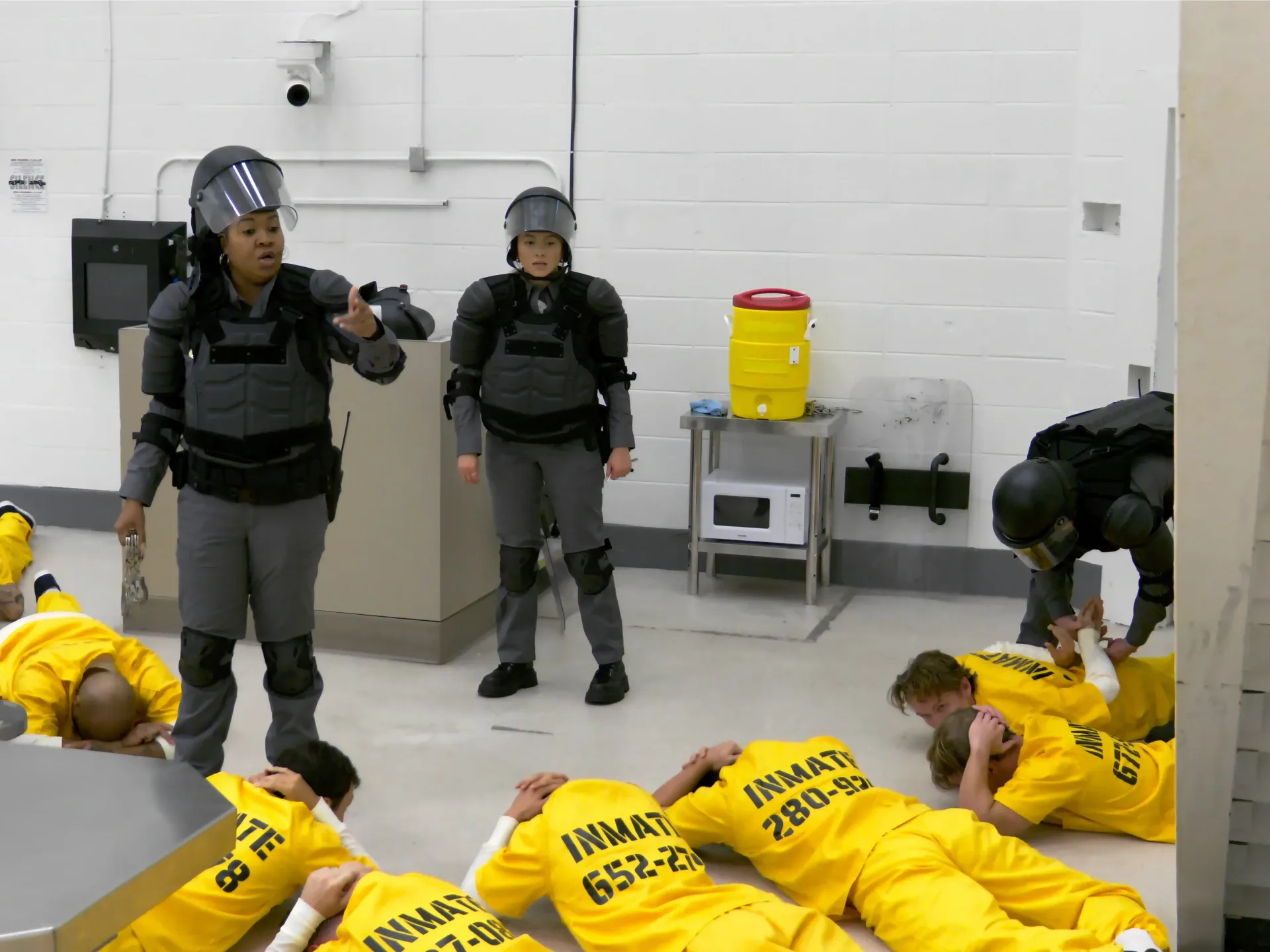
The clearest parallel with 1971 emerges when prisoners Pete and Brandon are punished for allegedly conspiring against the guards. They are placed in “23 and 1,” a term used in the show for being confined to their cell for 23 hours per day, with one hour outside for showering and recreation. The restriction is severe enough that Brandon nearly leaves the experiment, ultimately staying after an emotional conversation with his mother.
For the series, this moment functions as more than an interpersonal dispute. It shows how a system’s vocabulary can make a choice sound ordinary even when its impact is extreme. Calling something “23 and 1” gives the practice a compressed, procedural label. Explaining the actual daily routine makes its isolation much clearer. That difference between institutional shorthand and lived experience is one of the central tensions any prison-focused program has to confront.
Pete and Brandon are also not drawn as uncomplicated heroes. Their actions frustrate other prisoners as well as the guards, raising the uncomfortable question of whether resistance is principled, disruptive, self-interested, or some mixture of all three. The show leaves room for that ambiguity. It is possible to find someone aggravating while also recognizing that punishment, social exclusion and unchecked authority can become dangerous.
Role reversal exposes the fragility of authority
Producers organize the project through four phases: Transformation, Hierarchy, Role-Reversal and Self-Governance. The names make the series feel structured like an experiment, but the role-reversal phase is where its design most directly pressures participants to reconsider status.
During that phase, the heavily punished Pete and Brandon become guards. Several guards—including Chet Hudson, an oil rigger from Mississippi who had put the pair in 23 and 1, and Chris Lee, a 41-year-old startup CEO—become prisoners. The switch changes the social map quickly. Chet, uneasy without power, exits after a day.
The more alarming development occurs when prisoners who had resented Pete and Brandon begin crowding them as the two occupy guard positions. The situation comes close to physical violence before three female guards from the other shift step in. Laura Berens, a CEO and entrepreneur, leads that intervention and is portrayed as an especially effective leader: firm about maintaining order, but attentive to escalation and the people caught in it.
That is a useful distinction. Authority is the recognized ability to make or enforce decisions; leadership is the ability to guide a group toward an outcome. The two can overlap, but they are not identical. A person can have formal power and use it destructively, or possess it and use it to de-escalate a volatile situation. Berens’ approach suggests that maintaining control does not have to mean humiliating, provoking or abandoning people.
The women’s intervention also broadens a premise historically centered on men. The original study’s participant pool was overwhelmingly white and male. This series does not claim to settle how gender or race determines behavior, and its producers specifically resist making sweeping conclusions. Still, including people with varied backgrounds allows the program to surface questions the 1971 version was poorly equipped to ask.
Self-governance delivers the series’ defining image
In the last phase, Self-Governance, the existing rules are discarded and prisoners are allowed to decide what to do. Some want to remain and complete the experiment, including Lee. Then comedian Mike Paramore persuades the group that leaving together would carry more force than staying apart.
The prisoners walk out arm-in-arm, ending the experience on its 13th day.
It is an unexpectedly hopeful image, particularly after the series has spent so much time showing the appeal and danger of hierarchy. It should not be treated as proof that difficult social issues have been solved inside a television format. But it does reveal a different possibility from the one embedded in the prison simulation: people can reject a role that has been assigned to them, recognize shared interests across divisions, and act collectively rather than compete for proximity to power.
That ending also changes how the audience might read the earlier conflicts. A prison scenario naturally rewards the language of sides—guards and prisoners, compliance and defiance, winners and troublemakers. The collective exit rejects that binary. Participants who had been given separate roles choose a common action outside the roles’ logic.
Why the format invites debate rather than easy answers
There is an unavoidable contradiction in making a reality series from the legacy of a deeply criticized experiment. Turning social pressure into compelling television risks reproducing the very incentives it wants viewers to scrutinize. At the same time, the safeguards, experts and withdrawal mechanisms indicate an effort to avoid treating participant discomfort as disposable drama.
The result is likely most productive when watched critically. Viewers can ask several questions without assuming the show provides final answers:
- Who gets to set rules, and who bears the consequences of those rules?
- When does discipline become humiliation or isolation?
- How does a role change someone’s conduct, and how much responsibility remains personal?
- What conditions make people intervene before conflict becomes violence?
- What does it take for a group to choose solidarity over the status offered by a hierarchy?
Those questions extend beyond the simulated cell block, which is why the premise remains resonant even when it is uncomfortable. The program’s producers have pointed to the relationships formed among men from backgrounds that might not otherwise intersect, in an environment without phones or alcohol. That observation should not be inflated into a verdict on the broad discussion around male loneliness or the manosphere. It does, however, point toward the series’ most constructive thread: people who begin as strangers and competitors can listen, learn and revise their behavior in proximity to one another.
Netflix has recently continued to foreground a wide range of international and high-profile programming, including the titles covered in its Korea-focused slate celebration. The New Stanford Prison Experiment occupies a very different corner of that catalog: a reality project built around an infamous social-psychology reference point, with an ending that challenges its audience to look beyond the roles they have been asked to watch.
There is no confirmed second season. The executive producers have expressed interest in returning to the setting, while also acknowledging that a follow-up should not simply repeat the same design. A version centered on women or framed around different questions has been raised as a possibility. For now, the first season’s most significant statement is its final act: when the simulation gives participants room to decide, they choose to leave together.