Christmas Eve is supposed to be a season of ritual, reconciliation and the faint possibility that nobody will mention politics before dessert. The Fire Within You, the new Italian drama from director Edoardo De Angelis, appears determined to treat that expectation as kindling. Set almost entirely in a family apartment during a holiday meal, the 93-minute film places its characters around a table packed with food, old grudges and a mother whose every interaction seems built to cause a fresh emotional crater.
The film, originally titled Il fuoco che ti porto dentro, screened in competition at the Venice Film Festival on September 9, 2026. It is an Italy-set production from PicoMedia and Rai Cinema, made in collaboration with Netflix. Rai Cinema International is handling world sales. While its scenario has the useful compactness of a one-location pressure cooker, the response to its high-volume domestic warfare has been notably harsh: its conflict is described as repetitive, its visual intensity as overly insistent, and its hoped-for pathos as arriving too late to balance the damage.
That setup could still make it a title worth tracking for viewers fascinated by family dramas that refuse a polite exit strategy. Just do not mistake the holiday setting for a cozy one. This is not a movie about quietly enduring awkward small talk while someone burns the potatoes. It is about a family seemingly incapable of speaking without drawing blood.
Angela rules the apartment
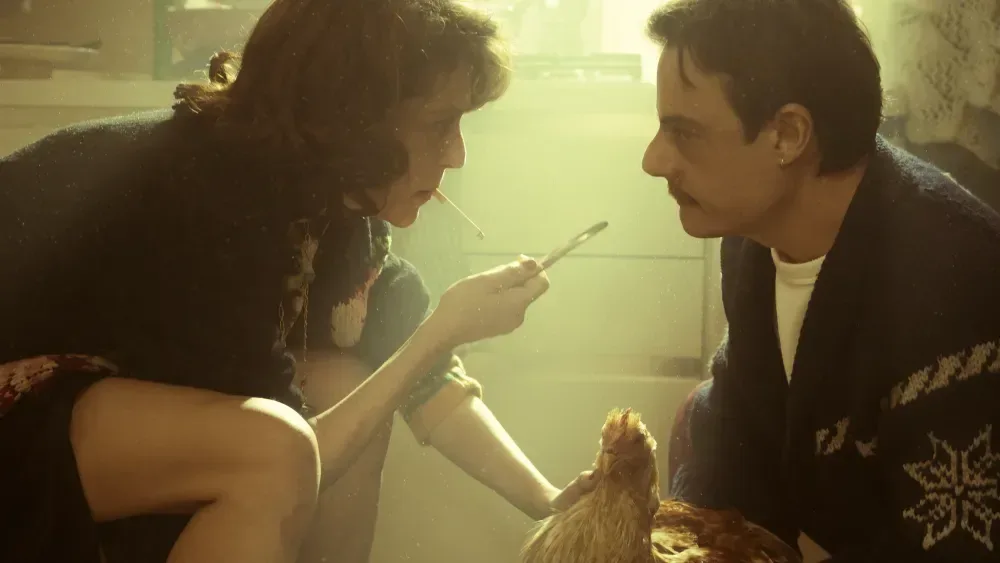
Vanessa Scalera plays Angela, the family matriarch at the story’s center. Angela is introduced in the kitchen, already drinking and preparing the Christmas Eve meal. Her first notable confrontation involves her adult son Antonio, played by Lino Musella, whom she berates for lacking the nerve to kill a live capon. From there, the hostility expands outward with alarming efficiency.
Antonio is a successful literary editor, but Angela characterizes him as weak and worthless. His wife Benedetta, played by Elena Radonicich, is criticized for her cooking and blamed for Antonio having left Naples for Milan. Their son Andrea, portrayed by Samuele Mazza, is targeted for taking ballet lessons; the film depicts Angela using a homophobic slur against him. Granddaughter Valentina, played by Nicole Malaj, becomes another target because she is vegetarian.
Angela’s cruelty is not confined to a single explosive scene. The structure presents it as the evening’s persistent background noise: cigarettes, frying food, alcohol and invective all sharing the same crowded domestic space. Food preparation becomes part of the movie’s corrosive atmosphere, with oil-heavy dishes and rough kitchen work mirroring the emotional brutality at the table. The effect is designed less as comforting holiday realism than as sensory overload.
Paola, Angela’s daughter, arrives later, played by Ivana Lotito, and brings a greater willingness to argue back. That distinguishes her from Antonio, who absorbs a sustained barrage of abuse before he finally erupts in a confrontation involving broken glass. But a character answering Angela does not necessarily mean the movie makes more room for anyone else. The core criticism is that Angela dominates the narrative so completely that the supporting family members struggle to become more than people waiting for their turn to be wounded.
A family drama built around an untouchable mother
The cultural idea hovering over the film is the Italian phrase La mamma è sempre la mamma, or “the mother is always the mother.” It conveys the special, nearly inviolable place motherhood can hold within family life. The Fire Within You uses that concept to explain why Angela’s children remain tethered to her even as she humiliates them. The bond is not presented as simple affection. It is obligation, history, guilt and ingrained familial hierarchy, all concentrated into one holiday gathering.
That is potentially potent terrain. Films about damaged families often become most compelling when they recognize that leaving, confronting or forgiving a parent is rarely as uncomplicated as an outsider believes it should be. Yet the central objection here is that the screenplay does not supply enough understanding of Angela to make the emotional trap feel dramatically rich. Her behavior is extreme, but the script reportedly offers little grounding for the bitterness that defines her.
That leaves Scalera with a difficult assignment. The role demands relentless aggression and emotional ugliness, while providing limited access to the character beneath the attacks. A fearsome performance can make a one-note character memorable, but it cannot automatically add the missing notes. If the movie wants the audience eventually to consider compassion for Angela, it must earn that shift through a more developed portrait than mere late-arriving information.
The screenplay comes from Francesco Piccolo, Ilaria Macchia and De Angelis, adapting a novel by Antonio Franchini. Its eventual revelation is meant to reframe Angela and encourage sympathy from both her family and the viewer. The reported issue is not that a family drama changes perspective; reversals of that kind can be effective. It is that the twist is telegraphed too clearly, and that the movie has spent so much time making Angela abrasive that the intended emotional reorientation has insufficient force.
An outsider arrives, but the apartment stays crowded
Antonio’s work creates an avenue for one additional guest. Giulio, a writer who will collaborate with Antonio on his next novel, arrives uninvited and is played by Tommaso Ragno. His presence gives the script an outsider who can prompt more disclosures about the family’s past and observe the dysfunction from beyond its usual boundaries.
In theory, that is a classic locked-room drama device: introduce someone unfamiliar with the household’s rules, then let their presence destabilize the brittle equilibrium. In practice, Giulio’s arrival reportedly does not provide enough surprise to offset the predictability of the larger plot. Angela, becoming more intoxicated, directs flirtation toward him while continuing to lash out at everyone around her. The dinner is thus not transformed into a new kind of encounter; it remains a long escalation of the same hostile dynamic.
Other characters fare unevenly. Tony Laudadio plays Paola’s Buddhist husband, Edoardo, in a characterization described as broad. Andrea begins with some individual definition through his ballet training, but the use of his dance later in the apartment is said to land awkwardly rather than poignantly. When an intimate family story depends on every person at the table feeling like a full human being, turning those people into easily read sketches is a major risk.
For a different sort of film-related event built around September nostalgia and theatrical presentation, readers can also see how Batman Day is bringing Burton, Phantasm and LEGO Batman back to theaters. The Fire Within You, by contrast, is firmly rooted in contemporary domestic discomfort rather than celebratory fan culture.
Style turns the volume up
De Angelis previously directed The Vice of Hope, and he teams here with cinematographer Vladan Radovic, editor Lorenzo Peluso and musician La Niña. The visual approach reportedly favors restless camera movement within the apartment. The technique seems intended to externalize the instability inside the home, but it has drawn criticism for underlining tension viewers can already hear in the shouting.
There is a fine line between immersive claustrophobia and cinematic overstatement. A confined setting can become electric when framing, cutting and sound find new patterns as relationships shift. It can become exhausting when every technical choice repeats the same declaration: this family is having a terrible night. In the account of The Fire Within You, the unsteady camera and forceful music sit alongside the bickering instead of revealing an additional layer of character or atmosphere.
Place also becomes a peculiar point of tension. Antonio is established as living in Milan after growing up in Naples, and Angela repeatedly takes digs at Milan. Yet the apartment used to represent Milan reportedly looks distinctly Neapolitan, an impression reinforced by the closing credits. For audiences attuned to the contrast between the two cities, that detail could become distracting, especially in a drama where regional identity is part of the family’s language of resentment.
Cast and production details
- Director: Edoardo De Angelis
- Screenplay: Francesco Piccolo, Ilaria Macchia and Edoardo De Angelis, based on Antonio Franchini’s novel
- Cinematography: Vladan Radovic
- Editor: Lorenzo Peluso
- Music: La Niña
- Producers: Roberto Sessa and Chiara Grassi
- Executive producer: Linda Vianello
- Running time: 93 minutes
- Language: Italian
Alongside Scalera, Musella, Radonicich, Lotito, Ragno, Malaj, Mazza and Laudadio, the cast includes Giovanni Franzoni. The names suggest an ensemble designed to convey years of shared history in close quarters. The central concern is that the film gives its principal antagonist so much space that those relationships do not develop with equal texture.
The Fire Within You is therefore a Christmas Eve chamber drama with an intentionally bitter recipe: a family, an apartment, a meal and a mother who makes every course feel like an attack. Its Venice competition placement underscores the ambition behind the project, as does the pedigree of its cast and creative team. But the reported response suggests that the fire in its title burns too hot and too uniformly, leaving limited room for surprise, empathy or relief.