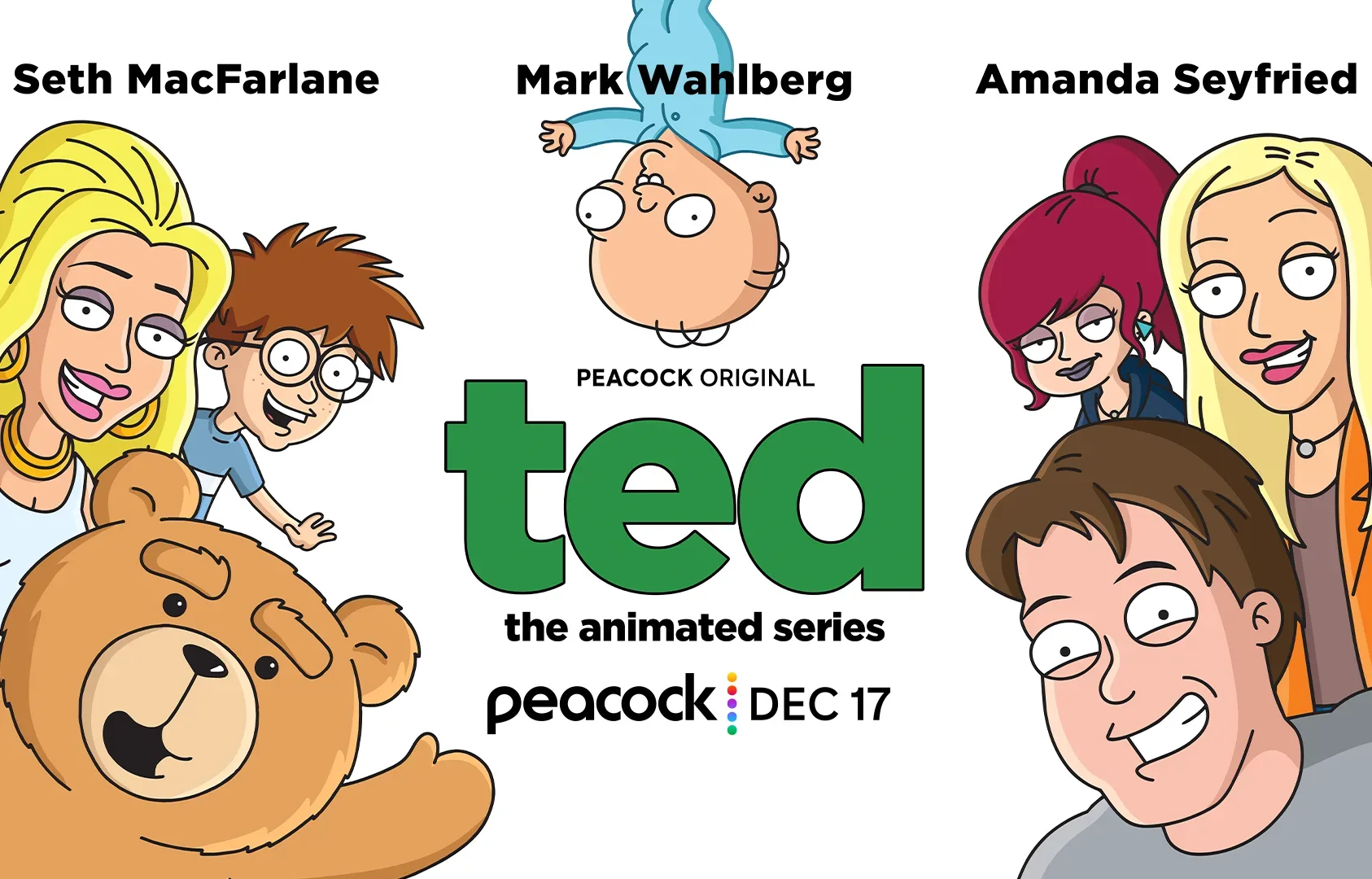
Ted: The Animated Series will bring Seth MacFarlane’s sentient, spectacularly ill-advised teddy bear back on December 17. The first batch contains eight episodes, while further episodes are planned to stream in 2027.
The animated show is a sequel to the 2012 film Ted and 2015’s Ted 2, rather than a continuation of the live-action prequel series. Its biggest point of continuity is its voice cast: MacFarlane returns as Ted, Mark Wahlberg returns as John, Amanda Seyfried returns as John’s wife Sam, and Jessica Barth returns as Ted’s wife, Tami-Lynn.
The setup moves the story forward 12 years from the second movie. John and Ted are now neighbors, both have families, and both are stuck in dead-end jobs. That is a meaningful change of frame for a franchise built around arrested development: the characters are older and surrounded by adult responsibilities, but the premise remains that they are entirely too willing to encourage one another’s worst ideas.
A movie-cast reunion for an animated sequel
Getting the principal film performers back matters because the series is not merely borrowing the Ted name or revisiting the character in a disconnected setting. Wahlberg’s John is central to the franchise’s “thunder buddies” partnership with Ted, while Seyfried’s Sam and Barth’s Tami-Lynn anchor the domestic lives that the new premise places directly in the path of those two friends’ poor decisions.
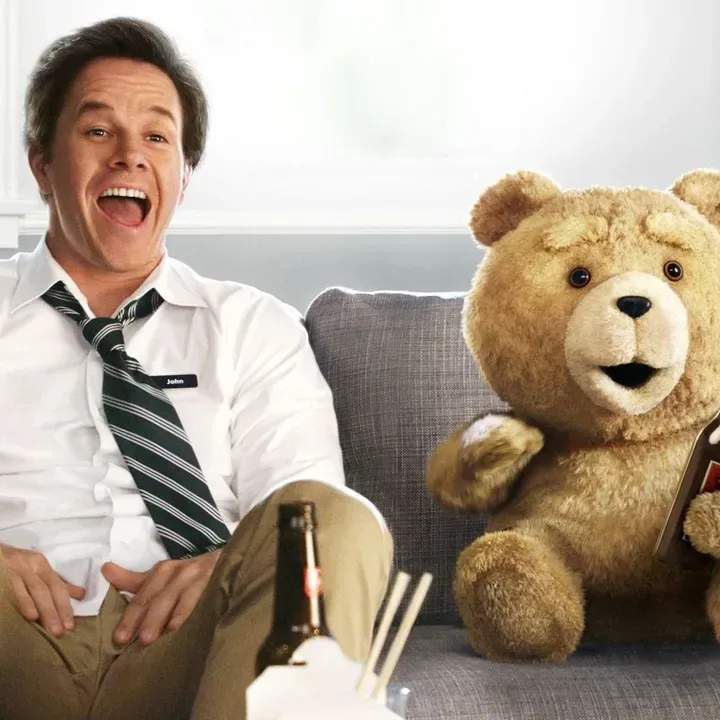
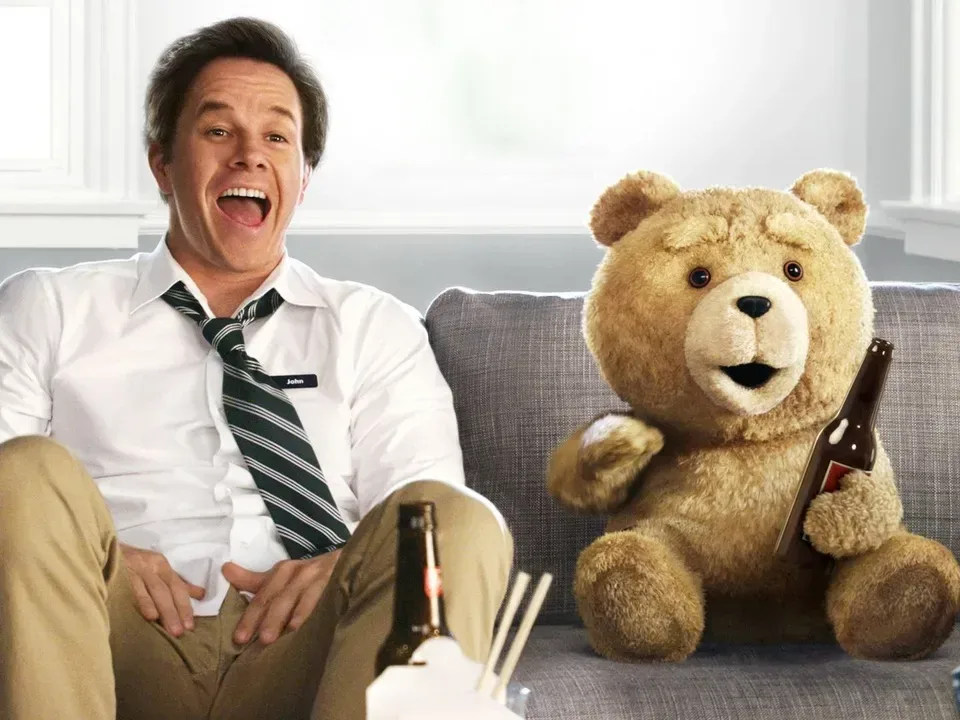
MacFarlane again voicing Ted also preserves the most immediately recognizable piece of the property. Ted’s performance has always depended on the contrast between his innocent stuffed-animal appearance and the decidedly adult behavior and language associated with the character. Animation can retain that visual joke while placing the character in a new period of his life.
Kyle Mooney and Liz Richman join the regular cast as Apollo and Ruth, respectively. No further character details have been provided, so it is not yet clear how either newcomer fits into John and Ted’s neighborhood, workplace lives or family circles. Their inclusion nonetheless signals that the show will add ongoing characters rather than rely solely on the returning movie ensemble.
What the premise says about the new series
The official description casts John and Ted as neighbors with families and unrewarding jobs, dealing with marriage, parenthood and adult life in the least constructive way possible: by enabling each other. In plain terms, “enabling” here means reinforcing someone’s impulsive or damaging behavior instead of challenging it. That dynamic is the engine of the comedy. The circumstances have changed, but Ted and John’s friendship is still positioned as a source of escalation rather than maturity.
That gives the series a relatively clear episodic foundation. Family responsibilities, marriage and jobs can produce distinct pressures from episode to episode, while the two leads’ bad decisions can supply the complication. The show is therefore set up as an adult animated comedy about a long-running friendship under new strains, not as a return to John and Ted’s earlier coming-of-age period.
It also distinguishes this project from the live-action Ted: The TV Series, which previously ran for two seasons. The new show is explicitly tied to the movie timeline and takes place after Ted 2. Viewers looking for the story’s chronological next step should treat the animated series as that continuation.
For another example of how established screen franchises keep reshaping familiar characters and premises for new projects, see the discussion around a possible Barbossa return in Pirates.
Why animation is a practical fit for Ted
Animation means the characters and environments are created as drawings or digital animated imagery rather than filmed as physical performers and locations. In this case, the format changes more than the look of the series. Ted is a fully animated character even in live-action productions, where he must be integrated into scenes with human actors through visual-effects work.
The live-action series’ future has been questioned because of the cost of those effects. An animated production does not erase the need for craft, time or a substantial production team, but it avoids the specific recurring challenge of making a computer-generated teddy bear convincingly share photographed space with live actors. That makes the format a sensible fit for a story that still centers on Ted while restoring Wahlberg, Seyfried and Barth as voice performers.
That is analysis of the production circumstances, not a claim that animation is inherently cheap. High-quality animation requires its own resources. The practical difference is that the show no longer has to solve the same live-action integration problem for Ted in every scene.
Rough Draft Studios, Inc. is animating the series. Paul Corrigan and Brad Walsh will serve as co-showrunners alongside their creative involvement with MacFarlane. A showrunner is the senior creative leader responsible for guiding a television series at the story and production level. Having co-showrunners gives the project named leadership focused on maintaining its direction across episodes.
The key details confirmed so far
- Premiere: December 17.
- Initial release: Eight episodes.
- More episodes: Planned for 2027.
- Format: Animated television sequel to the two live-action films.
- Returning cast: Seth MacFarlane as Ted, Mark Wahlberg as John, Amanda Seyfried as Sam and Jessica Barth as Tami-Lynn.
- New regulars: Kyle Mooney as Apollo and Liz Richman as Ruth.
- Creative leads: MacFarlane, Corrigan and Walsh created the series; Corrigan and Walsh are co-showrunners.
- Animation: Rough Draft Studios, Inc.
The important unanswered questions are equally straightforward. Beyond the eight-episode launch and additional 2027 installments, there is no supplied episode count for the later run, no release schedule for those episodes, and no detailed description of Apollo or Ruth. There is also no indication that the animated series resolves the uncertainty around a third season of the live-action show; it is a separate continuation with its own premise and format.
What is clear is that the franchise is leaning into a version of Ted that can advance its original film characters into a new stage of life without abandoning their defining relationship. John and Ted may have families, neighbors’ addresses and jobs, but the promised comedy comes from the prospect that neither has become especially equipped to handle any of it.