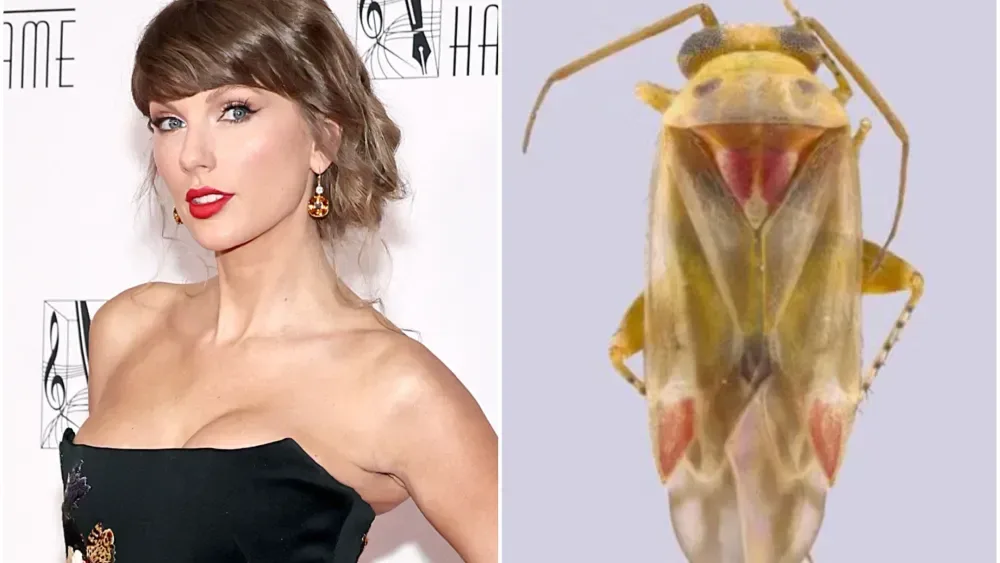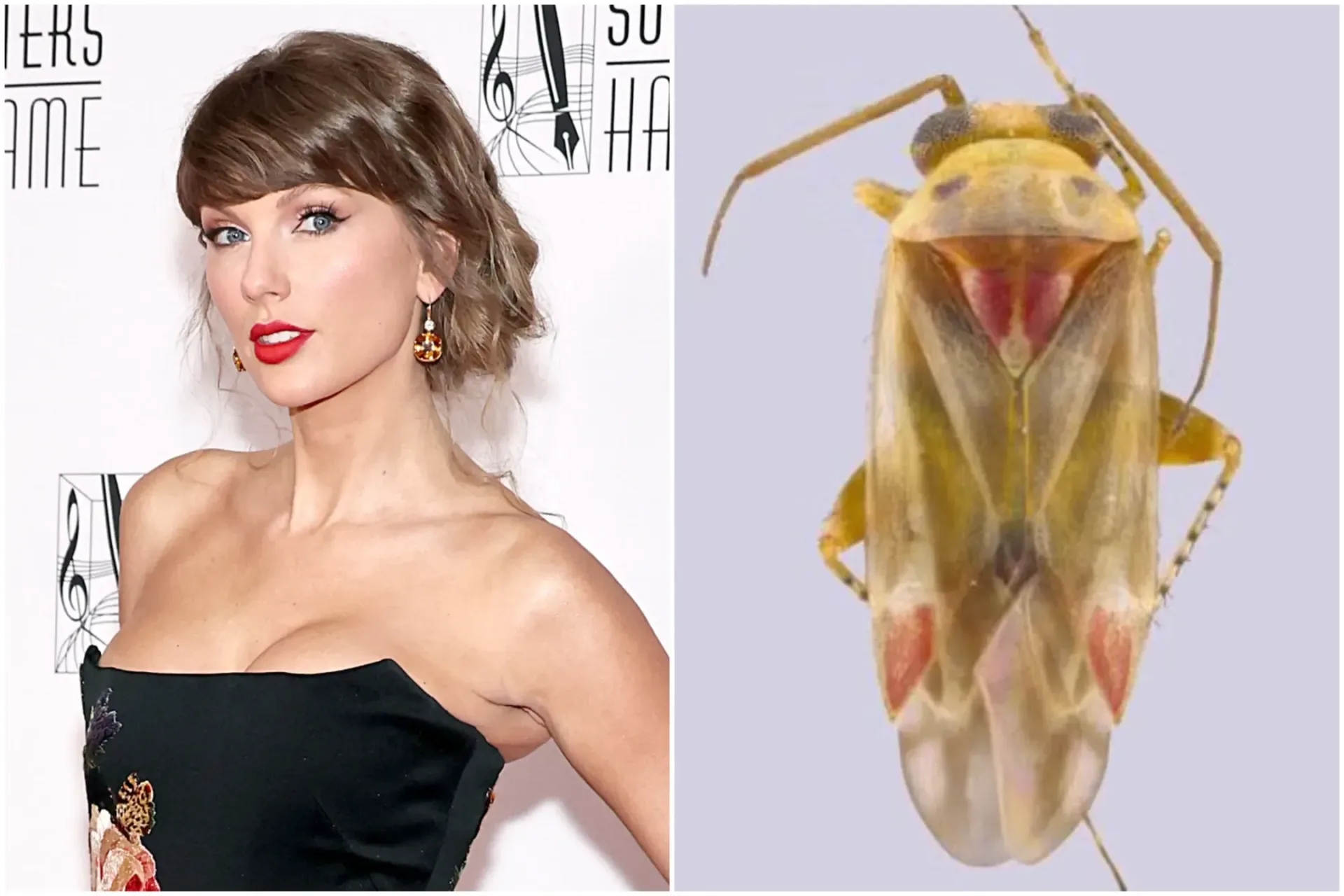
Taylor Swift has collected another distinction that cannot be placed on a shelf, framed on a wall, or slipped into a deluxe-edition vinyl package: her name is now part of insect taxonomy. Researchers at the University of California, Riverside have described 12 newly recognized species of Australian plant-feeding bugs in Insect Systematics and Evolution, including a genus called Swiftiephylus.
It is a wonderfully specific kind of pop-culture crossover. The name combines “Swiftie,” the familiar name for Swift’s fan community, with “Phylus,” a naming element commonly associated with this group of insects. The result is not a novelty label casually pinned to a creature after the fact. It is a formal scientific name attached to a newly described branch of biodiversity—one connected to Australian she-oaks and to the lengthy, often unseen work of sorting out which organisms exist in the first place.
Four of the species carry names that point directly toward Swift, her fan culture, and album-era language: Swiftiephylus taylorae, Swiftiephylus amator, Swiftiephylus intrepidus, and Swiftiephylus poetorum. Their epithets are Latinized forms associated with Taylor, lover, fearless, and poets. For a fandom accustomed to decoding tiny details in lyrics, imagery, and track lists, this may be the rare easter egg requiring a taxonomy key rather than a pair of headphones.
A scientific name with a conservation purpose
The decision came from UC Riverside entomology doctoral student Sarah Schroeder, who is a longtime Swift fan. Schroeder’s stated goal was larger than a celebrity tribute: she hoped the connection would draw attention to insects and to conservation science, especially the extraordinary number of species that still await recognition and description.
That rationale matters because taxonomy can sound like administrative housekeeping to people outside biology. In reality, giving a species a formal identity is a foundational step in understanding it. A creature can be alive, ecologically important, specialized to an unusual habitat, and completely overlooked in public discussion if it has not yet been separated from similar organisms and described in the scientific record.
Scientists cannot meaningfully track a species’ range, study its host relationships, determine whether its population is declining, or build conservation plans around it without first establishing what it is. A high-profile name may bring a burst of attention, but the underlying achievement is the research that turns a long-held specimen into a documented species.
This is also why a name like Swiftiephylus fits the moment surprisingly well. Pop culture has a reach that technical terminology generally does not. A person who might never otherwise stop to think about plant bugs, host plants, or museum collections may now encounter the subject through an artist they know. Celebrity-linked collecting news has taken many forms before, including the recent Billy Joel and Yankees apparel collaboration, but the Swift connection has a very different kind of permanence: it lives in scientific nomenclature.
The bugs behind the name
The new insects are associated with Australian she-oaks, a group of trees and shrubs capable of growing across dramatically different environments. Their habitats can range from tropical forests to coastal dunes and places exposed to intense heat. That flexibility in the host plants does not mean the insects themselves are ecological generalists. Many plant bugs spend their whole lives on a specific host, beginning at hatching and continuing through adulthood and reproduction.
For organisms like these, the plant is not merely scenery. It can be food source, shelter, meeting place, nursery, and camouflage backdrop all at once. A change in a host plant’s local conditions can therefore affect species that outside observers may barely notice. The small scale of the insects does not make their relationships small in ecological terms.
Their look played a role in Schroeder’s naming choice as well. The bugs are pale yellow with red accents, and their coloring appears suited to blending among she-oak flowers, which have slender red-to-orange structures. Schroeder described the insects as “blonde” in the paper, an observation that naturally echoes Swift’s well-known blonde-and-red visual association.
There is a serious evolutionary question beneath that visually amusing comparison. Similar cream and red patterns have been seen in distantly related bugs found on the same plants. That may indicate camouflage traits evolved independently on multiple occasions, with unrelated insects arriving at a comparable solution because the she-oak environment rewards it. In evolutionary biology, resemblance does not always mean close family ties; sometimes similar surroundings produce similar survival tools.
For anyone picturing a tiny insect invasion arriving with a dramatic bridge and a confetti cannon, there is reassuringly mundane news. These newly named bugs are not known to be pests to humans or animals. They belong to Miridae, the plant-bug family, which is the largest family of true bugs and includes more than 11,000 described species around the world.
Decades between collection and description
The insects may be new to science in the formal sense, but the physical specimens have been around for a long time. They were gathered between 1995 and 2004 during a major biodiversity collecting effort involving the American Museum of Natural History and collaborators in Australia. That work generated more than 50,000 specimens.
That number helps explain why formal descriptions can arrive years—or even decades—after a field expedition. Collecting is only the opening act. Specimens need to be preserved, cataloged, compared, examined for diagnostic features, matched against existing descriptions, and placed into a broader classification. Researchers must determine whether differences represent a new species, variation within a known one, or traits shared across related lineages. Scientific names are compact, but reaching a defensible one is not quick.
There is something fitting about this timeline. The specimens were collected long before the new genus name existed, long before Swift’s present-era cultural scale, and before the term “Swiftie” carried its current global weight. Now, years later, the patient work of insect systematics has connected that stored biodiversity record with a name likely to make people pause.
Why celebrity names can do more than create headlines
Taxonomic names inspired by public figures are sometimes treated as trivia, and they can absolutely be fun. That fun is not incompatible with the scientific work. A memorable name can help an overlooked organism cross the boundary from specialist journals to everyday conversation, particularly when the researchers are transparent about why the honor was chosen.
In this instance, the objective is explicitly tied to the still-unknown diversity of insects and the need to conserve species that may otherwise remain invisible. The Swiftiephylus names do not turn the bugs into merchandise or imply that they were discovered on a concert tour. They point attention back to she-oaks, Australian ecosystems, museum specimens, and the practical importance of describing life before it disappears from view.
UC Riverside’s researchers have used recognizable names in taxonomy previously. In 2022, a tarantula-killing hermaphroditic worm received a name honoring actor Jeff Daniels. The Swiftiephylus case follows that broader tradition while carrying a particularly apt visual hook: pale insects marked with red, tucked among red-orange she-oak flowers, bearing names that bring a vast fan community into a field usually associated with microscopes and Latin endings.
Swift has not publicly commented on the newly named genus and species. Whether or not a response arrives, the scientific record is already set. Somewhere in Australia’s she-oak habitats, small plant bugs with cream-and-red camouflage are carrying a name built for both taxonomy papers and group chats—and, more importantly, for a reminder that a great deal of life is still waiting to be recognized.