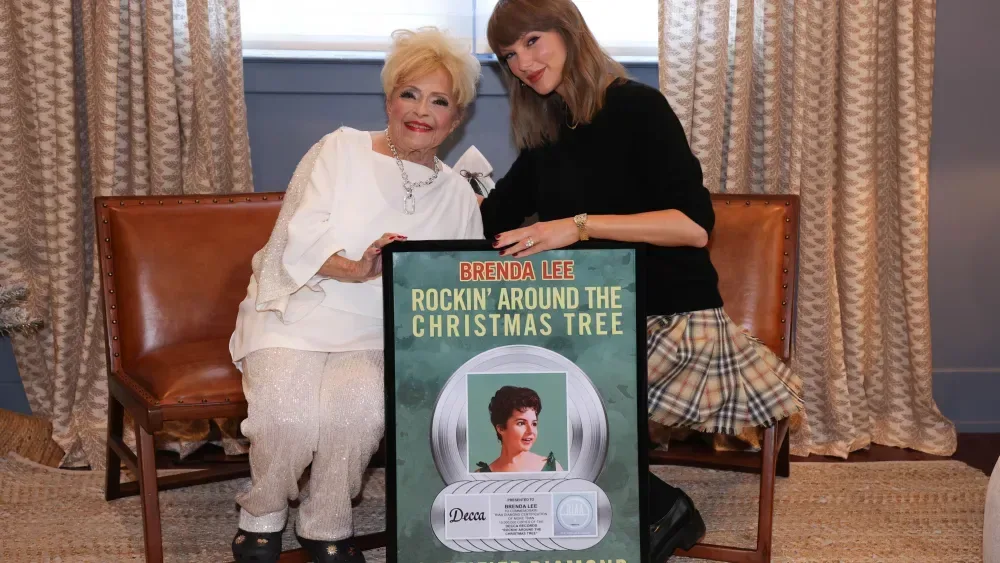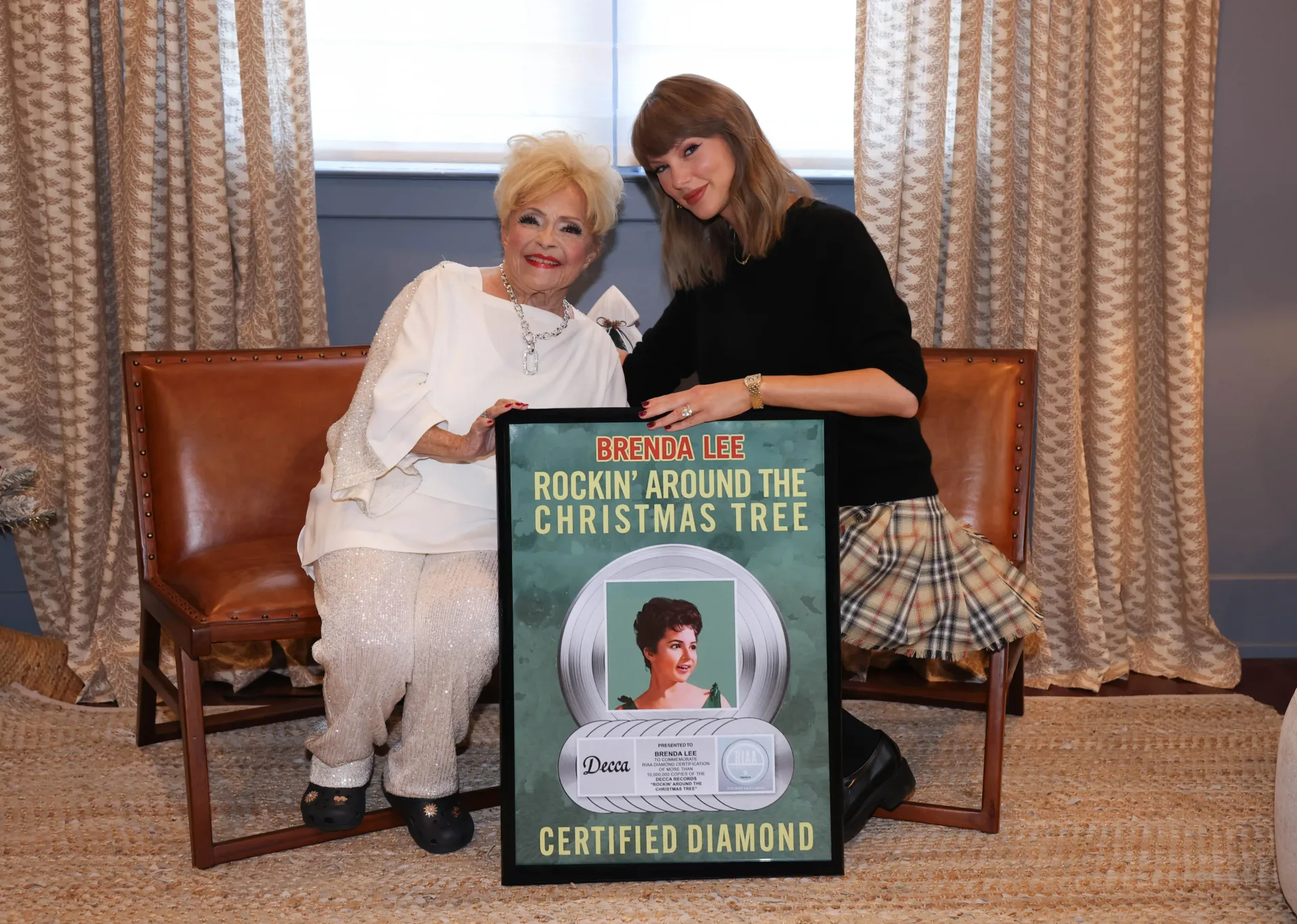
Taylor Swift has helped celebrate a rare holiday-music milestone, presenting Brenda Lee with a diamond certification for “Rockin’ Around the Christmas Tree.” The honor recognizes more than 10 million copies sold for Lee’s 1958 recording, a song that has become one of the most durable fixtures of the Christmas season.
The moment carries a notable generational symmetry. Swift has spoken of her admiration for Lee since her teen years, while Lee’s work stands as an early example of country-rooted stardom reaching a much broader pop audience. Their meeting was not framed as a new collaboration or a commercial campaign; it was a fan and fellow artist recognizing the scale and staying power of a recording made when Lee was just 13.
In video shared on Instagram and X, Swift arrives at a room where Lee, now 81, is waiting. The initial exchange is playful: Lee reacts in disbelief, and the pair joke about Swift’s height. That lightness makes the ensuing presentation feel less like a formal industry event and more like a personal acknowledgment between performers whose careers occupy very different eras of popular music.
What the diamond certification means
“Diamond” is a certification threshold used by the Recording Industry Association of America, commonly abbreviated as the RIAA. In this instance, it marks 10 million copies sold. It is a sizable achievement for any single, but especially striking for a seasonal release whose annual public attention is concentrated around the holidays.
Lee’s recording is only the second Christmas single certified at the 10 million-copy level. The other is Mariah Carey’s “All I Want for Christmas Is You.” The comparison does not flatten the two songs into the same story: they come from different musical eras and have distinct histories. What it does show is how unusual it is for holiday music to become an enduring, mass-scale catalog success rather than a song remembered chiefly by one generation.
Catalog music refers to recordings that remain commercially and culturally active after their original release cycle. Holiday songs have a special advantage within that category: their occasions for return are built into the calendar. Yet recurrence alone does not create a standard. A song still needs to be familiar enough for families, stores, playlists and individual listeners to choose it again and again. “Rockin’ Around the Christmas Tree” has evidently done that for decades.
“You recorded this when you were only 13 years old, and it is one of only two Christmas songs to ever reach this milestone,” Swift told Lee while presenting the certification.
Swift also thanked Lee on behalf of listeners whose Christmases, in her words, have gained “dazzle and sparkle and warmth” from the recording. Her remarks placed the achievement in its practical cultural setting: the song’s meaning is not limited to a number on a plaque. Its commercial scale reflects repeated use in homes and holiday traditions.
Related coverage includes Taylor Swift Presents Brenda Lee With Diamond Honor for ‘Rockin’ Around the Christmas Tree’.
Lee points the honor back to the people behind the record
Lee’s first response was to name the people who helped make the song and are no longer alive to see the latest recognition. She mentioned songwriter Johnny Marks, producer Owen Bradley, the musicians and the fans.
That response is an important reminder of what a hit recording represents. A singer is the public face of a record, but the finished work is built from several contributions: the songwriter creates the composition; a producer guides the recording process; musicians perform the instrumental parts; and listeners ultimately give the work its life beyond the studio. Lee’s acknowledgment did not reduce her own performance—her voice is central to the recording—but it accurately widened the frame around the honor.
Marks wrote “Rockin’ Around the Christmas Tree,” and Bradley produced the recording. Lee’s comments make the diamond recognition feel like a belated collective salute as much as an individual award. That is particularly apt for an old recording that has continued to find listeners long after many of its original creators have gone.
A meeting between two country-pop crossover artists
Swift’s appearance also puts a spotlight on a meaningful artistic connection. Lee became known as “Little Miss Dynamite” and, at the height of her fame, stood 4 feet 9 inches. The affectionate height joke during the presentation gives the video a memorable human detail, but the greater connection is musical: both artists have occupied the space where country music and pop music meet.
“Crossover” is often used casually, but here it describes a real career pattern—an artist associated with one musical tradition reaching listeners well beyond that lane. Lee’s success helped establish her as a country-pop predecessor; Swift’s own path has made her one of the most prominent modern examples of an artist whose audience crosses format boundaries.
Swift’s admiration is not a recent discovery created for the occasion. At 18, she wrote an essay about Lee titled “Rare Peer.” The essay later appeared in the 2017 book Woman Walk the Line, an anthology in which female country artists wrote about their heroes. That earlier piece supplies useful context for the presentation: Swift was not simply arriving to hand over an industry marker, but revisiting an artist she had already publicly treated as an influence and peer-worthy figure.
Lee, meanwhile, returned the warmth. When Swift said she had been a fan for a long time, Lee said that she was a fan too—before teasing Swift that she wished the younger star were not so tall. The exchange keeps the tribute reciprocal rather than reverential in only one direction.
Why a 1958 recording is still making news
The biggest number attached to this moment is the 10 million-copy certification, but the song’s longevity has produced another striking benchmark. In 2023, “Rockin’ Around the Christmas Tree” reached No. 1 on the Billboard Hot 100 for the first time, 65 years after its release.
That fact is worth separating from the diamond milestone because charts and certifications measure different things. A chart placement captures performance during a particular period; certification recognizes a cumulative sales threshold. One tells the story of a major recent peak, while the other reflects the record’s long-term commercial reach. Together, they show a song that is not merely preserved as a nostalgic artifact but still capable of participating in contemporary listening culture.
For listeners, the practical takeaway is simple: holiday playlists do not operate like ordinary new-release cycles. They are a recurring arena in which old and new material competes for attention. A decades-old song can re-enter public conversation every year, and a recording with enough familiarity and affection behind it can keep generating new milestones. Lee’s single is a dramatic example of that model working across generations.
It also offers a useful counterpoint to the tendency to treat musical relevance as a matter of novelty alone. The recording’s success did not require a newly written sequel, a modern remake or an invented origin story. Its appeal has been sustained by the original performance and the continuing ritual of hearing it at the same time of year.
That kind of longevity is part of why tributes between artists matter. They can direct audiences toward the people and songs that shaped later stars, while giving credit to older work still actively enjoyed in the present. In a different corner of music culture, the idea of listening to an album as a complete experience remains an active conversation too, as explored in Lil Uzi Vert’s description of the next album as an “audio movie”. Lee’s achievement comes from the opposite end of the format spectrum: one concise single, repeatedly returned to over time.
The real weight of the plaque
A certification plaque is a physical symbol of a numerical benchmark, but this one represents more than sales. It recognizes a record made by a teenage singer in 1958, shaped by Marks, Bradley and the session musicians, then carried through decades by audiences who kept inviting it back into their holiday routines.
Swift’s tribute made that chain visible. She noted Lee’s age when she recorded the song, its unusually exclusive diamond company and the warmth it has brought to listeners. Lee, in turn, redirected attention to the people who wrote, produced and played it. Their short meeting connected the song’s original creation to its present-day legacy without overstating the occasion.
For “Rockin’ Around the Christmas Tree,” the diamond status is the latest evidence that a seasonal favorite can also be a lasting cultural institution. For Lee, it is recognition shared with the collaborators and fans she immediately named. And for Swift, it is a chance to honor an artist she has respected since long before she was invited to present the plaque.