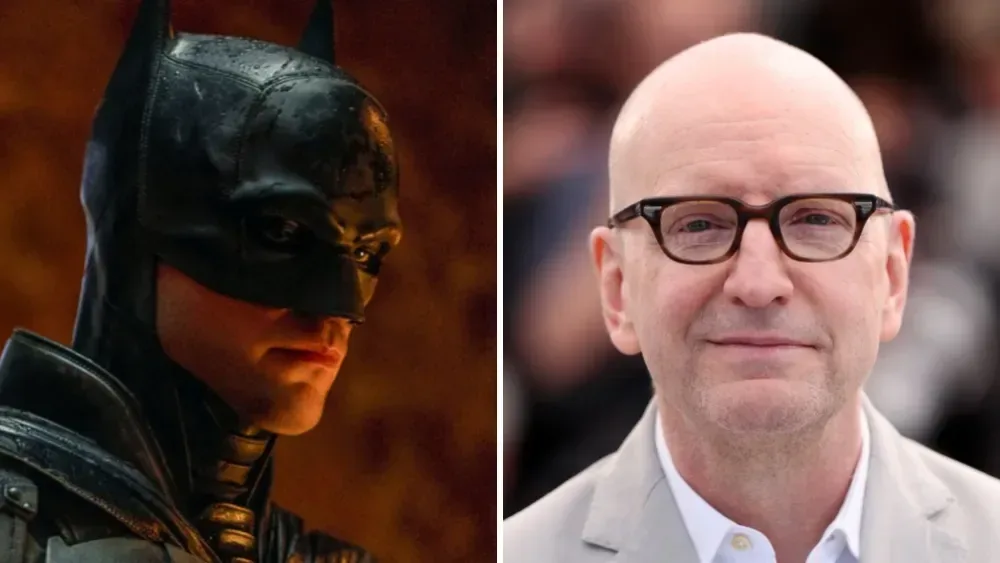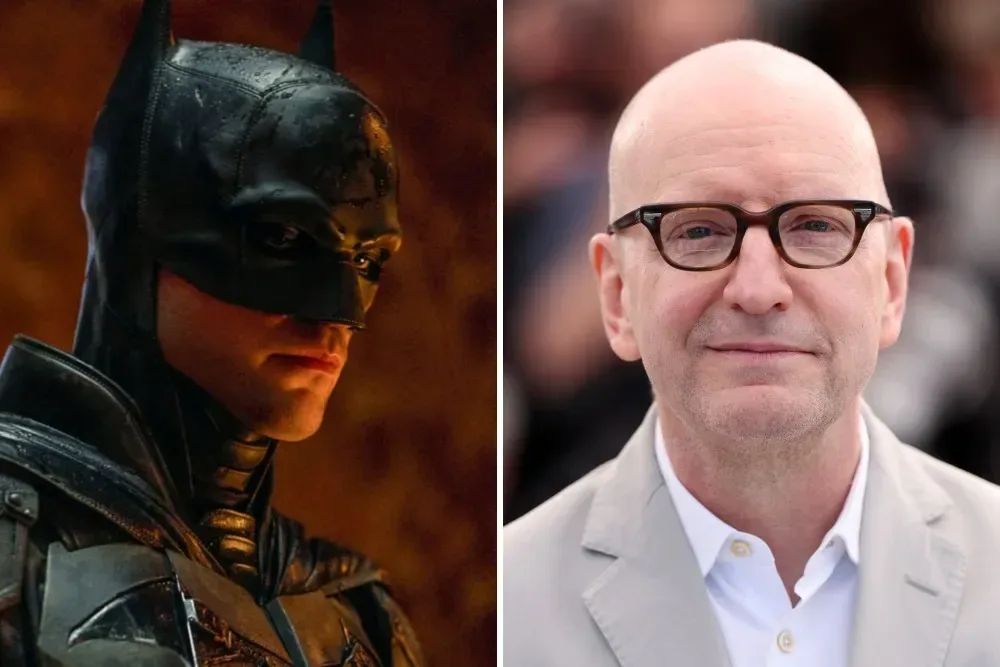
Steven Soderbergh will step in to help complete the final weeks of principal photography on The Batman Part II while director Matt Reeves attends to an ongoing family matter. The arrangement has the support of DC Studios, and the stated plan is for Soderbergh and Reeves to work closely with the cast and crew so the material fits Reeves’ established approach to the film.
This is not being framed as a replacement of Reeves. Instead, it is a temporary production solution designed to keep a large-scale film moving while allowing its writer-director to focus on a private family situation. Soderbergh approached Reeves as an admirer of the first The Batman, and has emphasized that his role is to help create footage that can blend with the scenes already completed, leaving Reeves able to properly finish the movie.
What Soderbergh’s role means
On a film of this size, the director’s work during shooting is not limited to choosing where the camera goes. The director coordinates performances, shot construction, pacing within scenes, visual priorities and the practical decisions needed to finish each day’s planned material. When a filmmaker temporarily steps away late in production, continuity becomes the central concern: new work needs to feel compatible with footage made weeks or months earlier.
That is why the language around this arrangement matters. The goal is not simply to capture any usable images. It is to produce scenes that integrate seamlessly with what Reeves has already shot and to carry out his vision. In practical terms, that means close coordination with Reeves, the actors and the crew rather than a newly announced creative direction for the sequel.
Principal photography is the main phase in which a movie’s scripted scenes are filmed with its cast. The reference to the “final weeks” indicates that Soderbergh’s assistance concerns the remaining stretch of that core shoot, not necessarily every stage between filming and release. A finished theatrical feature still typically needs post-production work, including editing and other processes, but no particular post-production timetable or duties have been detailed here.
For audiences, the important distinction is between completion and authorship. Reeves remains the filmmaker whose vision the production says it is serving. Soderbergh’s job, as described, is to help the team get the required material while Reeves is unavailable, then make it possible for Reeves to bring the film to completion.
Why Soderbergh is a notable fit
Soderbergh is an Oscar-winning filmmaker whose directing credits include Sex, Lies, and Videotape, Erin Brockovich, Traffic and Ocean’s Eleven. His more recent releases include The Christophers, Black Bag, Presence and John Lennon: The Last Interview.
His participation is notable because he is being brought in as an accomplished director with his own well-known body of work, yet the stated mandate is unusually specific: respect the intentional, precise and coherent filmmaking Soderbergh sees in Reeves’ first Batman film. The task is therefore one of controlled collaboration. Any incoming filmmaker working in this situation must prioritize the production’s existing visual and dramatic language over personal signatures.
Related coverage includes Steven Soderbergh Joins ‘The Batman Part II’ to Help Complete Filming.
That kind of work depends on preparation and communication. A continuing production already has an established cast, crew, costumes, sets, lighting plans and footage. It also has a set of creative decisions that have been made before the substitute director arrives. The public statements do not spell out the behind-the-scenes process, but their emphasis on working closely together signals that continuity is the key creative objective.
It also offers a clearer picture than the earlier pause alone. In early October, production was temporarily paused after Reeves stepped away to address a family matter. The decision to bring in Soderbergh is a way to resume work on the remaining material without suggesting that Reeves has abandoned the project or that the sequel has changed hands.
The release date remains February 2028
The Batman Part II is currently scheduled for February 2028. The sequel has had a long route to that date: it was announced at CinemaCon in 2022, initially dated for October 2, 2026, shifted to October 1, 2027, and then moved again to February 2028 in June.
No new release-date change has been announced alongside Soderbergh’s involvement. That is worth keeping separate from speculation. A production pause and a new directing arrangement naturally invite questions about scheduling, but the only release information provided remains the February 2028 date. Until a studio announces otherwise, that is the date attached to the film.
The first The Batman, directed by Reeves, arrived in March 2022. Its sequel brings back Robert Pattinson as Batman, also known as the Caped Crusader. The listed cast also includes Scarlett Johansson, Colin Farrell, Sebastian Stan, Andy Serkis and Jeffrey Wright.
With a returning lead and returning members of the broader ensemble, preserving continuity has value beyond camera and production design choices. Characters have already been defined through prior performances and, in some cases, through material made earlier in the sequel’s shoot. A collaborative handoff during the last stretch of filming is meant to protect that continuity while ensuring the production can proceed.
What has been confirmed—and what has not
The confirmed elements are straightforward:
- Reeves has temporarily stepped back because of an ongoing family matter.
- Soderbergh will help with the final weeks of principal photography.
- DC Studios supports the arrangement.
- Soderbergh, Reeves, the actors and the crew will work together to fulfill Reeves’ vision.
- The film remains set for a February 2028 release.
Several details have not been made public. There is no stated breakdown of which scenes Soderbergh will direct, no announced endpoint for Reeves’ hiatus, and no indication that the film’s cast, story or release plan has otherwise changed. There is likewise no reason, from the information available, to treat this as Soderbergh taking over the film outright.
That restraint is important with a project that has already faced multiple date changes. The confirmed development is significant, but it has a defined purpose: keep production moving and maintain the creative consistency of a film that remains Reeves’ project. It does not establish a broader shift in the sequel’s leadership.
A collaboration built around continuity
Big franchise productions can make a director change sound like a blunt, all-or-nothing event. This case is more specific. Reeves’ temporary absence created an immediate production need, while Soderbergh’s participation gives the crew a filmmaker equipped to oversee the remaining shoot. Their stated collaboration is intended to prevent that short-term solution from becoming a mismatch on screen.
For fans, the most useful takeaway is that the movie is not merely paused indefinitely. The remaining principal photography is expected to continue with a plan that keeps Reeves connected to the work. That is a meaningful update, even if the exact shape of the final footage—and the length of Reeves’ absence—remains private.
It is also another reminder that sequel filmmaking can involve extensive coordination long before an audience sees a trailer or a finished cut. Readers tracking the wider slate of returning-screen franchise news can also catch up on Brendan Fraser and Rachel Weisz reuniting for The Mummy: The Book of the Dead.
For now, the key point is simple: Soderbergh is joining the The Batman Part II production to help complete filming, while Matt Reeves remains tied to the creative direction and is given room to attend to his family.