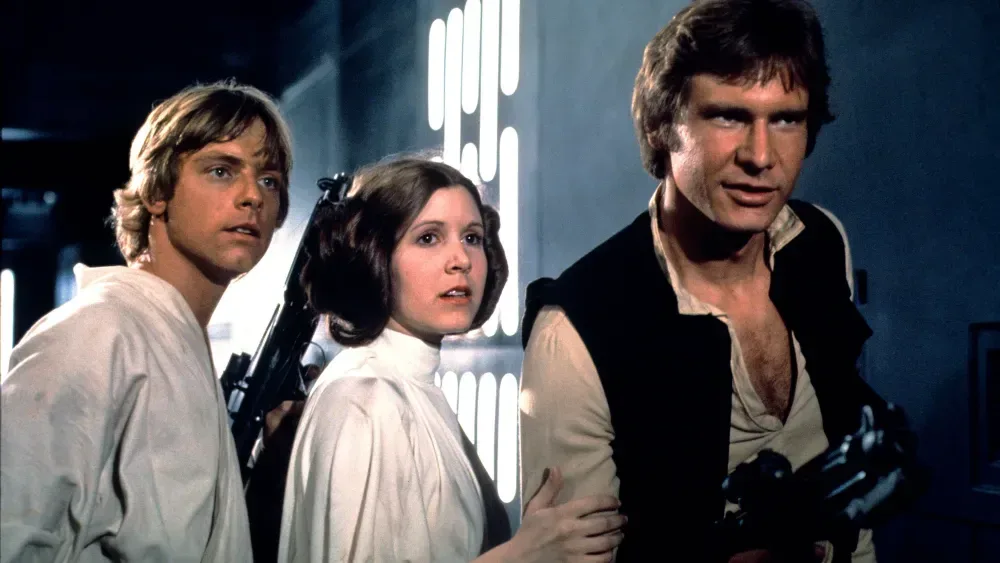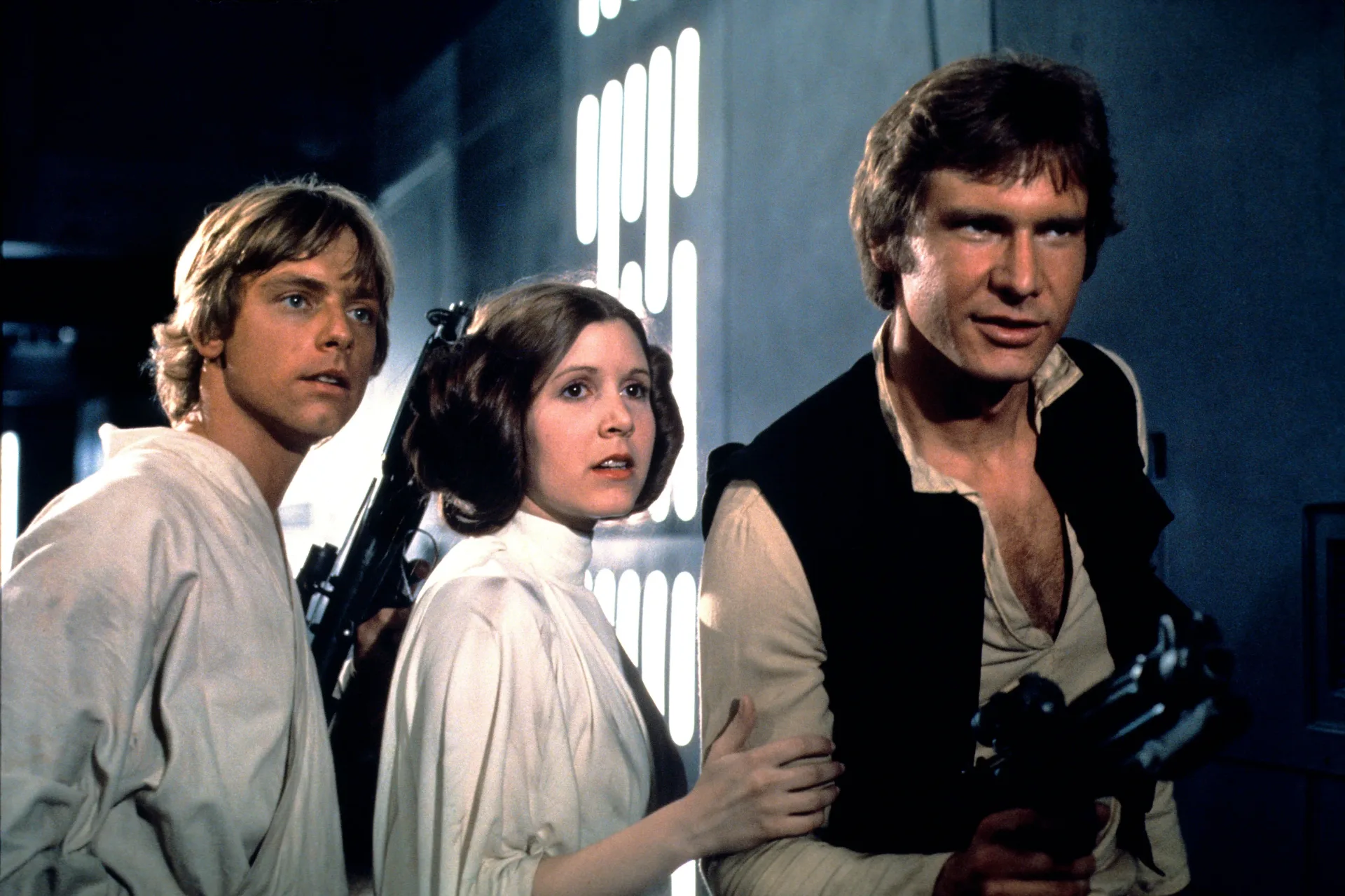
For a film built around gigantic moons, tiny droids, planet-cracking weapons and one extremely dramatic trench run, Star Wars: Episode IV – A New Hope has somehow never previously landed on an IMAX screen. That changes in 2027. The 1977 original is set to return to theaters on February 19 for its 50th anniversary, with presentations planned in both digital IMAX and the increasingly rare IMAX 70mm format.
The event is paired with another major galaxy-sized theatrical date. Star Wars: Starfighter, directed by Shawn Levy and starring Ryan Gosling, is scheduled for May 28, 2027—exactly 50 years after the first Star Wars debuted in 1977. That film is also expected to play in digital IMAX and IMAX 70mm locations.
It is a notable double bill for a franchise whose most recognizable imagery has always felt engineered for a towering movie screen. The important caveat, naturally, is that IMAX 70mm is a very limited format. The format exists at only a small number of theaters around the world, so the prospect of seeing Luke Skywalker, the Millennium Falcon and the Death Star at that scale will be geographically selective. The Force remains powerful, but it has not yet solved travel logistics.
A New Hope gets a new kind of first
The February 19 return is more than another anniversary booking. It will mark the first IMAX screening of any kind for the original Star Wars. That distinction makes the occasion particularly unusual: one of the defining theatrical blockbusters of the modern era is only now reaching a format that has become synonymous with premium large-scale cinema.
Both announced versions matter. Digital IMAX will give the re-release a far wider footprint than film-only engagements can offer, while IMAX 70mm is the collector-grade, pilgrimage-worthy component of the plan. It is the version most likely to prompt fans to scrutinize theater lists, compare driving distances and suddenly consider whether a cross-country journey is a completely reasonable response to wanting a larger X-wing.
For movie-history-minded fans, the anniversary also places a familiar object of cultural memory in a different exhibition context. The original film’s practical effects, model work, production design and optical effects have been revisited repeatedly over the decades through home-video editions, restorations and theatrical returns. An IMAX presentation does not change its place in history, but it creates a fresh way to encounter the scale and texture of the film in a theater.
That theatrical emphasis is fitting in a moment when large-format engagements have become their own form of event collecting. A ticket stub, a specially branded screening, a one-weekend booking at a particular venue—none replaces the movie itself, but each becomes part of how audiences remember seeing it. Fans interested in the wider relationship between screen history and tangible artifacts may also enjoy this look at long-lost set footage and its role in a living Derek Jarman portrait.
Starfighter heads into the same large-format lane
Star Wars: Starfighter arrives a little more than three months after the anniversary re-release. Ryan Gosling plays Kade Auberon, described as a skilled space pilot. The story follows a cynical rogue forced to confront a mysterious past before being pulled into a dangerous adventure across the galaxy and toward a confrontation with destiny.
The title alone invites some immediate expectations. “Starfighter” is not exactly subtle terminology in this universe, and that is part of the appeal. The franchise has long understood that spacecraft can be characters in their own right: X-wings and TIE fighters are functional vehicles, design icons and the source of noises that can cause an entire room of fans to make engine sounds without prior coordination.
Levy directs from a screenplay by Jonathan Tropper. Kathleen Kennedy produces alongside Levy. Gosling, Dan Levine, Mary McLaglen and Josh McLaglen are listed as executive producers.
The cast also includes Matt Smith, Mia Goth, Aaron Pierre, Jamael Westman, Daniel Ings, Flynn Gray and Amy Adams. Beyond Gosling’s role as Kade Auberon and the broad outline of the premise, the announced details leave substantial space for speculation. The sensible position for now is to treat the disclosed cast as the confirmed foundation and avoid assuming character identities, alliances, legacy appearances or whether anyone owns a cape with an unnecessarily complicated fastening mechanism.
Why IMAX 70mm has become such a big-screen obsession
IMAX 70mm has drawn heightened attention in 2026, propelled in particular by Christopher Nolan’s The Odyssey. The format is available at only a handful of cinemas worldwide, yet those locations have posted exceptional business. IMAX 70mm venues have generated a reported $78 million globally this year, equating to a $1.9 million per-screen average.
That figure helps explain why film-format news now attracts attention beyond the usual projection and theater-tech circles. A premium presentation is not merely an add-on when audiences are booking far ahead, scheduling trips around a particular venue and returning for repeat viewings. The scarcity of the format is inseparable from its appeal. You can stream plenty of things at home; you cannot casually recreate a towering 70mm IMAX screen in the living room unless your living room has made some very aggressive zoning decisions.
The Odyssey extended its IMAX 70mm run through September, reaching an 11-week theatrical engagement in the format. It has been reported as the highest-grossing IMAX release to date, bringing in more than $450 million worldwide through IMAX, while its total box-office revenue has exceeded $1.6 billion. It is also described as the highest-grossing R-rated film in history.
Those results do not guarantee that every future title will duplicate them, and no screening count, ticketing timetable or individual theater list has been detailed here for either 2027 Star Wars event. Still, they establish the commercial backdrop for the decision to put both A New Hope and Starfighter into the format. Giant-format screens are once again being treated as destinations rather than simple upgrades.
Two very different Star Wars occasions
The pairing offers fans two distinct reasons to make the theater trip. A New Hope is an anniversary encounter with the film that began the saga, now receiving an IMAX debut five decades after its original release. It carries the weight of shared memory: first watches, worn physical-media copies, quotes absorbed by cultural osmosis, and the knowledge that a simple opening crawl somehow still commands attention.
Starfighter, in contrast, is built around discovery. It introduces Kade Auberon and a new adventure while using one of the franchise’s most inherently cinematic concepts: a pilot moving through a galaxy where history, danger and destiny are apparently queueing up in the same lane. Its May 28 release date makes it both a new chapter and a precisely timed anniversary gesture.
Neither presentation should be mistaken for an announcement that every theater will have the film-based option. Digital IMAX engagements will be the more broadly available route, while IMAX 70mm screenings will be confined to equipped locations. For anyone hoping to attend the latter, the practical next step will be watching for official theater and ticketing details closer to the respective releases.
What fans can responsibly expect now
- February 19, 2027: Star Wars: Episode IV – A New Hope returns to theaters for its 50th anniversary.
- A historic format debut: The original 1977 film is set for its first IMAX screenings, with digital IMAX and select IMAX 70mm presentations.
- May 28, 2027: Star Wars: Starfighter is scheduled to open exactly 50 years after the original film’s 1977 debut.
- Large-format plans for the new film: Starfighter is also planned for digital IMAX and IMAX 70mm engagements.
- Confirmed creative team: Shawn Levy directs, Jonathan Tropper writes, Ryan Gosling stars as Kade Auberon, and Kathleen Kennedy produces with Levy.
- Limited-format reality: IMAX 70mm remains available in only a small number of cinemas, so location-specific information will matter greatly once it is released.
The 2027 calendar therefore has room for both nostalgia and hyperspace. One date gives a foundational blockbuster a long-delayed IMAX first. The other sends a new pilot, played by Gosling, toward a galaxy-spanning problem with all the reassuringly inconvenient timing of destiny. For fans of theatrical spectacle, the next jump to lightspeed is going to be very, very large.