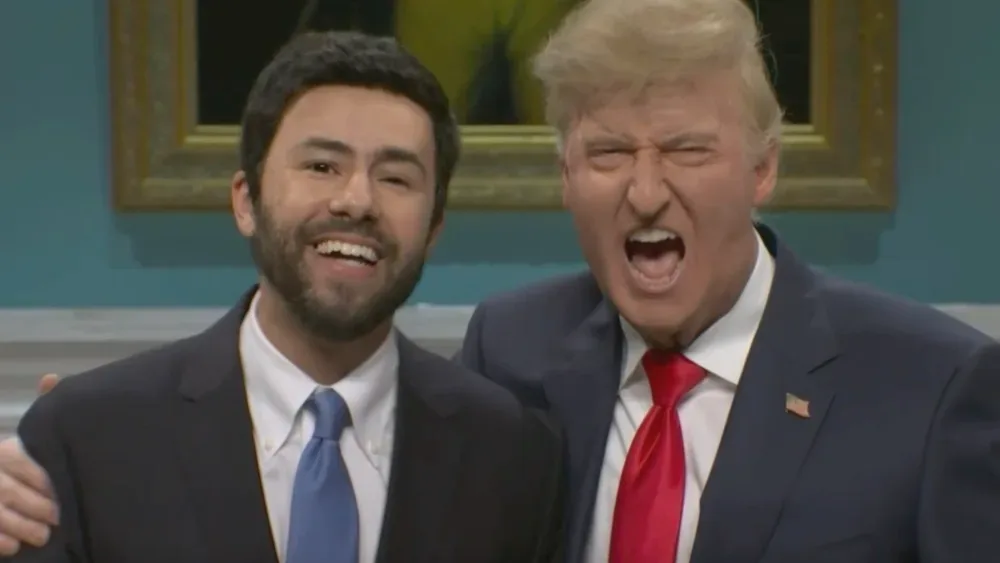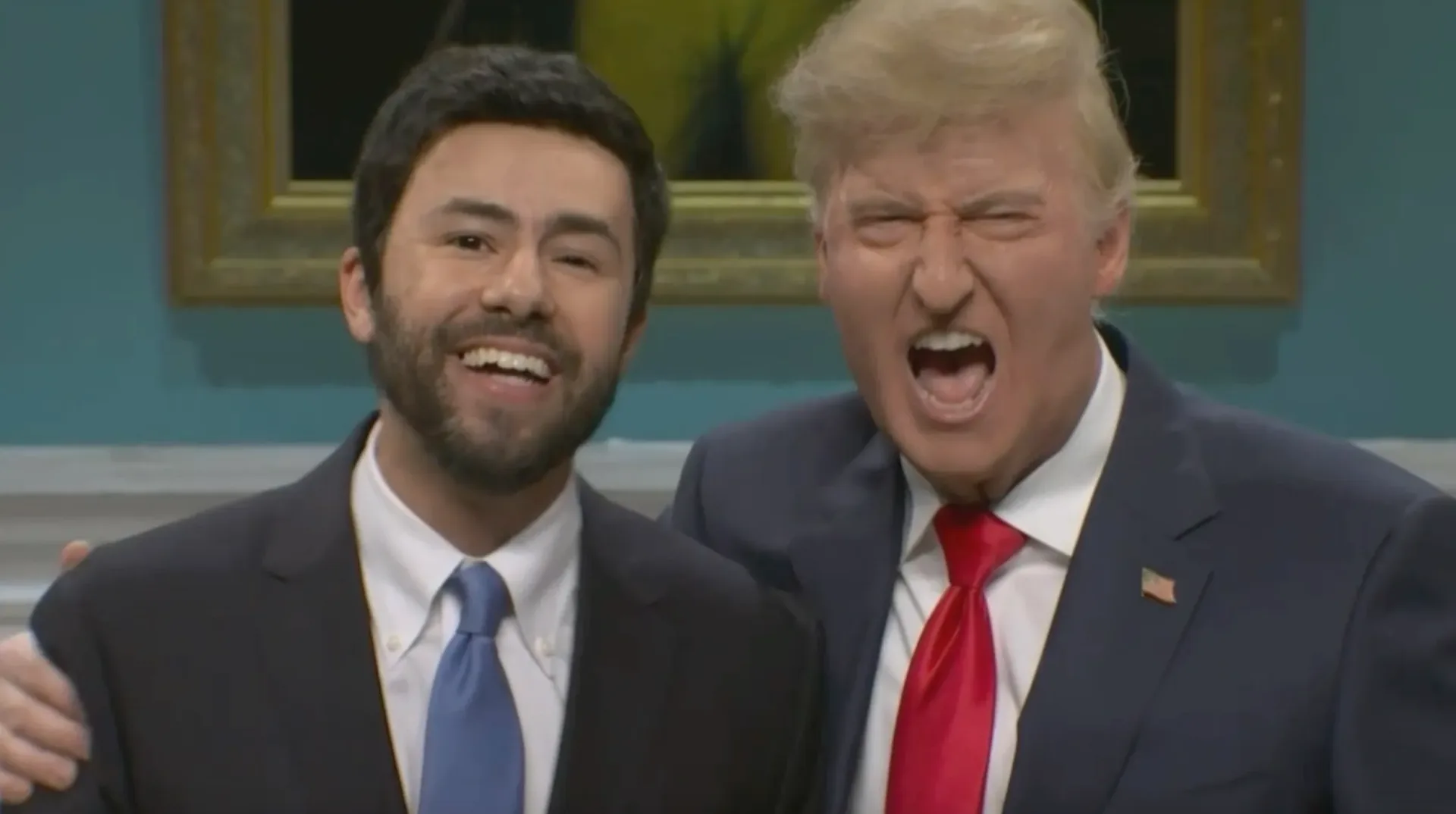
Saturday Night Live opened Season 52 by imagining an unusually warm political pairing: Ramy Youssef appeared as New York City Mayor Zohran Mamdani, receiving a visit in his office from James Austin Johnson’s Donald Trump. The joke was not a policy debate or an attempt at plausible political détente. It was the sheer oddity of Trump’s conspicuous affection for Mamdani—an apparent relationship that the sketch itself presented as impossible to explain.
Johnson’s Trump gets the premise moving with a declaration that he really, really likes Mamdani “for some reason that no one can figure out.” That wording establishes the cold open’s comic engine. Rather than ask viewers to accept the friendship, the sketch treats its lack of an explanation as the explanation: two figures who would not ordinarily be framed as friendly are suddenly presented as political BFFs.
An office chat built from New York-scale subjects
The Trump and Mamdani conversation moved through a distinctly oversized pile of topics: the storm hitting the East Coast, a Knicks championship, the week’s United Nations meeting in New York City, and Trump’s hosting of Chinese President Xi Jinping. Each subject broadens the imagined scope of an office visit that begins as a personal political check-in.
That accumulation is a familiar useful tool for a cold open. A cold open is the sketch that runs before a show’s main title sequence. It has to establish a premise quickly, find an escalation path, and leave room for a sharp final turn. Here, the premise is the Trump-Mamdani rapport; the expansion comes from the mounting civic, international and pop-cultural matters being discussed around it.
The Knicks reference also gives the bit a specifically New York flavor, fitting Mamdani’s setting as the city’s mayor. But the sketch’s comedy does not rely on a detailed sports joke. The championship functions as one more grand item in an already grand conversation: weather, city status, global diplomacy and basketball all receive comparable conversational weight.
The central contrast is deliberately simple. The audience is asked to watch a version of political conversation in which friction has been swapped for unexplained fondness. That lets Johnson’s Trump play the relationship with an extra layer of absurdity: the affection is emphatic, while the rationale is blank.
A thriller parody interrupts the political sketch
The cold open takes its bigger turn when Natalie Harp enters. Ashley Padilla plays Trump’s executive assistant as an intensely protective presence, drawing an explicit parallel to Nikki, the character from Obsession. The sketch then changes modes. What began as an absurd political friendship scene becomes a possessive-thriller parody.
Padilla’s Harp announces that, in spite of the storm, she ran from Washington, D.C., “Weapons” style. Trump follows that with the sketch’s succinct reading of the character: she is like the woman from Obsession, only blond. The lines establish the reference point without slowing down to explain it. The humor comes from placing a heightened stalker-thriller energy inside an official-office setting.
Related coverage includes SNL Season 52 Opens With Trump, Mamdani and Natalie Harp Cold Open.
A parody borrows recognizable traits from another work or genre and reworks them for comic effect. In this case, the traits are fixation, intrusive devotion and menace. Harp is not merely interrupting Trump and Mamdani’s unlikely bonding session; she is positioned as someone who sees the new friendship as a threat to her own attachment.
That makes the entrance more than a one-off reference. It gives the sketch an escalation: Trump’s fondness was already strange, but Harp’s reaction makes it actively precarious. By the end, she draws Mamdani aside and threatens, “If you hurt him, I will end you.” The warning provides a clean button for the scene, converting the initial BFF premise into an overprotective, thriller-shaped confrontation.
Why the crossover structure matters
The cold open is working with two kinds of recognition at once. One is political impersonation: viewers recognize Johnson’s ongoing Trump portrayal and see Youssef step into the role of Mamdani. The other is screen-language recognition: Harp’s behavior is coded through a thriller comparison, with Obsession supplying the shorthand for her intensity.
Joining those structures gives the sketch flexibility. It does not need to make every joke about the real-world details of politics, and it does not need to recreate a thriller plot. Instead, it takes a political premise—an inexplicably friendly meeting—and lets a familiar genre archetype crash into it. The abruptness is part of the gag. A scene that had been politely discussing storms, sports and international matters is suddenly governed by jealousy and a threat.
It is also an example of how a sketch can use an impersonation without requiring the performer to deliver a comprehensive portrait. Johnson’s Trump serves the relationship premise; Youssef’s Mamdani is the person unexpectedly receiving Trump’s admiration; and Padilla’s Harp changes the direction of the piece. The roles are arranged less like a panel discussion and more like a compact comic triangle.
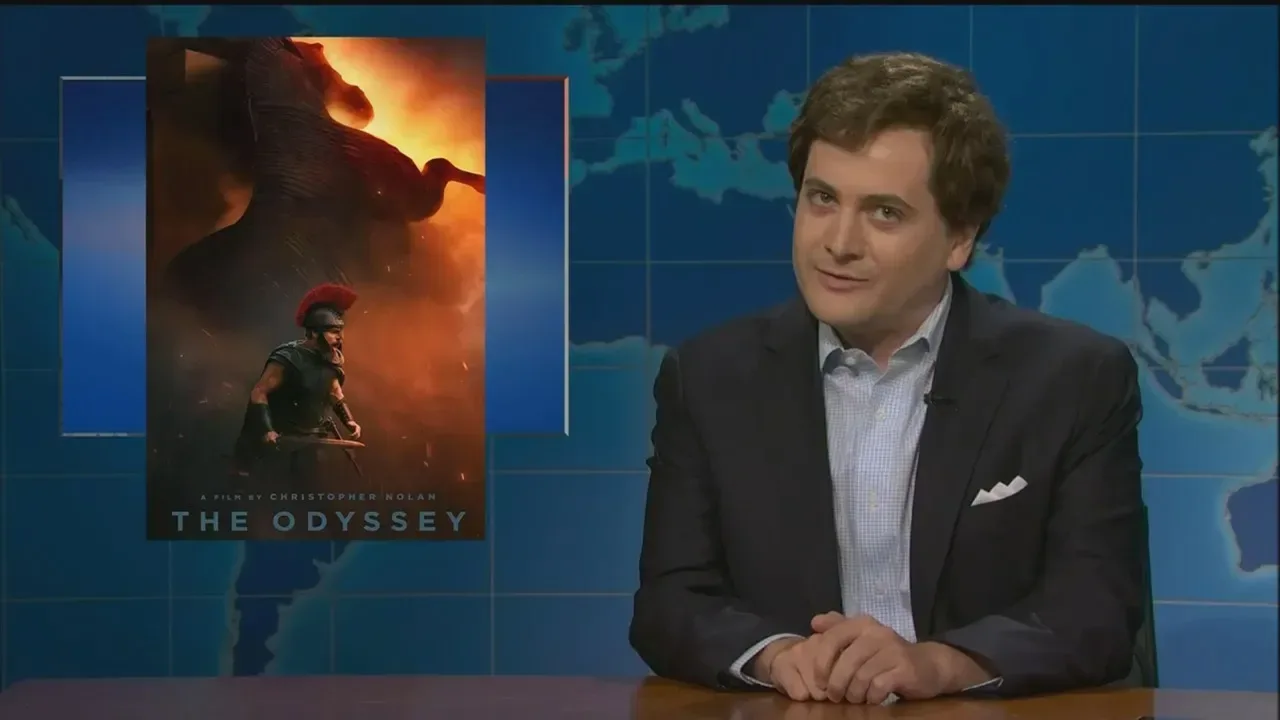
For viewers keeping up with the show’s recurring political comedy, the season opener also sits alongside its broader habit of using public figures as the starting point for format shifts. A previous Weekend Update satire built around a Tucker Carlson movie-review setup, for example, likewise used a recognizable persona as a route into a more specific comic premise. This cold open takes the alternate route of political friendship colliding with suspense-movie obsession.
Season 52 begins with a guest turn and new cast members
Youssef’s Mamdani is a guest appearance in the premiere, while Johnson and Padilla take on Trump and Harp. The episode is hosted by Jalen Brunson, with Katseye as musical guest. It also marks the debut of new cast members Saidah Belo-Osagie and Grace Reiter.
Those details make the cold open part of a larger premiere-night introduction. The opening sketch delivers a high-recognition premise, the host comes from the basketball world invoked in the sketch’s Knicks conversation, and the cast expands with two newcomers. None of that requires the cold open to carry the entire episode on its own; it simply gives Season 52 a pointed opening image.
Most importantly, the sketch does not pretend its Trump-Mamdani dynamic is grounded in normal political logic. It announces the mismatch, leans into it, then lets Harp’s Obsession-styled possessiveness turn the dial further. The result is a cold open built around an intentionally baffling friendship, a broad New York-and-world-affairs backdrop, and a final threat designed to land as the scene’s most exaggerated beat.