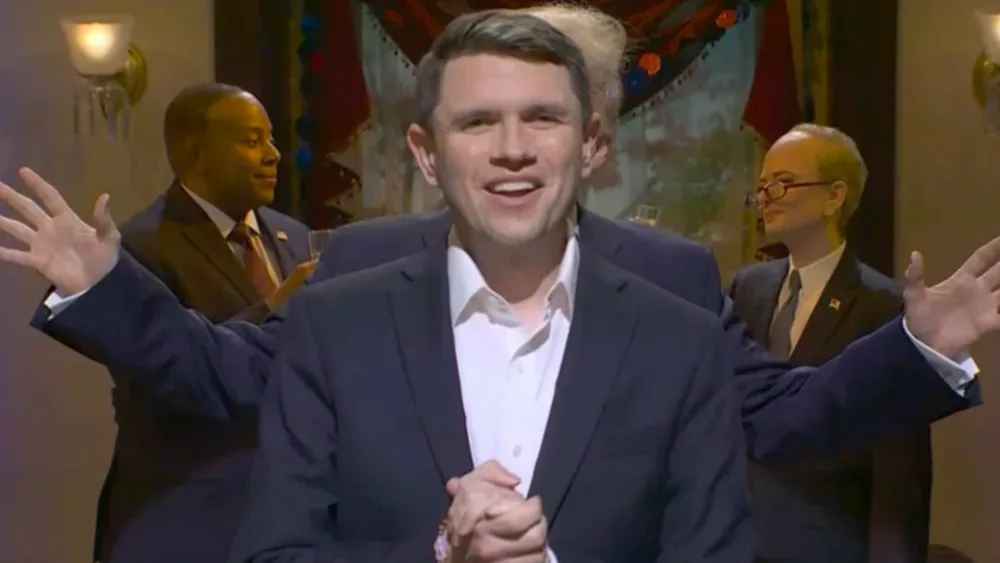
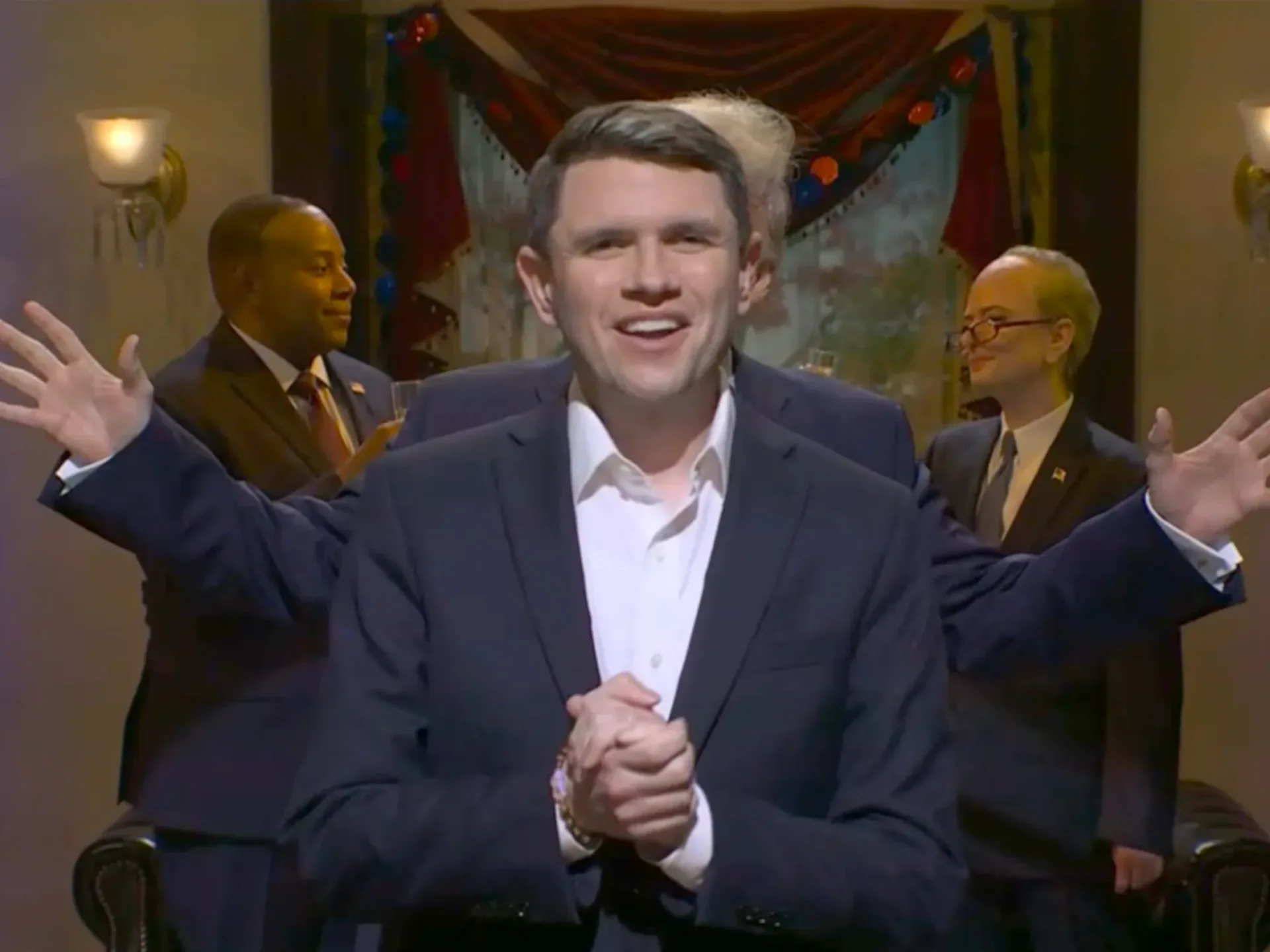
Saturday Night Live put its own political-comedy routine under the microscope in a post-midterm cold open featuring Texas senator-elect James Talarico. The sketch began as a celebration of Democratic election success, then pivoted into a familiar device: James Austin Johnson’s Donald Trump stopping the action so the character could deliver a stream-of-consciousness monologue. Talarico eventually entered to ask the question that the sketch itself had spent several minutes inviting: how many more times can the show use this exact format?
The answer from Johnson’s Trump was blunt: “Infinity!” It was a tidy payoff because the cold open did not merely use the device; it made the repetition of the device the joke. Talarico’s cameo gave the bit a voice from inside the election narrative while also letting the program acknowledge an audience expectation around its Trump cold opens.
A political sketch that argues with its own structure
The opening started with Sarah Sherman as Chuck Schumer and Kenan Thompson as Hakeem Jeffries celebrating what the sketch called a “blue tsunami.” Their characters were also reluctant to concede that newly energized younger Democrats might be ready to take a larger role. Before that generational tension could become the full premise, Johnson’s Trump froze the scene.
That freeze-frame interruption has become a recognizable piece of the show’s political language. Rather than keeping Trump inside a conventional scene with other characters, it gives the impersonation room to veer from the immediate subject into side observations, grievances and pop-culture tangents. Here, the election backdrop quickly became an excuse for the character to discuss an ugly economy, war, a ballroom and his stated frustration about working with millennials.
In sketch-comedy terms, the premise is the basic comic situation that tells viewers what kind of joke they are watching. The heightening is the process of escalating that initial idea rather than simply restating it. This cold open’s premise was not only an imagined post-election meeting between Democrats and Trump. It was also the show’s awareness that viewers recognize the freeze-and-ramble construction. Talarico’s entrance heightened the self-awareness by saying it out loud.
His introduction played on political fundraising texts: he called himself the person who had been asking viewers for $5 every day. The Trump character responded that the economy made the request understandable. Talarico then offered the language of bipartisan cooperation, saying that working together could improve life for everyday Americans, before turning the pitch toward television comedy. People want something new and different, he argued—meaning a new kind of cold open.
The move mattered because it kept the cameo from functioning only as a victory-lap appearance. It gave Talarico one sharply defined task in the sketch: represent the apparent appetite for change, then redirect that idea toward SNL itself. Johnson’s “Infinity!” response immediately restored the Trump character’s refusal to be redirected, while allowing the writers to land a joke at their own expense.
Johnson’s Trump wanders from elections to New Girl
Johnson’s Trump first offered a version of political credit-taking, arguing that Democrats would not have prevailed without poor economic conditions and war. He followed that with a joke built around a reference to Moana. The character then confronted the idea that the “era of Trump” was over, prompting a brief interruption from an imagined JD Vance declaring that Vance’s era had started. Trump’s hostile, baffled response made clear that the succession pitch was not welcome.
Related coverage includes James Talarico Joins SNL’s Post-Midterm Trump Cold Open.
The monologue’s more revealing comic detour came when the character began talking about New Girl. Rather than treating the series as a simple name-drop, the sketch had Trump ruminate on its ensemble: Jess, Schmidt and Winston. The character’s argument was that Winston became easier to write once the show paired him with a cat, unlocking more stories.
That is an intentionally disproportionate tangent. The political scene around it ostensibly concerns a major election, power and party leadership. The Trump character instead uses his uninterrupted time to deliver a semi-serious television-writing note. The contrast is the punchline: a figure presented as facing huge events becomes absorbed in an oddly specific observation about sitcom character construction.
It also illustrates why the freeze-frame format is useful to this particular impersonation. A standard dialogue scene requires another character to respond, challenge or move the action forward. A direct-to-camera ramble can jump across topics without needing naturalistic motivation. The risk, naturally, is that a device designed for wild detours can become predictable. Talarico’s cameo turned that risk into material rather than pretending it was not there.
Colin Jost’s Pete Hegseth enters the chaos
Colin Jost appeared as Pete Hegseth, portraying the character as defiantly unshaken by an election result. His line reworked “YOLO”—usually shorthand for “you only live once”—as “you only lose often.” The character then suggested that losing would continue unless Congress impeached him, before closing with “Peace out, war in.”
The phrasing is built from compressed reversals: a carefree slogan becomes a slogan about defeat, and a familiar sign-off is twisted into a militarized sendoff. Whether each jab lands for every viewer is separate from the sketch’s strategy. The scene keeps piling figures and side arguments into the Trump pause, making the political landscape feel crowded, self-serving and difficult to contain.
Talarico’s arrival is what gives that crowded construction its endpoint. He is not asked to play an exaggerated caricature of himself. Instead, he arrives as the comparatively grounded person in a sketch full of politicians talking past each other, then uses that position to make the program’s format the real target.
Why the Talarico cameo carries extra context
The appearance came days after Talarico’s reported Texas Senate victory over Ken Paxton. The reported result was 55.09% of the vote, flipping the seat to Democrats; the sketch’s surrounding election narrative described the win as part of a broader Democratic sweep that delivered control of the House and Senate along with a majority of governorships.
That context explains why the show could frame Talarico as both a political guest and a representative of a new cohort. The opening’s Schumer and Jeffries material had already raised a generational question: should long-established Democratic leaders pass responsibility to younger figures? Talarico’s real-person appearance gave that abstract debate a visible participant, even though his actual joke was about SNL’s writing habits.
There is a practical distinction worth making. A cameo in a comedy sketch is not a policy statement, and the segment did not turn into an interview or campaign speech. Its political relevance came from timing and symbolism. The entertainment value came from allowing a newly elected figure to puncture a television ritual that has become recognizable enough to parody.
Druski’s hosting milestone shaped the night beyond the cold open
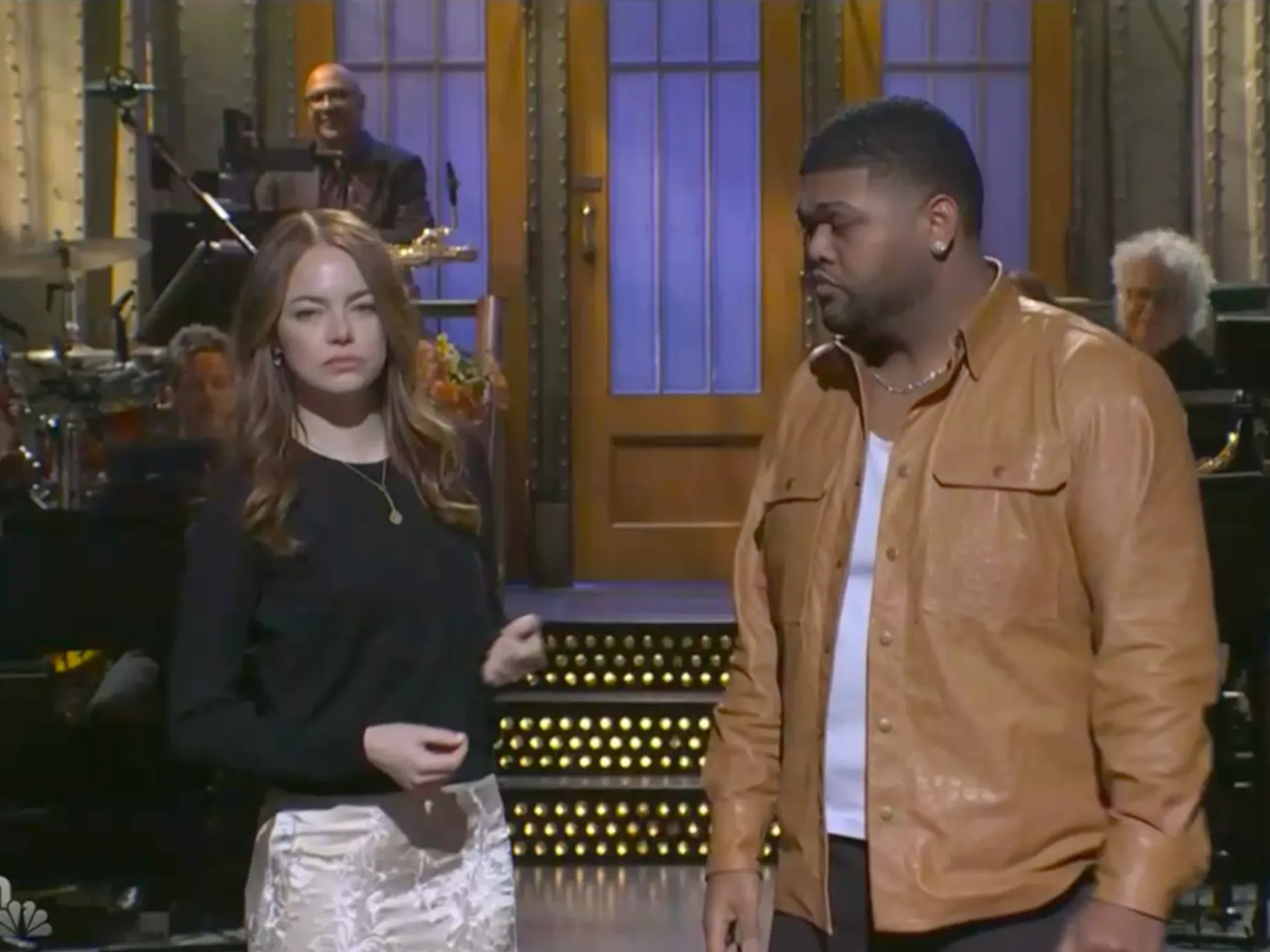
The episode was hosted by comedian Druski, whose real name is Drew Desbordes, with The Strokes as musical guest. Druski became the first online content creator to host the program, a notable marker for a series that has long used hosting gigs to bring in people from film, music, sports, stand-up and television.
That milestone was separate from the Talarico cameo but fits a broader episode built around crossover. A digital-comedy creator anchored the broadcast, a senator-elect entered the cold open and a veteran rock band served as musical guest. For more on how the episode’s host used that career milestone in his opening material, read Druski’s SNL monologue and its Emma Stone bit.
The season has already featured hosts from several different entertainment and sports lanes: New York Knicks player Jalen Brunson, Dakota Johnson, Shane Gillis and Inde Navarrette. Its musical guests have included Katseye, Turnstile, Rosalía and Gracie Abrams. Navarrette’s Halloween episode averaged 5.2 million viewers, the season’s biggest audience so far.
Next, John Mulaney is scheduled to host the Nov. 14 episode, with Phoebe Bridgers slated as musical guest. Mulaney’s frequent association with the show gives that booking its own built-in expectations, but this episode’s takeaway is simpler: SNL used a timely political cameo not to abandon its established Trump format, but to tease the format openly. And, in the logic of Johnson’s Trump, it apparently has no plans to stop.