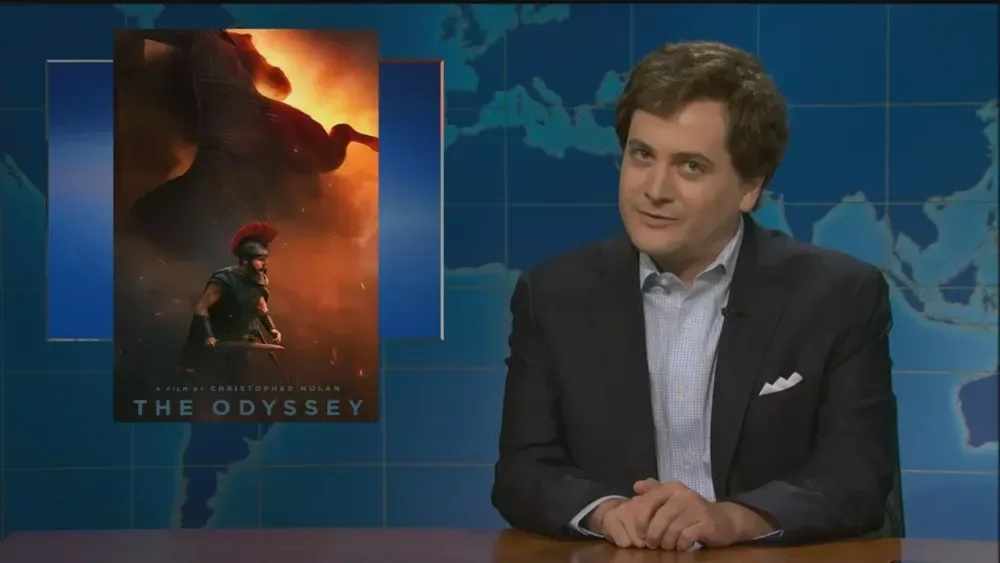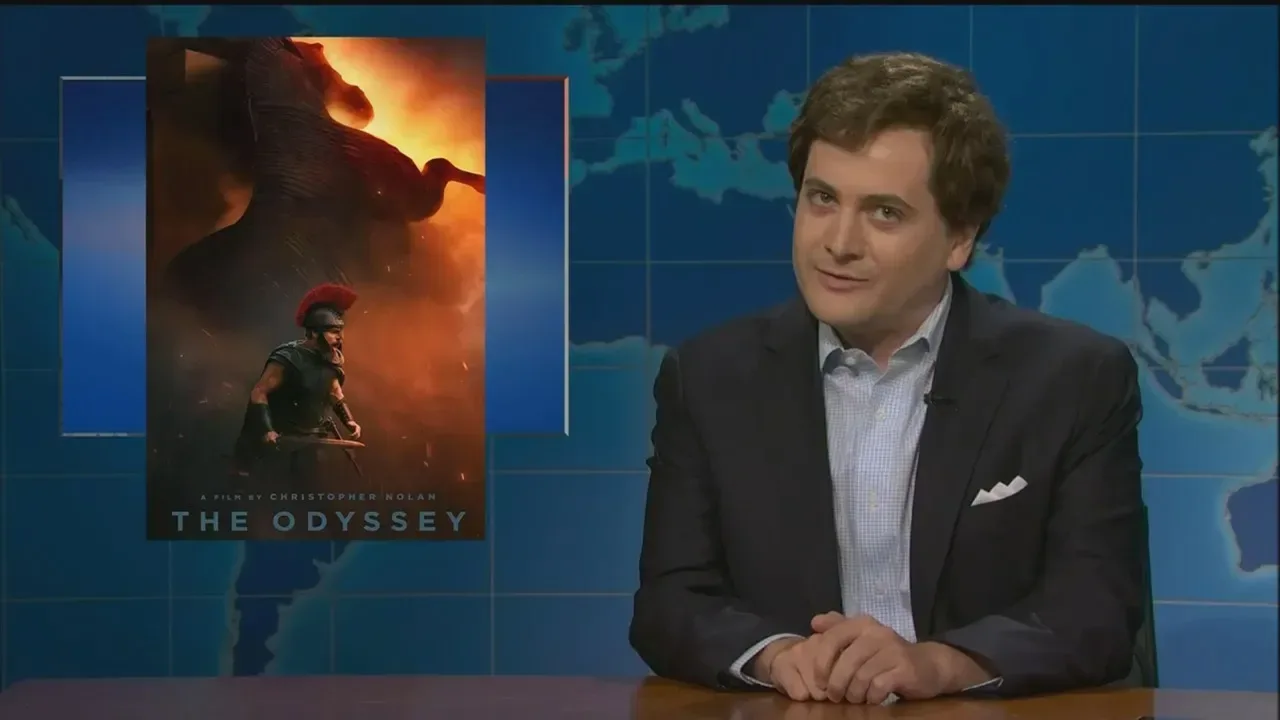
Jeremy Culhane returned to Saturday Night Live’s “Weekend Update” desk with his Tucker Carlson impression during the first episode of Season 52, turning a supposed roundup of summer movie opinions into a rapid-fire parody of grievance-driven media commentary.
The sketch’s premise was simple: Culhane’s Carlson was invited to weigh in on prominent films including The Odyssey, Spider-Man: Brand New Day, Obsession, Minions and Monsters, and Toy Story 5. But he rarely approached any title on its own terms. Instead, each answer swerved into an exaggerated complaint, false alarm, or deliberately warped reading of ordinary details. Colin Jost’s role was to supply terse corrections and let the character make the situation increasingly stranger for himself.
It was the third appearance of Culhane’s Carlson on “Weekend Update.” The character debuted in Season 51 and has now become a recurring vehicle for a particular kind of comedy: not merely impersonating a recognizable public figure, but using that figure’s familiar rhetorical rhythms to lampoon a broader style of commentary.
A film-review segment that does not review films
The joke is that this is emphatically not useful movie criticism. Culhane’s character treats movie titles, casting, formats, and even names as opportunities to find an imagined ideological threat. The disconnect between the assignment and the response is the engine of the piece.
On The Odyssey, the discussion moved quickly from IMAX 70mm to a crudely distorted interpretation of the format’s measurement. IMAX 70mm is a large-format film presentation associated with image size and detail; in the sketch, it becomes raw material for an absurd culture-war gag instead. That pivot establishes the structure: a real, mundane piece of movie vocabulary enters the conversation, then the character forces it into an unrelated ideological frame.
The segment makes a similar move with Spider-Man: Brand New Day. Culhane intentionally misnames the film “Spider-Man: Brand New Gender,” prompting Jost to correct him. Rather than accepting the correction, the character launches into an invented song and keeps escalating the premise. The comedy depends on the refusal to engage with basic information. Accuracy is not a goal for the character; it is an obstacle that makes the performance more ridiculous.
That distinction matters. A spoof can reproduce an opinion, but this sketch is built around the machinery behind the opinion: the jump from small details to sweeping conclusions, the insistence that a correction is proof of a larger plot, and the presentation of confusion as certainty.
Jost plays the necessary straight man
Jost’s contributions are brief but structural. When he notes the correct Spider-Man title or points out that Zendaya is mononymous, he establishes a basic shared reality. Culhane’s Carlson then treats that reality as suspicious.
Related coverage includes Jeremy Culhane’s Tucker Carlson Returns to ‘SNL’ Weekend Update for Movie Review Segment.
The Zendaya exchange is a clear example. The character hears that she does not have a conventional last name and transforms a simple fact about a performer’s public name into a sprawling, nonsensical complaint. It is not a joke about Zendaya herself so much as a joke about the desperate need to make every harmless fact signify a cultural emergency.
This is a familiar “Weekend Update” format: one performer delivers the escalating oddity while the anchor provides just enough resistance to define the boundaries of the joke. Jost does not need to win an argument. The contrast between his matter-of-fact clarifications and Culhane’s unearned alarm already explains the satire.
Why the chosen movies work for the bit
The lineup gives the sketch several distinct pop-culture entry points without requiring detailed discussion of any one film. The Odyssey offers a technical term in 70mm. Spider-Man: Brand New Day offers a title that can be deliberately mangled. Obsession provides a horror-film setup for an exaggerated political interpretation. Minions and Monsters becomes the launchpad for a punchline involving Trump’s cabinet, and Toy Story 5 closes the segment with an innuendo built around Woody’s name.
The title-driven approach is significant. A genuine review would need to discuss plot, performances, filmmaking, or a viewer’s response. The character does none of that. Movies are treated as cultural labels—things that can be misread before anyone has to say anything meaningful about them.
That makes the sketch accessible even for people who have not followed every release in the bit. Knowing the basic associations is enough: Spider-Man is a superhero, Woody is a toy cowboy, and IMAX 70mm is a premium film format. Everything else comes from the character’s escalating logic.
The target is performative outrage
Satire often works by making a recognizable pattern more explicit. Here, Culhane’s impression turns every conversational detour into a conspiracy-sized conclusion, then undercuts that certainty with a sudden self-congratulatory aside. When the character compares Minions and Monsters to Trump’s cabinet, he immediately frames the minor deviation as a heroic break from Trump. The contrast makes the “bravery” claim look comically inflated.
That is an important feature of the segment’s point of view. The character is not presented as a careful critic with unconventional tastes. He is presented as someone who needs to turn entertainment coverage into personal ideological theater, including theater about his own supposedly daring independence.
The device is especially effective in a movie-review setting because entertainment reporting is typically low-stakes. Asking someone what they thought about a film ought to invite discussion of a movie. The sketch mines the gulf between that normal expectation and the character’s relentless reframing of every topic as a crisis.
The format also allows Culhane to use the impression as more than a voice imitation. The identifiable cadence is part of the performance, but the writing gives it purpose: pauses, suspicious questions, and abrupt pivots become markers of a worldview that converts uncertainty into insinuation.
A recurring Update character with a clear function
Culhane first introduced his Carlson impression in Season 51. With this third “Weekend Update” appearance, the character has a defined role in the show’s desk ecosystem: he is a disruptive commentator whose apparent subject is always less important than the way he derails it.
The latest installment keeps that premise focused. It uses a concentrated run of movie references rather than a broader political interview, and it lets each reference demonstrate the same comic rule from a different angle. One moment is about a projection format, another about a title, another about a star’s name, and another about a children’s-film character. Yet all arrive at the same portrait of punditry as a performance of perpetual, self-serving suspicion.
For more movie-focused pop-culture coverage, see our look at the creative boundary behind Godzilla Minus Zero’s R rating.