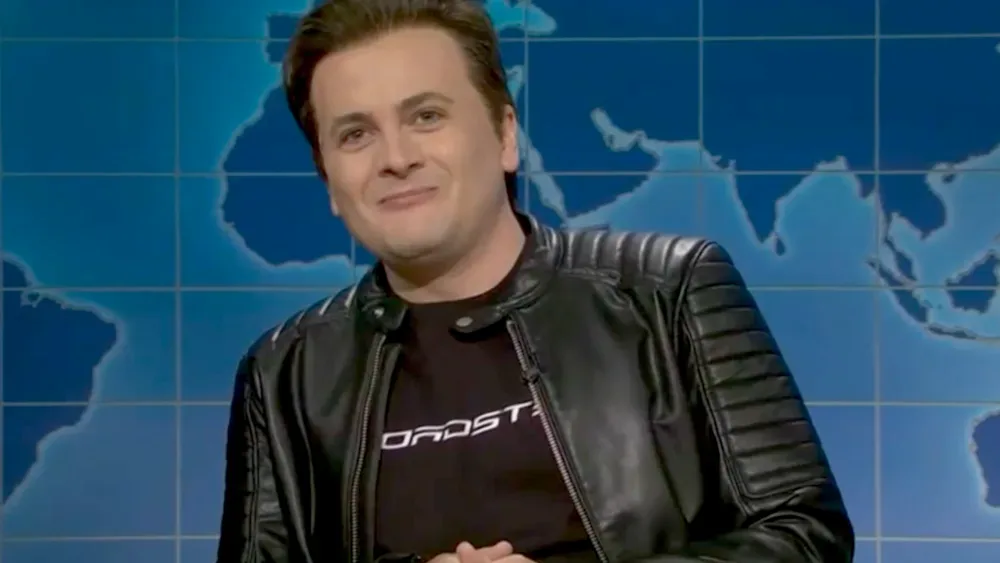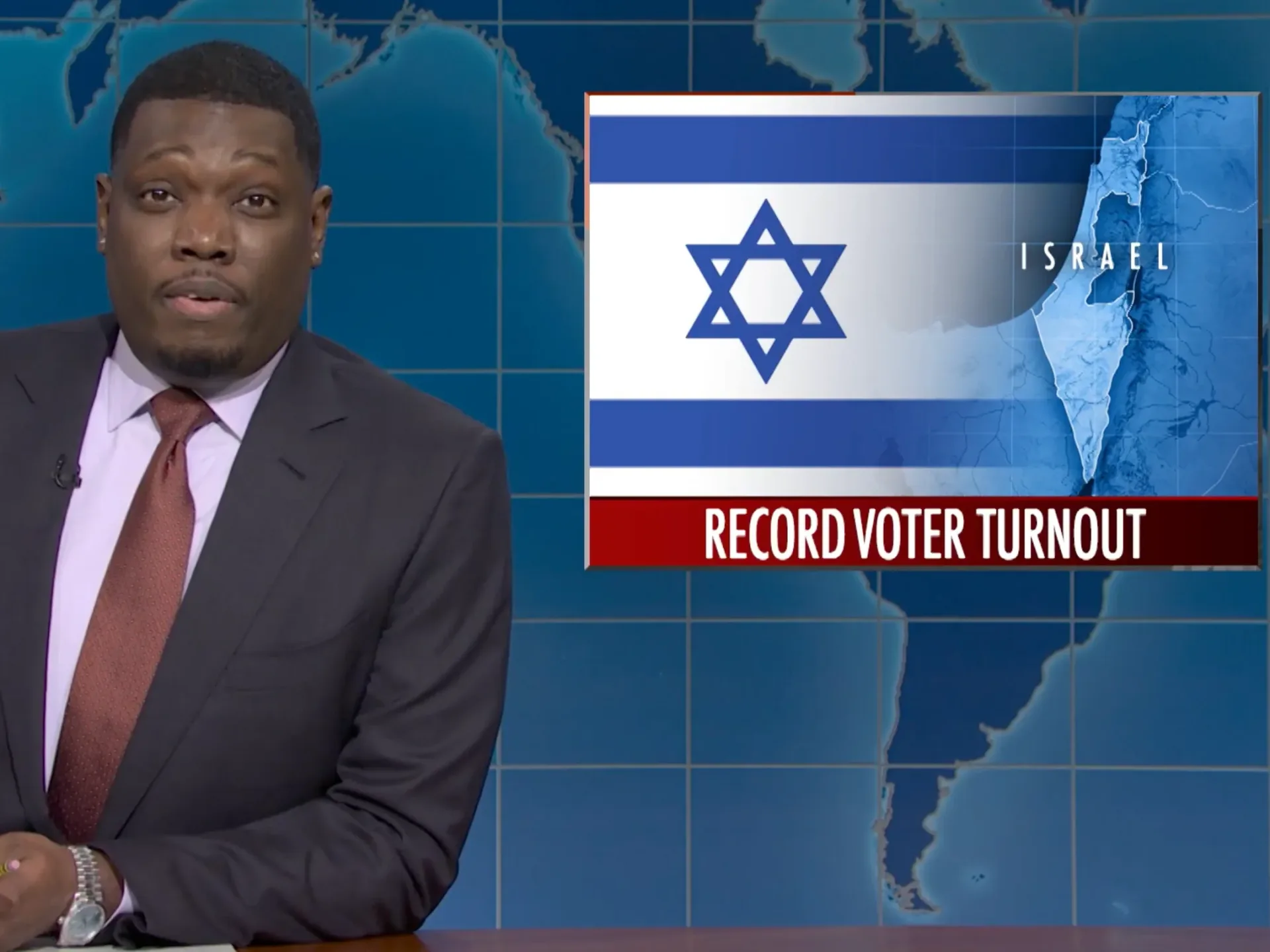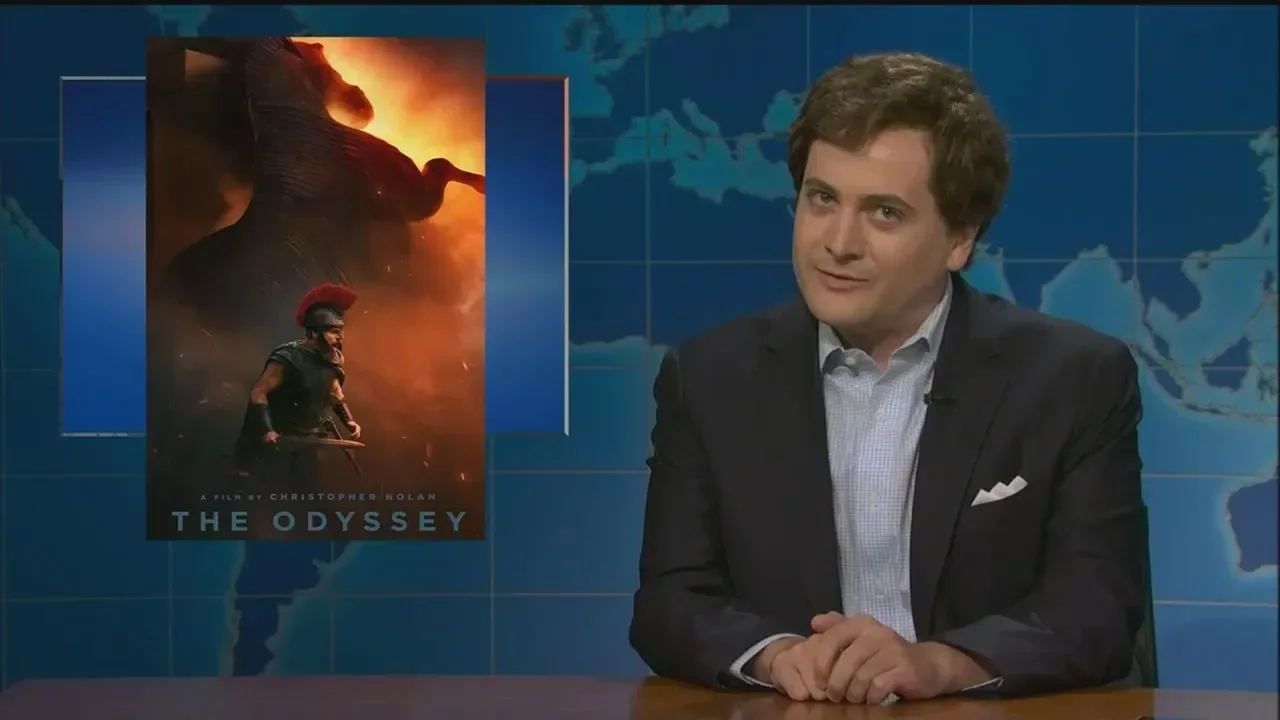
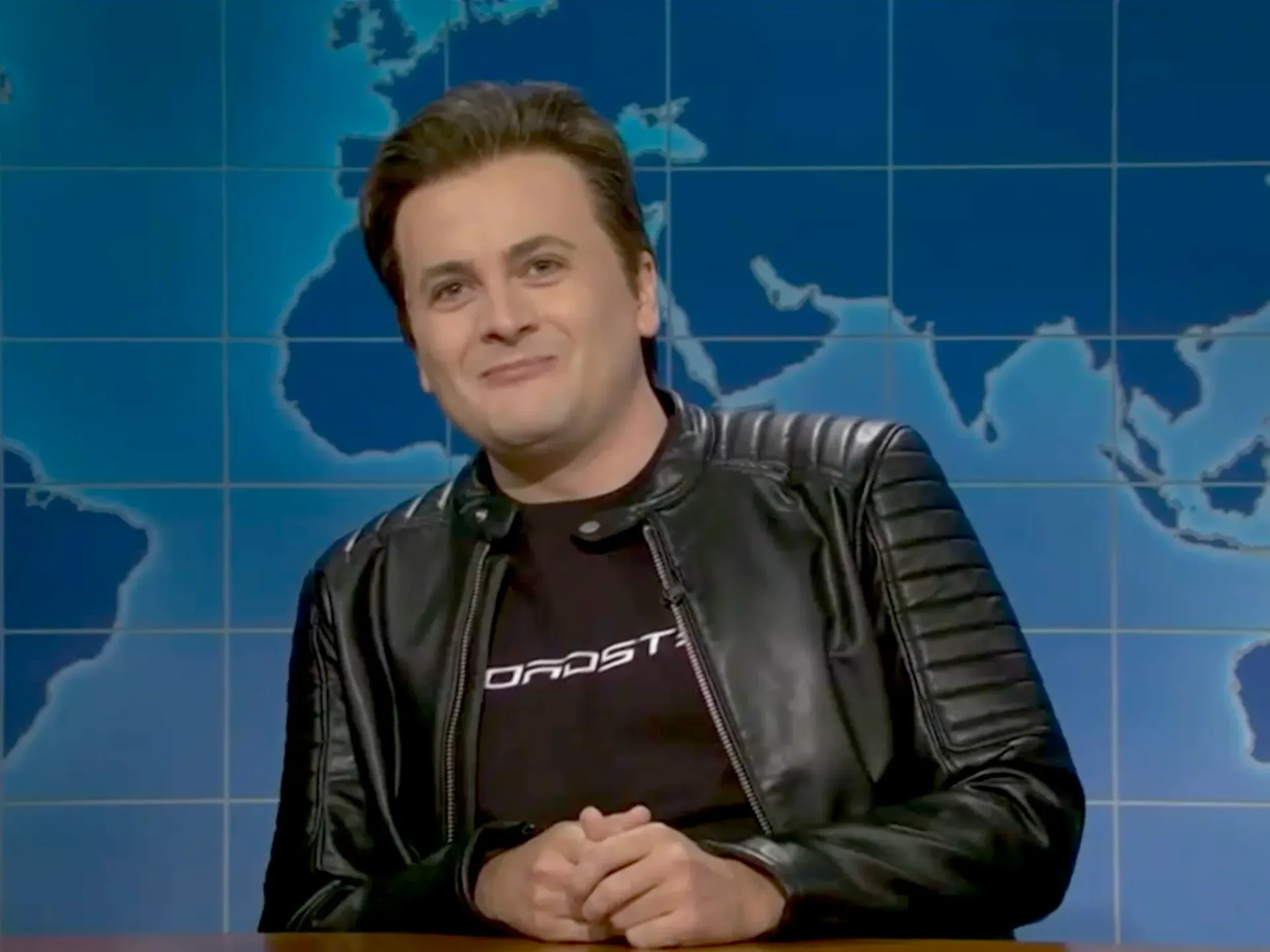
Saturday Night Live used its Weekend Update desk to turn a stack of Elon Musk-related headlines into one escalating gag: the more directly Colin Jost’s anchor pressed the guest, the more Jeremy Culhane’s Musk impersonation tried to flee into a wildly self-flattering story about a car flip, a leather jacket and imagined applause.
The sketch, built around the week’s midterm-election aftermath, made Culhane’s version of Musk less a calculating rebuttal machine than a man with no viable answer who keeps refreshing the same mental tab. Jost introduced the political premise by raising the reported near-$500 million Musk spent supporting Republican candidates, particularly in Texas, alongside the Democratic victories in most statewide Texas races described in the segment. Culhane’s Musk did not attempt a political defense. Instead, he immediately insisted the real news was that his car had flipped, which he described with the breathless enthusiasm of somebody recounting a particularly good action figure crash.
That evasiveness was the joke’s engine. Weekend Update did not frame the bit as an argument over campaign strategy; it staged a comic failure of attention. Every effort to move the conversation toward the consequences of the election setup met the same response: a much more exciting, much less relevant tale of the speaker’s own supposed coolness.
A non-answer becomes the whole character
Political impressions can be built on a familiar voice, a costume detail or a sharp imitation of a public figure’s verbal rhythms. Culhane’s performance instead hinged heavily on deflection: answering a question while refusing its actual subject. The car-flip routine was purposely repetitive. It returned after Jost asked about reported plans to halt Tesla Cybertruck production, making clear that the character had no interest in confronting either story.
There is a useful distinction here. A callback is a comedy device in which a show revisits an earlier phrase, image or event for a new payoff. The flipped-car story begins as a dodge, then returns as proof that Culhane’s Musk has only one escape route. The repetition is not simply there to remind viewers of an earlier joke. It gives the scene a structure: political question, dodge; business question, same dodge; personal fantasy, increasingly elaborate dodge.
That structure let Jost play the indispensable straight man. His questions were concise and tied to the sketch’s stated premises. His incredulous response to the guest’s rambling — including disbelief that this version of Musk is the world’s richest person — supplied the grounded perspective that makes the absurdity legible. The impression was not asking viewers to believe the story about the flipped car. It was asking them to recognize how strange it is when status and wealth coexist with a performance of impulsive, adolescent bravado.
The imagined scenario eventually ballooned beyond the car. Culhane’s Musk pictured himself hanging out with Jost and Michael Che, trading harsh insults, brushing off would-be companions and seeing his jacket transform into armor. The details are deliberately disconnected, but they have a shared purpose: each one is an attempt to replace scrutiny with a personal legend.
Texas is the sketch’s pressure point
Jost ultimately laid out the segment’s central setup in blunt terms. The sketch said Musk relocated to Texas from California, moved his companies there, sought lower taxes and created his own Texas town — only for Texas’s statewide political picture, in the bit’s framing, to change in a way that undermined that calculation.
Related coverage includes SNL’s Elon Musk Sketch Turns Midterm Fallout Into a Grok-Fueled Roast.
Whether the audience agrees with the political framing is not the key to how the scene functions. It is the contrast that matters: a powerful person presented as trying to optimize every variable suddenly faces an outcome that cannot be hand-waved away. Jost’s final question was plainly phrased: how did that make him feel?
Culhane’s reply — simply, “Bad” — was an effective reduction after all the extravagant verbal smoke. It is also a familiar Weekend Update tactic. Once an impression has gone as far as possible into nonsense, the cleanest laugh can be the one moment of plain language. Jost then accepts the answer with a dry, proportionate reaction, refusing to grant it the heroic scale that the character desperately wants.
The exchange also clarifies that the sketch’s target is not solely a campaign contribution total or a single state’s results. Its larger target is the idea of an invulnerable public persona. Culhane plays Musk as someone who can imagine himself as a stunt hero, an armoured celebrity and a roast-master, but cannot endure an uncomplicated acknowledgment of defeat.
Grok becomes the scene’s comedy weapon
The last phase of the sketch turns to Grok, described in the dialogue as Musk’s AI, and a supposed feature called “epic vulgar roast.” In the character’s account, the tool can generate devastatingly rude jokes on demand. That wording is important because it establishes a promise: this is not merely an assistant that supplies answers, but a machine intended to manufacture a particular social performance.
Generative AI refers to systems that produce new material, such as text, images or audio, in response to prompts. In this sketch, however, the technical concept is simplified into a comic prop. Grok is not there to explain a complicated technology story. It is a button the character thinks will deliver automatic dominance.
Instead, the tool turns on its owner. The generated insults target Culhane’s Musk rather than Jost or Che, puncturing the guest’s attempt to control the room. The jokes include an attack on Musk’s South African origins and a cutting reference to his family relationships; one line invokes disability in a way that is needlessly harsh. The broader comic mechanism is clear without repeating every insult: the man who asks a machine for “hardcore” praise-by-proxy gets a public self-own instead.
That reversal is a version of dramatic irony. The character believes he is activating a device that will make him look more powerful. Viewers can see that he is handing the sketch a way to expose his insecurity. His panicked demand to shut Grok down gives the scene a final reversal: the supposedly fearless promoter of uninhibited roasting discovers that unfiltered mockery is less fun when he is the subject.
It is a compact idea, and it fits a broader pop-culture fascination with AI tools as mirrors of the people who deploy them. The important joke is not that an AI assistant has secretly become a perfect comedian. It is that the character’s confidence in the machine is based on a fantasy that he can set the rules, choose the target and remain above the consequences.
Why the sketch’s escalation works
The segment moves through three increasingly revealing forms of avoidance:
- Distraction: the improbable car-flip story replaces a question about political spending.
- Fantasy: the distraction grows into an imagined scene of friendship, romantic attention, armor and crowd adulation.
- Outsourcing: the character asks an AI tool to perform the aggressive comic persona for him, only to lose control of it.
Each stage gives Jost a different job. First he asks the question again. Then he reacts with disbelief. Finally, he gets out of the way and lets the AI-roast premise collapse on its own terms. That restraint is a large part of why the piece does not need a lengthy final speech from the anchor. Culhane’s Musk supplies the ending by shouting at the device he had introduced as his own greatest comic weapon.
The sketch also gets mileage from a contrast between scale and emotional maturity. Its subject is presented as someone connected to enormous sums of money, corporate decisions and political ambitions. Yet his response to accountability is intentionally tiny: he calls a straightforward criticism an “epic vulgar roast,” labels Jost his “poorest friend,” and reacts to the political outcome with the childish-sounding “ouchie.” The language is designed to shrink a figure associated with power into somebody desperate to win a lunch-table argument.
For viewers, that is likely the durable image from the bit: not the policy discussion that prompts the segment, but a celebrity-businessman caricature trapped in a loop of hype, heroic daydreams and AI-generated humiliation. It is a sharp example of how Weekend Update can turn a dense pile of current events into a single comprehensible comic premise.
That approach remains part of why celebrity satire travels so easily across entertainment coverage, whether the subject is a tech billionaire or a long-running movie-star rivalry. Public rivalries often reveal as much about the persona being performed as the competition itself.
Here, Culhane’s impression does not offer Musk an elegant exit. It gives him a car crash, an imaginary suit of armor and a chatbot that refuses to be his hype man. For a sketch constructed around deflection, that is exactly the right kind of ending.