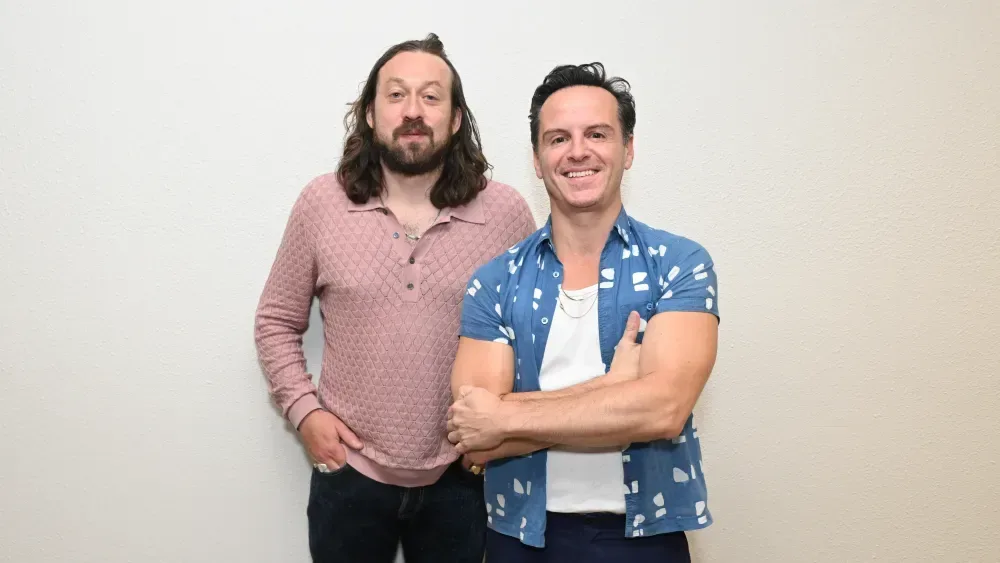
Simon Stone’s Elsinore is built around a formidable theatrical inheritance: Ian Charleson, the British actor known to many film viewers for Chariots of Fire, reached a personal ambition by playing Hamlet at the National Theatre while living with AIDS. Charleson died in 1990, during the height of the AIDS crisis. The new film, starring Andrew Scott and written by Stephen Beresford, approaches that period through a story of art, illness, community, and the determination to keep performing when time is painfully short.
Premiering at the 2026 Telluride Film Festival, Elsinore arrived with almost no distance between its completion and its first public screening. Stone said the production wrapped roughly a week and a half before the festival appearance. It is currently planned for a November release, an exceptionally brisk path considering filming will have occurred only around 10 months earlier by the time it reaches audiences.
That speed is not merely a bit of awards-season calendar trivia. It helps explain why Stone repeatedly frames the project as an ensemble-wide effort to meet Scott’s work rather than a conventional star vehicle in which a performer simply arrives to elevate the material. Stone’s description is strikingly direct: the filmmaking team set out to be fully in service of Scott, who plays Charleson.
A Hamlet production staged in real time
Elsinore has the daunting task of dramatizing a performer making one of the most famous roles in theatre his own. Fortunately, Stone and Scott came to the material with substantial Shakespeare and National Theatre experience already in their toolkits. Stone had previously directed Hamlet for the stage; Scott had played Hamlet in theatre; and Stone had directed at the National Theatre. That shared knowledge was intended to give the film’s rehearsal rooms and backstage spaces a sense of lived-in truth instead of the glossy, exaggerated version of theatre that movies can sometimes favor.
The rehearsal sequences reportedly use an especially unusual method. Scott had relearned the play’s major soliloquies, while Stone worked out the movement, rhythms, and ideas of individual scenes as filming happened. Johnny Flynn plays the production’s director, effectively serving as Stone’s on-screen stand-in. Rather than arrive with every beat pre-blocked, Stone directed the fictional stage production live, feeding Flynn directions immediately before takes when needed.
That means Scott knew Shakespeare’s words, but the choices around delivery, position, touch, and interaction could remain immediate. Stone has characterized those moments as genuine improvisation in the theatrical sense: a performer has the text and the situation, then discovers the staging and emotional route in the room. For a film about an actor pursuing Hamlet amid profound personal stakes, that approach could make the rehearsal footage feel less like a historical reenactment and more like a creative process unfolding before the camera.
It is also a neat bit of cinematic recursion. A director is directing an actor playing an actor, while an actor playing a director receives real direction from the director behind the camera. Somewhere in that chain, Shakespeare’s ghost is probably asking who signed the call sheet.
Theatre as shelter rather than stereotype
Stone’s vision of the theatrical world is central to Elsinore. The film does not treat a company of actors as a parade of ego, melodrama, and backstage betrayal—the standard-issue movie-theatre recipe that tends to add one pinch of diva and six pounds of shouting. Instead, Stone sees theatre as a gathering place for outsiders and a space where people can express parts of themselves that may not be welcome elsewhere.
Related coverage includes Simon Stone Says ‘Elsinore’ Was Made in Service of Andrew Scott.
That perspective matters deeply in a story set during the AIDS crisis, especially one involving a gay actor. Stone connects the theatre community’s outsider identity with the way many gay people found creative community and personal expression in the arts. Within the film, Charleson’s colleagues are portrayed as supportive when he reveals his illness. The choice is not presented as naïve denial of the prejudice and fear that marked the era. Rather, it emphasizes the possibility of a company becoming a shelter: a group of people recognizing someone as one of their own when that recognition is needed most.
Friends of Charleson were also involved in the film, adding a further connection between its dramatization and the real circle that knew him. Stone’s stated aim was authenticity—not only accuracy in costumes, rehearsal etiquette, or the geography of the National Theatre, but honesty about why people choose a difficult, communal, frequently underpaid life in the arts in the first place.
The story’s final movement reportedly makes that communal idea explicit. The ending is structured as a flashback, because Charleson has already died by the time viewers reach it. Rather than present the climactic moment purely as one artist’s individual victory, the film treats it as a memory of collective love and affirmation. Its triumph belongs to the people around him as well as to Charleson himself.
An AIDS-era story with more than one dimension
Stories set amid the AIDS crisis carry a heavy responsibility. Stone’s view is that the subject requires sincere historical reckoning without becoming frozen into a single, restrictive narrative mode. He compares the changing cultural distance from the AIDS epidemic to the gradual shift in films about World War II: an event may demand urgent, direct artistic engagement, yet later works can explore its legacy alongside other aspects of human life.
For Elsinore, AIDS is crucial context, but not its only concern. The film is also about division within communities, the damage done by taboos and exclusion, and the need to look for common ground rather than endlessly cataloguing differences. Charleson’s illness cannot be separated from the social and political realities surrounding HIV and AIDS at the time. At the same time, Stone’s framing suggests that the character is not reduced to illness, nor is the movie designed solely as a history lesson.
That distinction may be one reason the film’s festival response has been described as intensely emotional but ultimately uplifting. Its subject includes terminal illness and death, yet its intended effect is catharsis rather than despair. Stone has described hearing from viewers who cried during the screening but felt better the following day—a response he associates with confronting pain and emerging with hope.
There is a broader pop-culture pattern here worth noting. The strongest biographical dramas rarely work because they simply recount what happened. They work when the historical figure’s life opens a route into an enduring question. In this case: what does it mean to keep making something beautiful when the future feels uncertain? That question lands differently in every era, whether the setting is a stage, a recording booth, a game studio, or the small glowing rectangle where someone is trying to finish a save file before bedtime.
For another recent look at a nonfiction screen project shaped around a complicated public figure, see our coverage of the Alex Gibney documentary teaser for Musk.
Why Andrew Scott is at the center of Stone’s approach
Scott is already widely recognized as an actor capable of moving between wit, intensity, vulnerability, and unusually precise language. Stone’s comments on Elsinore suggest that the film was designed around making room for that range. He regards Scott as someone the industry has often relied on to improve projects through consistently excellent work—an actor brought in to serve the production’s needs. On Elsinore, the intention was reversed: every department was challenged to rise to Scott’s performance and create the best possible framework for it.
That is an especially fitting approach for Charleson’s story. Playing Hamlet has long been treated as a summit-level challenge for actors, a role carrying centuries of expectation and endless interpretive possibilities. Charleson’s determination to play it at the National Theatre, even as his health worsened, turns the familiar career milestone into something far more intimate. It is not merely about conquering the Shakespearean boss level. It is about continuing to claim joy, craft, companionship, and selfhood in the face of mortality.
Elsinore therefore appears poised to be both an actor’s showcase and a film about the people who make a showcase possible. Scott’s Charleson is at its center, but Stone’s account places equal importance on fellow actors, friends, collaborators, and the community around a stage production. For a movie named after Hamlet’s castle, that feels appropriate: the walls matter, but the people inside them are what give the place its life.