Costume design can establish status, emotional condition, ambition and even a character’s relationship to a room before anyone says a word. A group of forthcoming screen projects makes that argument unusually clearly: a queen begins in deliberately un-queenly dresses; a landowner’s wealth is measured in layers of scarce wool; an iconic pop performance is reconstructed from the loafer upward; and a troubled host’s blouse nearly disappears into the colors of her apartment.
The scale behind this work is substantial. Ellen Mirojnick created more than 5,300 designs for Christopher Nolan’s The Odyssey, while Marci Rodgers delivered more than 3,000 looks for Antoine Fuqua’s Michael. Yet the most revealing details are often highly specific: a darker shade, an unusually tall boot, a single family garment, or a printed shirt that must be duplicated for an actor and a stunt performer.
Across The Odyssey, Michael, Wicker, Sense and Sensibility, Werwulf, The Further Mis-Adventures of Cliff Booth and The Invite, clothing is not merely period decoration. It is a system of visual information, calibrated to tell viewers where a person stands, where they may be heading, and sometimes what they are trying to hide.
Penelope’s changing silhouette in The Odyssey
Mirojnick’s approach to Anne Hathaway’s Penelope is built around a measured visual escalation. Penelope possesses inner strength at the opening of the film, but she was not meant to read immediately as a conventional queen. That distinction shapes the starting wardrobe: dresses are simpler, vulnerable and without ornament. Her work at the loom has a softer, artistic quality.
The point is not that Penelope lacks authority. Instead, the early clothing withholds the overt symbols viewers may expect from royal costume. This gives the eventual shift more force. When Penelope moves to confront her suitors, she wears a magnificent blue gown intended to feel like armor.
Why the change matters: an “armor-like” garment is a narrative idea rather than a claim that the gown is literal protective equipment. Its color, presence and form are being used to make a change in resolve legible at a glance. The initial restraint establishes contrast; the blue dress becomes the visual punctuation of an arc already in motion.
Michael rebuilds a landmark performance from footwear to sequins
Michael, starring Jaafar Jackson, revisits Michael Jackson’s 1983 “Motown 25” performance of “Billie Jean,” the event associated with both the moonwalk and a defining stage ensemble. The recognizable elements include a black sequined jacket, fedora, single glove, white socks, cropped trousers and black loafers.
Rodgers began the reconstruction at the feet. The production used the same shoe model Jackson wore, the Florsheim Como Imperial loafer. The trousers draw from the tuxedo-pant style seen during “Off the Wall.” Such details matter because a performance costume works as a whole image: proportions at the ankle, the contrast of white socks and dark shoes, the cropped trouser length, and the reflection of sequins all contribute to the silhouette people remember.
Related coverage includes Costume Design Turns Character Into Story Across Seven New Films.
The jacket adds a personal layer beyond its famous visual impact. The garment worn for that performance belonged to Jackson’s mother, Katherine, giving it a significance that Rodgers likens to a cape. Jaafar Jackson had a similar jacket, which Rodgers was able to study to reproduce the sequin treatment as closely as possible.
Practical implication: a biographical costume is not always best served by broad resemblance. Specific construction references—here, the loafer, trouser style and available comparable jacket—help a costume department pursue accuracy while recognizing that production requires a newly made wearable item, not simply an untouchable museum object.
Wicker combines practical effects and digital manufacturing
In Wicker, Olivia Colman plays an independent spinster fisherwoman in a medieval community. Scorned by the villagers, she asks a basket weaver played by Peter Dinklage to create a wicker husband, portrayed by Alexander Skarsgård. The filmmakers wanted that husband created practically rather than delivered solely through visual effects.
That decision placed costume and makeup effects at the center of the character’s existence. Prosthetic makeup designer Joe Dunckley and lead makeup FX artist Sarah Rubano spent 18 months developing Skarsgård’s costume. The process started with a complete scan of the actor’s body so that components could be sculpted specifically for his frame.
The woven surface came from a powder-bed printing process using thermoplastic elastomer, a flexible polymer material. In basic terms, the method uses a laser to fuse selected points in a bed of powder, building up intricate shapes layer by layer. That makes it possible to manufacture interlocking, complex weave-like geometry that would be difficult to achieve as a conventional full-body costume.
The final design was 95% composed of 50 printed appliances—individual prosthetic pieces—painted to resemble wicker and sewn onto a spandex suit. The team’s challenge was twofold: create a convincing manufactured body while ensuring Skarsgård remained visible within it as a performer. The result represents a hybrid of physical makeup artistry, body-specific design and additive manufacturing. For another recent example of horror projects leaning into tactile concepts, see this first-person horror project rooted in Isla de las Muñecas.
Mourning rules and dangerous color in Sense and Sensibility
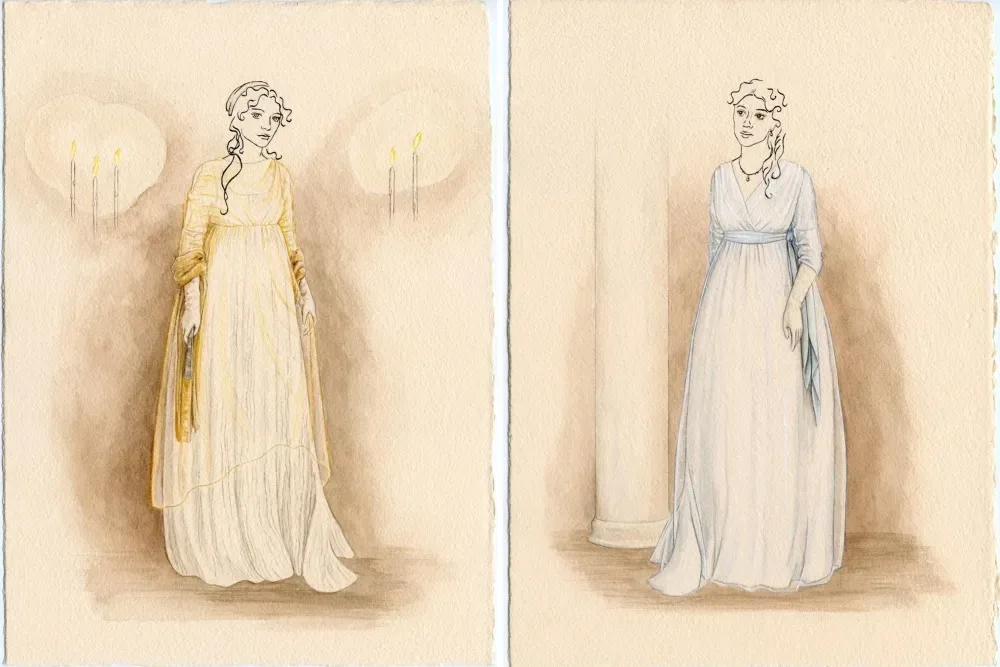
Grace Snell’s costumes for Georgia Oakley’s adaptation of Sense and Sensibility use constraints to define the Dashwood family’s early state of mourning. Daisy Edgar-Jones, Esmé Creed-Miles and Caitríona Balfe play the Dashwood women following the death of their father and husband. The wardrobe rules are clear: no shiny buttons; dull fabric; and a limited palette built around black, gray and lavender.
For Mrs. Dashwood, Snell chose the deepest expression of that grief: a black taffeta dress. Its near-black surface carries a dark green stripe that gives it a reflective quality, an example of how even mourning clothing can have depth without breaking the requirements of the character’s situation. Mrs. Dashwood remains in mourning for much of the film, but beige gradually enters her palette as the narrative proceeds.
Willoughby, played by Frank Dillane, receives a more aggressively expressive look. He is framed as someone interested in fashion and intent on being noticed. In the London dance scene with Marianne, he wears a rust-red moleskin coat against her pink dress, creating a pairing described as visually explosive. Silk pantaloons—then only just becoming fashionable—complete his outfit and identify him as an early adopter bringing the style from France.
Costume vocabulary: a palette is the controlled range of colors assigned to a character or group. It can track grief, recovery, status or desire without a script stating those things outright. Here, black, restrained texture and the slow appearance of beige turn mourning into an evolving visual condition, while Willoughby’s rust red and new-fashion silhouette mark him as showy and hard to reach.
In Werwulf, wool is status
Robert Eggers’ Werwulf, positioned as a companion to 2024’s Nosferatu, follows a 14th-century town terrorized by a werewolf. Willem Dafoe plays a landowner and hunter selected by the king to lead the pursuit of the creature.
Costume designer Linda Muir differentiates him from the impoverished people threatened by the beast through material abundance. Wool was scarce in the setting, and Dafoe’s character wears double layers of wool outerwear along with linen shirts. His boots rise higher than anyone else’s, further signaling rank. A family signet ring made by the props department and a bycocket hat, a style commonly associated with Robin Hood, complete the silhouette.
This is an especially direct form of costume storytelling. Wealth does not need a spoken explanation when the character’s wardrobe uses more of a scarce material than those around him. The double layers communicate insulation and expense at once, while the boots, ring and hat consolidate the image of a man with social standing and institutional backing. It also sets up an immediate contrast between the hunter chosen to act and the poor townspeople suffering the consequences of the threat.
Cliff Booth’s old clothes are part of the character’s continuity
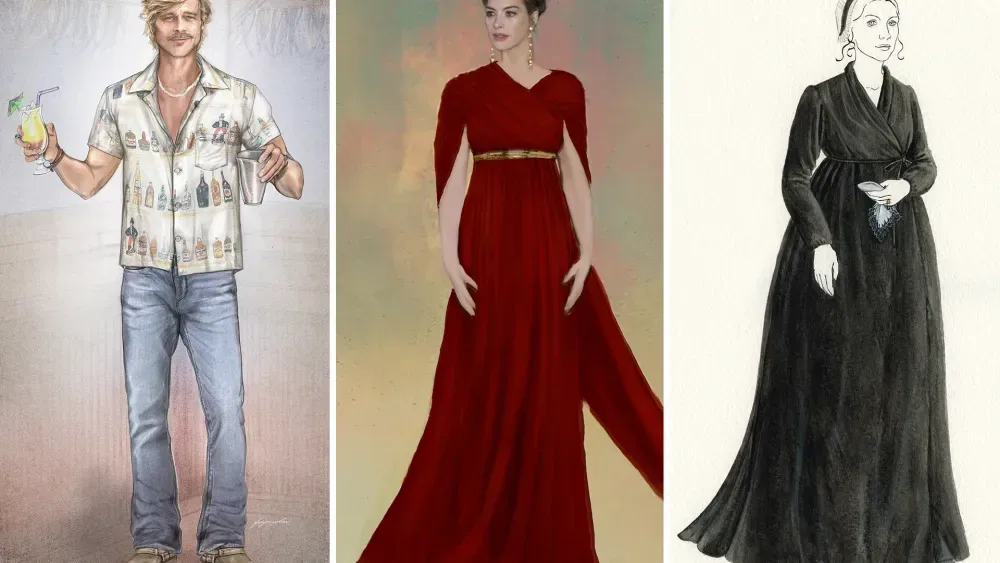
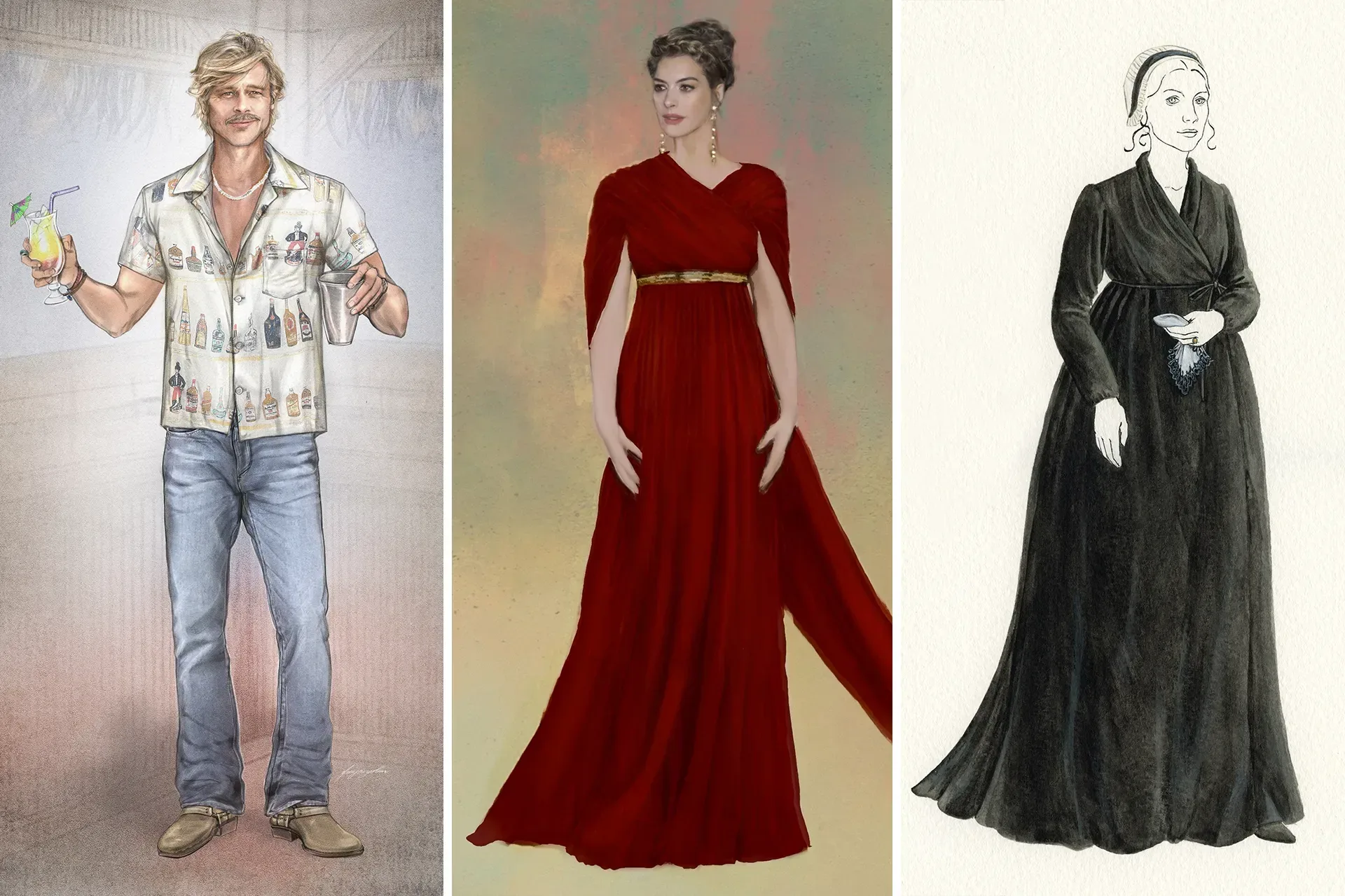
David Fincher’s The Further Mis-Adventures of Cliff Booth returns Brad Pitt to the character last seen as a stunt double in Once Upon a Time in Hollywood. Cliff is now tending bar, but costume designer Trish Summerville retains several wardrobe traits from the prior story: Hawaiian shirts, Levi’s jeans, moccasins and work shirts.
The guiding idea is that Cliff’s clothing is lived in rather than disposable. That is useful character continuity because it treats garments as things kept and worn over time, not a fresh rack of outfits selected for every new scene. A favorite pair of jeans can suggest routine and attachment; a familiar shirt pattern can preserve a recognizable identity even after a job change.
One Hawaiian shirt, printed with beer bottles, makes the point with a little more mischief. Summerville searched vintage rayon shirts from the 1950s through the 1970s that featured bottles of alcohol, but the production needed matching versions for Pitt and his stunt double. An artist combined the graphics, which were then printed on new shirts. The shirt suits a character presented as a relaxed rascal, but it also illustrates a largely invisible production requirement: a costume often has to exist in multiples so that action work and continuity can be managed.
The Invite turns an apartment into part of Angela’s wardrobe
The Invite brings the same storytelling principles into a contemporary setting. Olivia Wilde plays Angela, whose uneasy marriage to Joe, played by Seth Rogen, forms the backdrop for an intimate dinner with their noisy upstairs neighbors, played by Penélope Cruz and Edward Norton.
Costume designer Arianne Phillips worked from Wilde’s interest in the apartment’s doorways and windows, which create striking frames around the characters. That led Phillips to consider the clothing in portrait-like terms: not only what a costume says in isolation, but what happens when its wearer is positioned inside a particular interior.
Angela’s creative identity is so absorbed into the apartment that she is intended to blend into the walls. In a bedroom scene involving discussion of paint color, the tones are so similar that distinctions begin to blur; Angela’s blouse participates in that same close-color effect.
The larger takeaway: costumes do not stop at the edge of a garment. They interact with set decoration, lighting, framing and the colors around them. Angela’s near-camouflage makes the apartment feel like an extension of her state of mind and identity, while also giving a simple blouse an important job in the visual composition.
These seven examples span mythic epic, musical biography, medieval fantasy, literary adaptation, werewolf horror, a Hollywood character follow-up and a modern dinner-party story. Their materials range from taffeta, wool and rayon to sequins, flexible polymer and 3D-printed prosthetic components. What unites them is the precision of the choices: costumes tell viewers who holds power, who wants attention, who is mourning, who has changed, and who might be disappearing into their own surroundings.