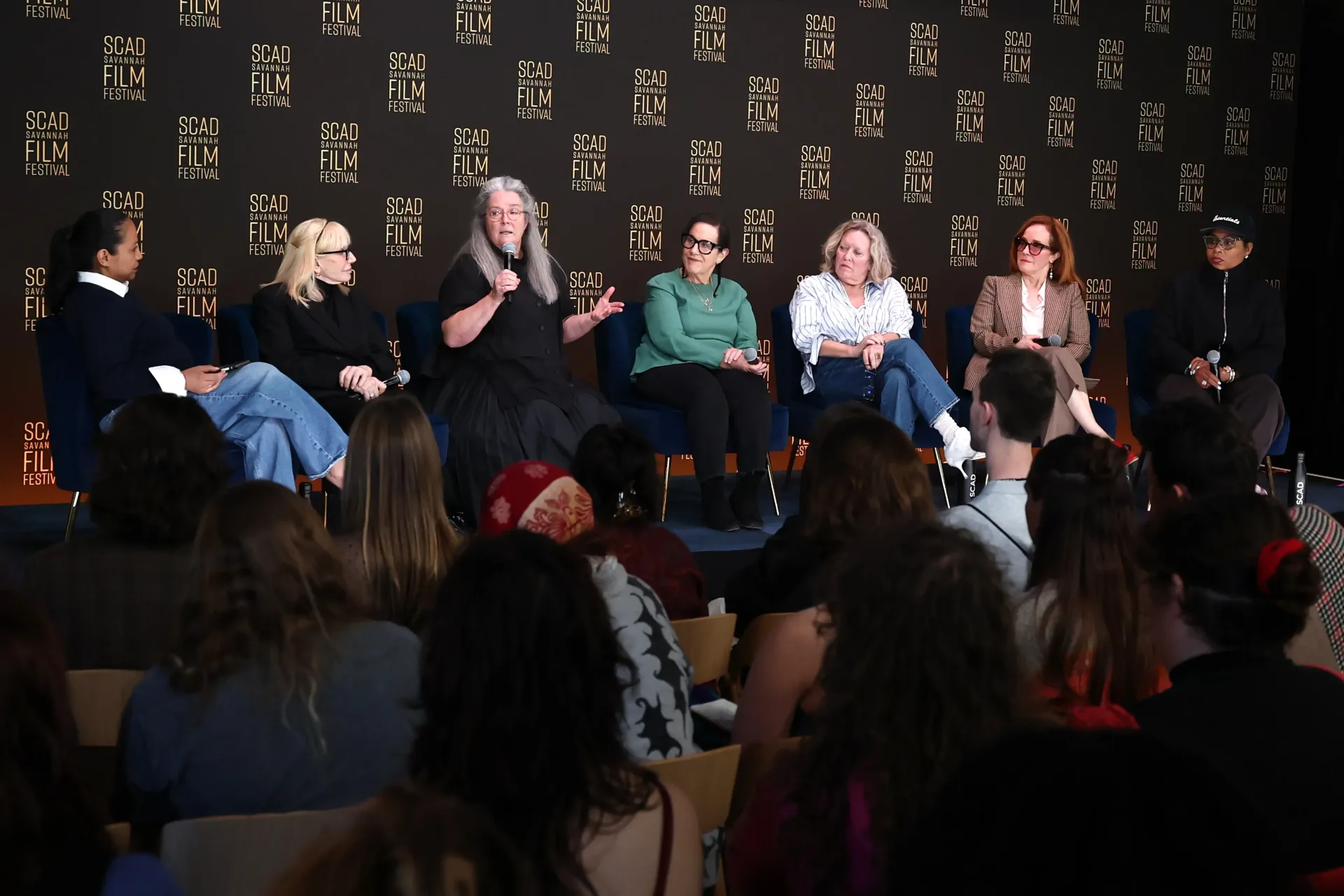
Film costume design is easy to underestimate precisely because it can look ordinary. A character in a contemporary story may wear jeans, a sweater, boots or a thrifted jacket—clothes that seem close enough to everyday life that viewers may assume the job begins and ends with buying the right items. Costume designers Molly Rogers, Ellen Mirojnick, Arianne Phillips, Linda Muir, Amy Roth and Marci Rodgers made the case that the reverse is true: making clothing feel truthful, specific and narratively useful can be one of the discipline’s hardest assignments.
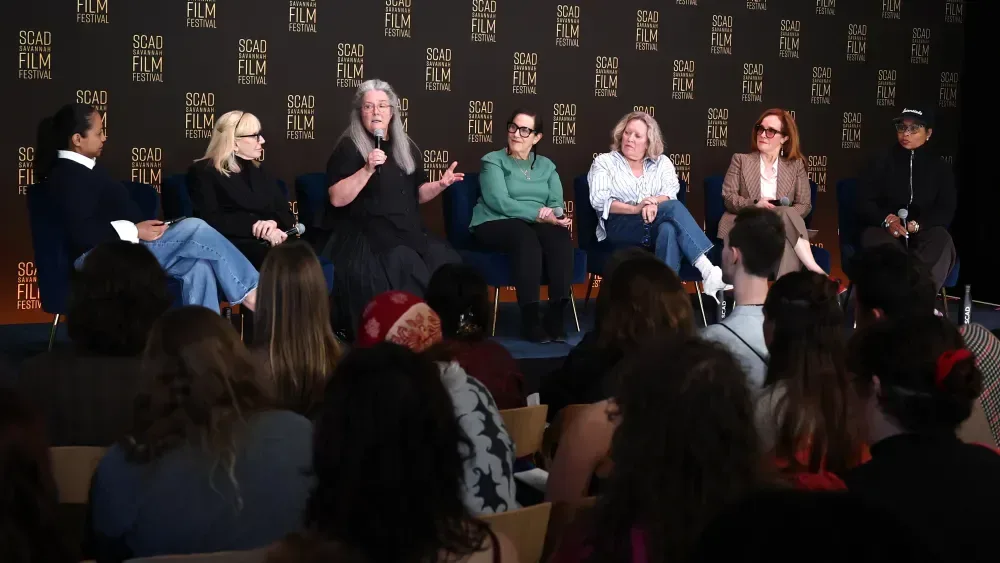
At a costume-design discussion during the SCAD Savannah Film Festival, the group described wardrobes as a storytelling system. A garment can establish class, location, memory, power, emotional distance and the changing state of a relationship. It must also work with an actor’s interpretation, survive production shifts and, increasingly, contend with commercial pressures. Shopping may be one tool in that process, but it is not the point of the work.
Rogers offered the bluntest version of that distinction. For an aspiring collaborator to lead with a love of shopping, she said, is a warning sign rather than a qualification. The essential task is to understand the character and tell the story through what that person wears.
Why “normal” clothes can be the tougher assignment
Contemporary costume design means clothing characters in a setting close to the audience’s own period rather than building a wardrobe for a distant historical era or overt fantasy world. That apparent familiarity is part of the challenge. The audience brings its own opinions about fashion, brands, status, neighborhoods and what feels plausible. A choice that is too polished, too expensive, too generic or simply out of tune with a character can register immediately.
Mirojnick, whose work includes Wall Street, Basic Instinct and Fatal Attraction, described contemporary work as both difficult and beautiful. She also framed it as a form of documentation. Clothing used to create a heightened character still records something about how a city and its people looked at a particular point. That makes costume design more than decoration: it becomes a selective portrait of a social moment.
The word selective matters. Documentation does not mean putting every character in a literal copy of whatever happened to be fashionable. A film wardrobe has to support an individual fictional person. It needs a coherent visual logic, one that is legible without turning each outfit into a diagram. In practical terms, the designer has to decide what a character notices, what they can afford, what they keep wearing, what they avoid and what they may be trying to project.
Rodgers’ recollection of beginning on Spike Lee’s She’s Gotta Have It illustrates the work behind that specificity. Having come from Chicago, she recognized that New York style had its own language. She asked Lee to join her during background casting so she could observe how people arrived dressed. That is a revealing detail: background performers are not merely visual scenery. Their clothes establish the environment against which the lead character’s choices will be read.
For Nola Darling, Rodgers learned that Prince was the character’s favorite artist. Purple became a meaningful accent, rather than an all-consuming gimmick. Rodgers also reasoned that Nola would not shop at Saks and concentrated on thrift stores to build the look. The result described at the discussion was not “purple equals Prince.” It was a chain of character decisions: taste informs color, economic and personal reality inform where clothes come from, and restraint keeps a reference from overwhelming the person wearing it.
Related coverage includes Costume Designers Explain Why Contemporary Film Wardrobes Are Far More Than Shopping.
Her approach to Barbershop, set in Chicago, likewise centered the community and the fashion of its moment. These examples explain why a contemporary costume cannot be judged solely by whether it looks appealing on a rack. Its success is relational. It has to look right next to the actor, within the setting, beside other characters and within the larger story.
Costume design is persuasion as well as design
Rodgers remembered being warned by a professor that contemporary work would be the most difficult work she would do. Actors can arrive with firm ideas about their characters, with no idea at all, or with assumptions that change after a table read. A table read is the stage at which performers read through the script together; it can reveal new dynamics and alter how a character is understood. That means a costume plan cannot be treated as immovable simply because garments have already been selected.
Phillips expanded on the interpersonal side of the job. She argued that costume design can be too easily dismissed by executives and other decision-makers who are personally comfortable with luxury shopping or accustomed to someone else buying clothes for them. That familiarity can create the false impression that dressing a character is a simple matter of taste or purchasing power.
But the designer’s responsibility is not to validate the most expensive suggestion in the room. Phillips described the need to act as a salesperson for the character: to explain why a proposed choice belongs, or does not belong, in the narrative. An actor might be certain a character wore a particular pair of Prada boots, but the costume department has to weigh that suggestion against story, behavior and visual continuity.
Continuity, in this context, is the consistency that lets separate shots and scenes feel like the same unfolding reality. It includes the obvious questions—does the jacket match from one shot to the next?—but also the subtler question of whether the character’s visual journey is coherent. If an outfit changes, the audience should be able to feel why, whether or not the film directly explains it.
Phillips also identified a larger pressure point: product placement. The term refers to the inclusion or required use of a commercial product within a film. She said luxury brands are entering the financing space and that designers may be instructed by producers to use a particular product. Her concern is straightforward. The more a wardrobe is dictated by outside commercial requirements, the more a designer needs directors who will defend story-based choices. A garment can carry a label and still serve a character, but the two interests are not automatically aligned.
This tension is particularly sharp in contemporary stories, where recognizable products and current fashion are part of the visual landscape. The discussion does not suggest that every branded item is artistically harmful. Rather, it highlights the creative question that must remain primary: does the item communicate something truthful about this character and this scene?
Color, silhouette and the visual grammar of character
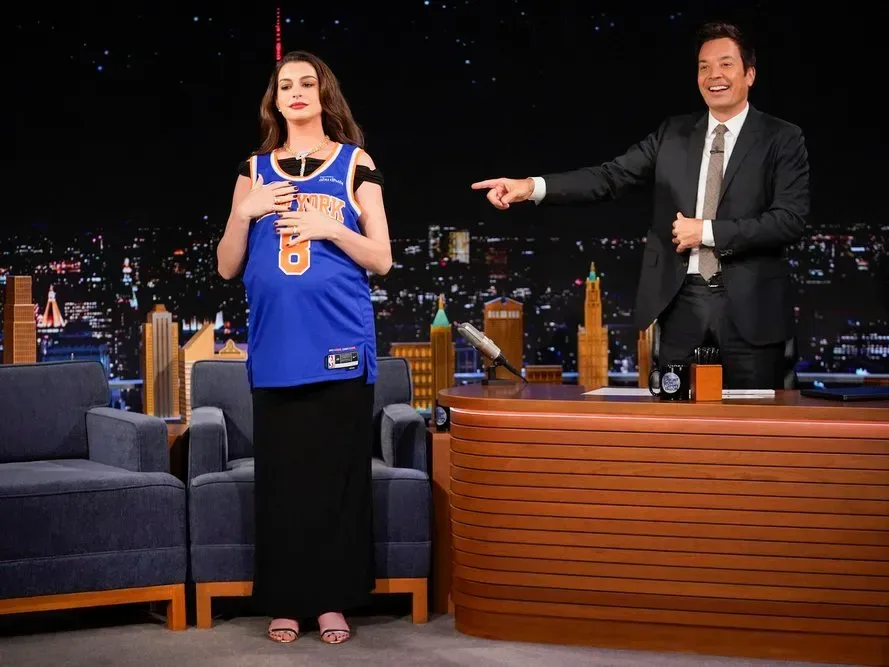
The designers’ newer projects showed the same principles operating in very different worlds. Mirojnick said she created more than 5,300 costumes for Christopher Nolan’s The Odyssey, with particular attention to Anne Hathaway’s Queen Penelope. The House of Ithaca was associated with a burned-red palette, and that color family informed Penelope’s clothing so the film’s visual language would not be disrupted.
A palette is the deliberate group of colors used across costumes, sets or other visual elements. It is not simply an aesthetic preference. Here, it connected Penelope to Ithaca and gave the audience a stable visual association. At the climactic point of Odysseus’ return, however, Penelope shifts into blue. Mirojnick described the gown as armor: closely pleated and shaped to the body, rising at the neck and paired with a gold necklace, one of the character’s few decorative elements.
The contrast gives color a narrative job. Burned red links Penelope to her house; blue marks a moment of resolve and confrontation. The dress is still a dress, but its drape, restriction, neckline and limited ornamentation are designed to make strength visible. This is costume storytelling at its most explicit: no physical armor is required for clothing to signal that a character is prepared to stand her ground.
Phillips described a more restrained version of that process in The Invite, her third collaboration with Olivia Wilde. She used one costume change to establish the film’s tone, while Cruz’s layered costume gradually disclosed more about her. Layering is the use of garments worn over or under one another, but in this case it also operates as narrative structure: what the audience sees, and what is revealed over time, become connected.
For Wilde’s Angela, a stay-at-home artist who has lost her creativity, Phillips worked with production designer Jade Healy so the character would blend into the walls. Production design concerns the physical environment of a film; coordinating it with costume means a character can appear integrated with, hidden by or at odds with their surroundings. Phillips initially found the blues in Seth’s wardrobe discordant with Angela’s palette, then recognized that the lack of harmony was exactly right because the relationship itself was out of sync.
That is a useful reminder for viewers: color coordination is not always the goal. A carefully uncoordinated palette can tell the audience that two people occupy the same room but are not emotionally moving together.
Historical authenticity is a material problem
Linda Muir’s work with Robert Eggers on The Northman and Werwulf moves into historical costume, but it reinforces why “just find the clothes” is an inadequate description of the profession. Muir discussed research into wool as a marker of wealth in Viking times. The wealthy bought wool, she explained, making abundant wool clothing a class signal.
For Muir, authenticity depends not only on knowing that hierarchy but on finding makers capable of constructing the full visual world: wool fabrics, hats, jewelry, buttons and belts. When a setting offers fewer available styles and elements than modern fashion, each material and accessory carries more weight. A belt or button is no longer background noise; it helps complete the social identity, period and texture of the person wearing it.
Authenticity does not mean an arbitrary accumulation of historically themed objects. In the terms raised at the discussion, it means a whole picture in which fabric, craft, status and character fit together. Research is therefore inseparable from sourcing and making. A designer can know what an era requires, yet still face the difficult task of locating or creating the components needed to place that knowledge on screen.
Recreating icons means managing collective memory
Rogers, who worked as an assistant costume designer on The Devil Wears Prada and is costume designer on its sequel, addressed a different kind of expectation: returning to a beloved film. She brought back Andy’s cerulean sweater because the character, played by Anne Hathaway, would plausibly still own it years later. That choice treats a famous costume not as a museum piece but as an object with a life in the character’s closet.
Its eventual form changed when Hathaway cut off the sleeves. Rogers had initially envisioned a more naturally worn sweater, like a valued piece with damaged elbows. The alteration turned it into a vest, fitting Rogers’ effort to bring a touch of menswear into Andy’s look. The episode neatly demonstrates how costume design remains responsive during production. A planned garment can become a different garment, and the designer’s task is to recognize the character opportunity in the change.
Amy Roth faced another version of iconic reconstruction on I Play Rocky. She said the original Rocky did not have a costume designer, leaving her without conventional costume-department references. Yet the character’s hat, leather jacket, gloves and bouncing ball remain deeply embedded in public memory. Roth’s challenge was to recreate an image viewers think they know while working from limited formal reference material.
The leather jacket was crucial enough that Roth made and aged one, then found the original jacket on eBay in her actor’s size. Aging is the process of making a costume appear used, worn or lived-in rather than newly made. It can be vital when the character’s identity depends on visible mileage rather than pristine presentation. Actor Anthony Ippolito also contributed reference images and committed to embodying Stallone’s physicality, helping costume and performance reinforce one another.
For Michael and its recreation of the “Thriller” video, Rogers worked from an 800-page research book and learned that the Levi’s jeans associated with the famous red look had originally been white before being dyed. Levi’s supplied several pairs for the recreation. Rogers used a Pantone book—a standardized color-reference system—to match the beaded jacket, finding two different reds whose distinct color values mattered to the final effect.
The work extended beyond the lead performer. Rogers emphasized the zombie dancers and the precise placement of details such as pearls on the woman in the pink dress. Iconic sequences endure because audiences remember the total composition, not only the central jacket. That principle applies just as strongly to contemporary film wardrobes: every visible costume helps build the world, and the most convincing designs are often the ones that make their extensive thought feel effortless.
For more fashion-focused movie coverage, read our review of I Love Boosters.