
Sesame Street has given a familiar Christmas-pop setup a distinctly educational remix. Elmo, Abby Cadabby, Grover and Cookie Monster have adapted Mariah Carey’s “All I Want for Christmas Is You” into a segment about the letter U, using a holiday-morning scenario to make vocabulary and letter recognition part of the joke.
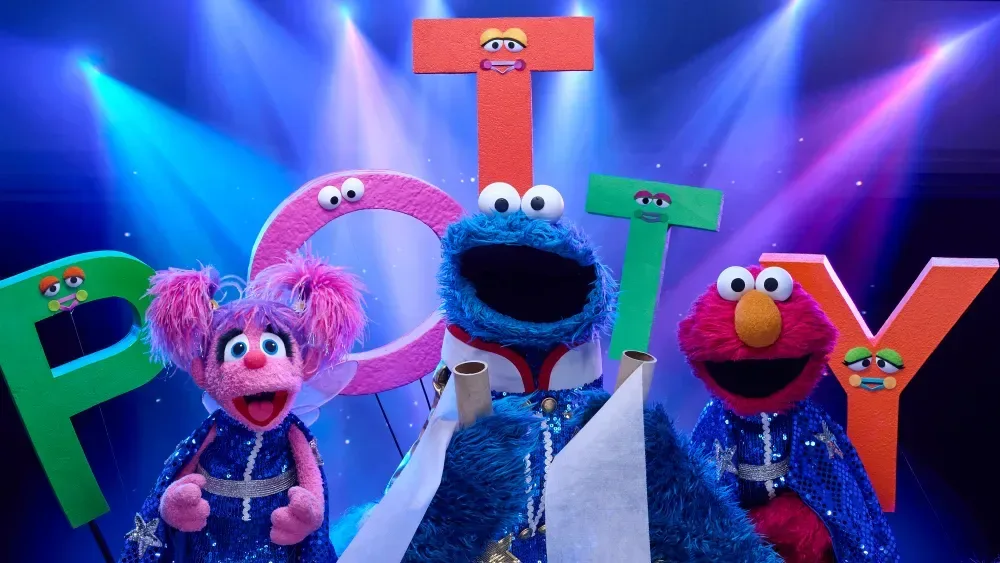
The video’s most direct visual cue is a green letter U wearing a Santa hat. Around it, the characters run through words whose pronunciation depends on that letter: Grover asks for a ukulele, Abby wants a unicorn, and Elmo hopes for a UFO. Cookie Monster waits until the song is over to reveal his own answer, opening a present containing heart-print underwear and declaring it “a letter U Christmas miracle!”
The premise is straightforward, but that is the point. The segment frames the absence of U as a practical holiday complication: ribbons cannot be undone, while tangled lights become harder to describe and sort out. Rather than presenting a letter as an isolated symbol, the sketch makes it part of recognizable objects, actions and punchlines.
A pop-song format built around phonics
Phonics is the approach of connecting letters or letter combinations with their sounds. In this case, the segment is not simply asking young viewers to spot a printed U. It places the letter in spoken words such as ukulele, unicorn, UFO and underwear, then pairs those words with clear imagery. That combination can help make the connection between the character, its sound and a memorable noun more concrete.
There is also a small structural joke in choosing Christmas gifts as the setting. A wish list naturally creates repeated opportunities to ask, “What do you want?” Each answer can introduce another U word without the segment needing to pause for a formal vocabulary drill. The gift reveal lets Cookie Monster supply a final payoff after the music ends, preserving the show’s familiar balance between instruction and character comedy.
The use of a well-known seasonal song matters because recognition does some of the scene-setting work immediately. For adults watching alongside children, the musical reference may be the initial hook. For younger viewers, the more important material is likely the visual pattern: the big green U, the repeated sound, the holiday props and the Muppet characters attaching each word to a distinct wish.
That is a useful distinction when looking at adaptations made for children. The recognizable song framework can make an activity inviting, but the teaching mechanism here is the repeated association of the letter with objects and actions. The concept does not require a child to know Carey’s original recording to follow the lesson.
Why the missing-letter gag works
The segment’s central idea—imagining Christmas morning without the letter U—turns language into a problem to solve. A missing-letter premise gives viewers a reason to notice a character that can otherwise feel abstract. If the letter vanishes, familiar things suddenly become difficult to name, request or explain.
That technique is especially suited to a program built around conversational learning. The audience is not asked to memorize a list in a vacuum; it is invited to see what changes when a part of the list is removed. Grover’s ukulele, Abby’s unicorn and Elmo’s UFO are deliberately fanciful choices, but each creates an unmistakable visual target for the word being discussed.
Cookie Monster’s underwear punchline provides a different kind of reinforcement. The word arrives with a surprise, and the object itself confirms what the audience has heard. It is a silly ending, but it is still connected to the letter lesson rather than being a gag pasted on after it.
For families, the segment also offers an easy prompt for an off-screen game. Children can look for other U words in a room, on a holiday list or in a book, then say what would become awkward to describe if U disappeared. The value of that sort of follow-up is not that it duplicates the video; it lets children supply their own examples after seeing how the format works.
The season’s music-led learning approach
The letter U video is part of a season that has used songs and stories to address more than one kind of learning. The season premiere arrived November 23 on Netflix and PBS Kids, and it featured Elmo, Abby and Cookie Monster performing “Puppy Dance Party” with Zara Larsson. In that episode, Grover helps search for a lost present belonging to Tango’s cousin.
Its larger stories are also designed to give children practice with sharing, listening and resolving disagreements. Those are social skills rather than alphabet skills, but the underlying method is similar: put a lesson inside a clear situation involving characters, a goal and a problem that needs attention.
Earlier in August, the show also adapted “Golden” from KPop Demon Hunters for a video about teamwork. Taken together, the two musical exercises show a flexible format. One is about cooperation; the Christmas segment is about a letter and vocabulary. In both cases, the music is serving a defined learning purpose rather than merely functioning as a celebrity or pop-culture cameo.
That is also why the U adaptation has a narrower assignment than a general holiday parody. Its creative choices repeatedly steer back to the same lesson. The Santa-hat U is visible, the requested gifts begin with U, and the missing-letter premise gives those words a reason to be noticed. The sketch has room for absurdity, but it does not lose the instructional thread.
Carey’s original has a personal history
Carey’s original recording appeared on her 1994 album Merry Christmas. She had begun developing the melody and lyrics at the piano before bringing them to co-writer Walter Afanasieff. In remarks collected for the song’s National Recording Registry recognition, Carey connected its emotional starting point to childhood Christmases—occasions that gave her something to anticipate even when family gatherings did not unfold as she had hoped.
“I wanted it to make people happy and make myself happy,” Carey said.
The single became Carey’s first recording selected for the National Recording Registry in 2023. That designation recognizes recordings for their cultural, historical or aesthetic significance, which gives some context for why a children’s series can use the song’s instantly recognizable shape as a foundation for a lesson. The adaptation does not try to reproduce the original’s full emotional role; it repurposes its holiday familiarity for a playful literacy exercise.
Carey continues to include the song in her own holiday performances. A recent Rio de Janeiro appearance also included “Oh Santa!” and “We Belong Together.” Her three-date U.K. run begins at Birmingham’s Utilita Arena, followed by London’s O2 on November 30 and Manchester’s Co-op Live on December 2.
The timing naturally places the Sesame Street sketch in the annual stretch when Christmas music, decorations and seasonal television become part of many families’ routines. For a broader look at another major holiday-season TV fixture, see our guide to the 100th Macy’s Thanksgiving Day Parade.
What the segment adds to a holiday staple
Holiday standards endure partly because they can be revisited in different settings, from concert stages to family playlists. This use is more specific: it converts the song’s premise into a compact language activity. The shift is not simply from adult pop to children’s TV. It is from romantic holiday longing to a set of concrete words that begin with the same letter.
That change gives each Muppet a useful role. Grover, Abby and Elmo provide examples, while Cookie Monster delivers the delayed comic answer. The characters’ requests keep the segment moving, and the Christmas-morning setting makes the vocabulary feel like part of a tiny story instead of a flash-card sequence.
For adults, the reference may land as a seasonal novelty. For the intended young audience, the lasting takeaway is more likely to be that a ukulele, unicorn, UFO and underwear all share a letter sound—and that even a tangle of lights can become an excuse to notice how words are built.