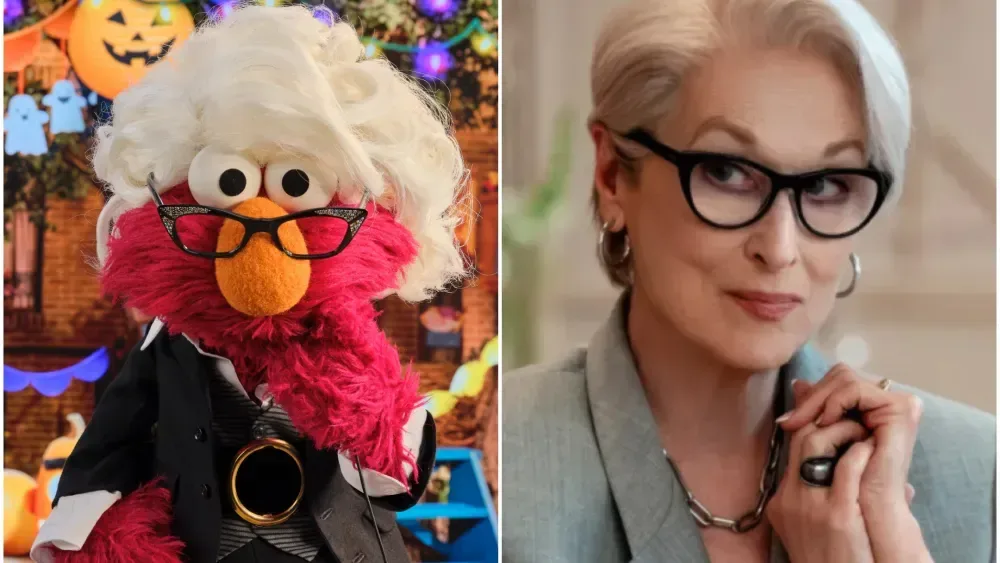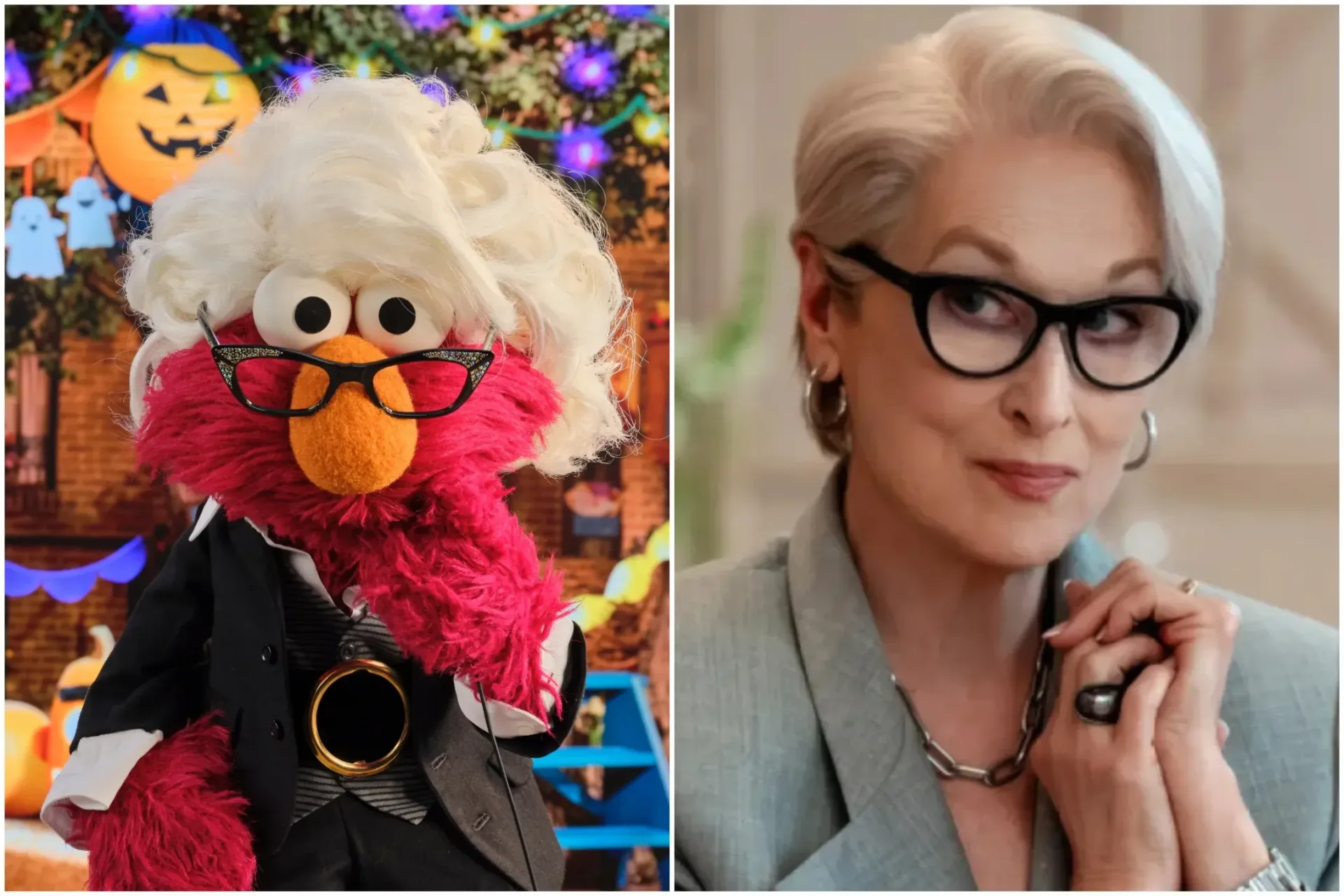
Elmo has taken a sharp detour from friendly Halloween dress-up and into intimidating fashion-editor territory. For Halloween 2026, the Sesame Street favorite appears as Miranda Priestly, the exacting editor figure played by Meryl Streep in The Devil Wears Prada.
The gag works because it puts one of children’s television’s most consistently warm characters into the posture of a famously chilly boss. Elmo opens by asking viewers to guess his costume, then reveals the Miranda-inspired look and begins issuing the kind of clipped, withering observations associated with the character.
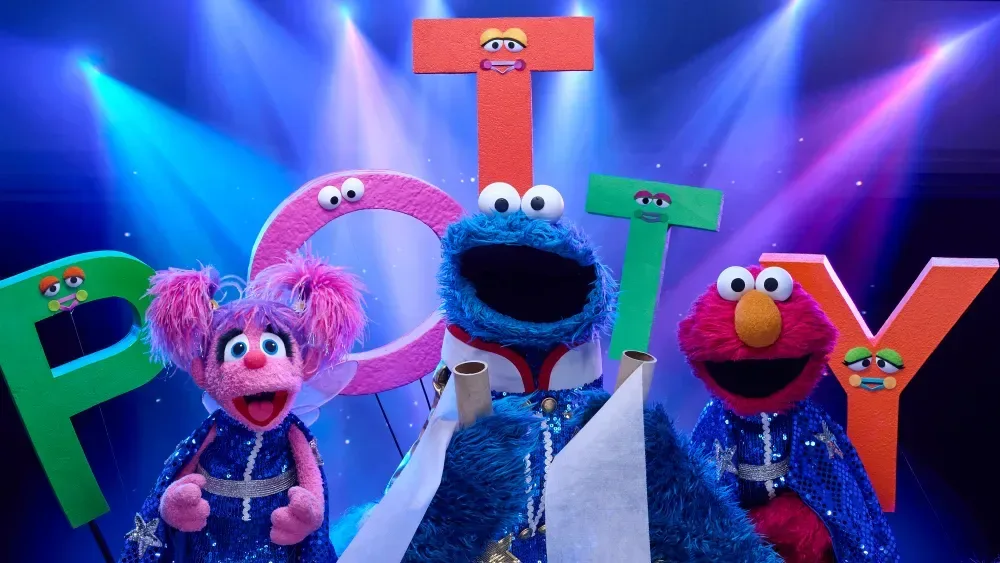
First, a sentient pumpkin crosses his path. Elmo responds with a fashion-world variation on the idea that seasonal imagery is hardly revolutionary: “Pumpkins. For fall. How groundbreaking.” When Cookie Monster arrives, Elmo turns his attention to the blue fur. “Well, it’s not cerulean. But, it works.” Cookie Monster’s uncertain “Uh, thanks? Me think?” is the appropriate response to being accidentally recruited into a high-pressure magazine-office parody.
A preschool costume with a second audience
The sketch is built around a simple two-level joke. Young viewers can follow the immediate Halloween situation: Elmo has put on a costume, a pumpkin has appeared, and Cookie Monster gets a funny comment about his color. Adults who know Miranda Priestly, meanwhile, get the deeper layer: a compact imitation of the character’s disdainful rhythm and two references designed for people who remember the movie.
That is what makes the crossover more deliberate than merely putting Elmo in a recognizable outfit. The costume establishes the reference, but the writing sells it. “How groundbreaking” frames an ordinary autumn symbol as though it were an underwhelming editorial pitch. The cerulean line turns Cookie Monster’s permanent blue coat into the subject of a color critique. Neither joke requires a lengthy explanation inside the clip, which is useful for comedy meant to work at different ages.
Cerulean is a shade of blue. In this context, it is more than a color word: it is a shorthand for one of the best-known scenes associated with Miranda Priestly, in which the character explains how a supposedly insignificant fashion choice travels through the industry before reaching an ordinary consumer. Elmo using the term on Cookie Monster is funny precisely because Cookie’s fur is not a seasonal wardrobe decision and because the seriousness of the judgment is wildly disproportionate to the subject.
The pumpkin joke works similarly. Pumpkins are one of Halloween’s most familiar images, so treating one as a profoundly uninspired fall concept imports the character’s elite editorial impatience into the gentlest possible setting. That contrast is the entire engine of the bit: couture-style severity, delivered by a small red monster standing near a pumpkin and a cookie enthusiast.
Why Miranda Priestly remains an effective shorthand
Miranda Priestly originated in Lauren Weisberger’s novel The Devil Wears Prada. The character was brought to the screen in the 2006 film, with Streep starring alongside Anne Hathaway, Emily Blunt and Stanley Tucci. Weisberger had worked at Vogue, and Miranda was modeled on real-life fashion editor Anna Wintour.
For the Halloween sketch, the key point is not simply that Miranda is a fashion editor. It is that the character’s name quickly communicates a highly specific comedic mode: pristine presentation, devastating brevity and a refusal to overstate the insult when a carefully placed aside will do. Elmo does not need to recreate a film scene word for word. A pumpkin dismissal and a blue-color assessment are enough to make the premise legible.
That economy matters in a short character segment. Rather than explaining the premise, the sketch relies on recognizable gestures and phrasing. It gives adults the pleasure of recognition while keeping the basic action clear for the younger audience. Cookie Monster’s puzzled reply also prevents the segment from becoming too insider-focused; his confusion is part of the joke, and viewers who do not know the reference have an on-screen guide.
Halloween has always made room for character play
Elmo has worn a number of Halloween looks in past Sesame Street segments, including a pirate, a witch and a spaceman called Galactic Stan. Those are direct, kid-friendly costume archetypes. Miranda Priestly is a more unexpected choice, but it still uses the same core format: a familiar character temporarily changes persona, then plays the concept broadly enough that the scenario remains understandable.
The difference is the target of the allusions. Pirate and witch costumes invoke imaginative play immediately. This one borrows a cultural persona whose most famous traits are adult workplace authority and fashion-industry judgment. The sketch does not ask preschoolers to understand those ideas in detail. It lets the grown-ups notice them while children can simply watch Elmo be unusually fussy about a pumpkin and Cookie Monster’s color.
It also reflects the unusual longevity of both sides of the crossover. Elmo remains a popular Halloween costume for children and adults, while the Miranda Priestly image remains recognizable enough to be condensed into a few visual and verbal cues. The original movie’s central cast—Streep, Hathaway, Blunt and Tucci—has returned as their characters in this year’s The Devil Wears Prada 2 from 20th Century Studios, giving the character another timely point of visibility.
What the clip is actually parodying
This is not a joke about fashion knowledge or an attempt to turn Sesame Street into a miniature magazine drama. It is a parody of status and tone. Parody, in this sense, means adopting recognizable traits of another work or character and placing them somewhere deliberately mismatched. Elmo’s Miranda voice carries authority; the topics under review are a pumpkin and Cookie Monster’s fur.
The mismatch protects the friendliness of the segment. The lines may be snippy, but the targets are harmless and absurdly low-stakes. The pumpkin cannot be offended, and Cookie Monster responds with confusion rather than conflict. That lets the sketch flirt with the sting of Miranda Priestly’s style without making its central characters feel cruel.
There is an additional visual-comedy advantage to Elmo playing a figure associated with polish and control. Elmo’s established persona is enthusiastic, direct and emotionally transparent. Miranda Priestly’s persona is controlled, selective and unimpressed. Putting those two energies together creates the joke before the dialogue even starts. The audience recognizes Elmo, recognizes the costume, and anticipates a collision between the two.
For a character famous for asking questions and meeting the world with eager curiosity, the brief move into “not cerulean” criticism is a wonderfully tiny act of Halloween mischief. It is specific enough for movie fans, simple enough for a family sketch, and restrained enough not to require anyone to explain the fashion hierarchy of a fictional magazine office to a preschooler.
It is also another example of television characters being able to carry references across generations without changing their basic identity. Readers looking at the other side of that enduring-TV conversation can see how personal connections shape a different kind of celebrity story in this look at The One About Matthew Perry. Elmo’s Halloween turn is much lighter, of course: no editorial deadline, no fashion emergency, just one red monster discovering that a perfectly placed put-down can be a costume accessory.