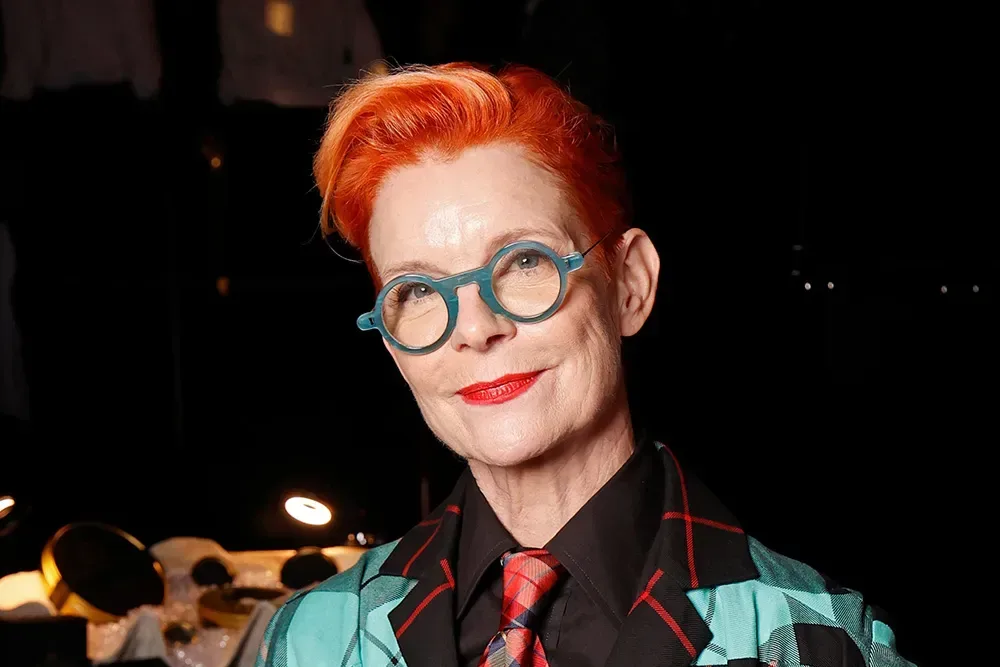
Three-time Academy Award-winning costume designer Sandy Powell will present the 2026 Film London Jarman Award on Nov. 24 and serve as the ceremony’s guest of honor. The appointment connects a major figure in contemporary costume design with an award created to honor filmmaker, artist and longtime Powell mentor Derek Jarman.
Powell’s place at the event is particularly meaningful because her career includes frequent collaborations with Jarman, including Caravaggio and Edward II. The Film London Jarman Award was established in 2008 in Jarman’s honor and celebrates U.K.-based artist-filmmakers working in the screen industry.
This year’s nominated artists are Sadia Pineda Hameed, Ilona Sagar, Rhea Storr and Alia Syed. Powell will present the award, placing the focus on the nominated filmmakers while also underscoring the collaborative crafts that shape cinema beyond its directors and performers.
Why Powell is a fitting choice
A costume designer’s work is sometimes reduced to the question of whether clothes look impressive on screen. That shorthand misses the broader role. Costume design helps establish character, period, social position, mood and visual rhythm. It can make a historical setting legible, sharpen a fantasy world’s rules or quietly tell viewers how a character wants to be perceived.
Powell’s screen credits span very different kinds of filmmaking. Her work includes Cinderella, The Wolf of Wall Street and Mary Poppins Returns, as well as collaborations with directors Martin Scorsese, Neil Jordan, Todd Haynes and Yorgos Lanthimos. That range matters in the context of an artist-filmmaker prize: it illustrates how a designer can work across changing tones and styles rather than applying one recognizable visual formula to every project.
Her connection to Jarman adds another layer. Jarman was not merely an early professional collaborator for Powell; he was also a mentor. A guest of honor with that direct creative relationship can speak to the continuing importance of an artist’s legacy without turning the occasion into a distant retrospective exercise.
“From her days collaborating with Derek Jarman on films like Caravaggio and Edward II to the peerless design she has brought to a staggering array of modern classics, her work is bold, beautiful and boundlessly creative,” Film London chief executive Adrian Wootton said.
Wootton also pointed to Powell’s vocal support for Jarman’s cultural legacy, calling her an especially appropriate guest of honor for the award.
Related coverage includes Sandy Powell to Present 2026 Film London Jarman Award.
Three Oscars, and a career across distinct screen worlds
Powell won the Academy Award for Best Costume Design for Shakespeare in Love, The Aviator and The Young Victoria. Those wins are useful markers of professional recognition, but the titles also show the demands of the discipline.
Shakespeare in Love and The Young Victoria are period films, where costumes carry immediate historical associations. The Aviator, meanwhile, moves through a different set of cultural and visual signals. In each case, costume design is not simply a collection of accurate-looking garments. The department has to build a coherent visual language for the film, one that supports performance and cinematography while remaining persuasive to the audience.
That work often involves a tension between authenticity and expression. Historical research may guide silhouettes, materials and details, but a costume also has to read clearly through a camera lens, in movement, and in relation to the film’s lighting and production design. The supplied record does not detail Powell’s process on these productions, so it would be wrong to assign specific creative choices to her here. Still, the variety of those recognized films helps explain why her career is an apt point of reference at an award for filmmakers whose work may move between art practice and cinema.
What the Jarman Award recognizes
The Film London Jarman Award was founded in 2008 to celebrate U.K.-based artist-filmmakers. “Artist-filmmaker” is a broad term, but it generally signals a practice in which moving-image work is connected to contemporary art as well as film production. The phrase does not describe a single genre, running time or budget level. Instead, it identifies a space for artists using film and screen-based work as a central part of their creative practice.
That makes an award like this different from a conventional craft prize or a box-office-centered ceremony. Its stated purpose is to recognize a particular community of artists and filmmakers, while retaining Jarman as its central point of reference. Powell’s participation reinforces that Jarman’s impact can be traced through collaborators as well as through the films associated with his name.
For audiences who primarily know Powell through lavish period costuming or high-profile studio productions, the ceremony is also a reminder that the film ecosystem includes many types of creators. Costume departments, directors, artists, cinematographers, editors and performers all contribute to the finished work, even when the public conversation narrows attention to only a few roles.
The 2026 nominees
The four artists nominated for the 2026 Film London Jarman Award are Sadia Pineda Hameed, Ilona Sagar, Rhea Storr and Alia Syed. The announcement identifies the nominees but does not provide project descriptions, judging criteria, or details on the final selection process. As a result, the clearest takeaway is the scope of the nomination itself: each artist is in contention for an award explicitly devoted to U.K.-based artist-filmmakers.
- Sadia Pineda Hameed
- Ilona Sagar
- Rhea Storr
- Alia Syed
The Nov. 24 event will determine which of the four receives the honor. Powell’s role is to present the award, not to be recognized as the year’s winner.
Jarman’s legacy, viewed through collaboration
Film history often favors a single-author narrative, particularly around directors. Collaboration is a more accurate way to understand how films reach the screen. Powell’s early work with Jarman provides a practical example: a mentor relationship can create opportunities, influence artistic confidence and establish working methods that remain meaningful across a long career.
Powell subsequently worked with filmmakers as stylistically varied as Scorsese, Jordan, Haynes and Lanthimos. That does not mean those directors or films share one aesthetic; it points instead to the adaptability expected of a costume designer. A successful collaboration requires translating a production’s particular creative needs into costumes that belong to that specific screen world.
Her guest-of-honor appearance also gives the ceremony a tangible connection between Jarman’s legacy and a craft that audiences encounter constantly, even if they do not always consciously identify it. A costume can signal time period or occupation in an instant, but it can also reveal tension, transformation or performance within a character. When it works, viewers may register the effect without stopping to name the department responsible.
That combination of visible result and often invisible labor is part of why recognition of screen crafts matters. Awards do not replace close attention to the work itself, but they can broaden the conversation about who makes a film’s visual identity possible.
What to watch for on Nov. 24
The confirmed details are straightforward: Powell will be the guest of honor and present the 2026 Film London Jarman Award on Nov. 24; one of Pineda Hameed, Sagar, Storr or Syed will receive the prize. The event also links Powell’s celebrated career back to the mentor and collaborator whose name the award carries.
It is a fitting spotlight for a designer whose credits include both ambitious period work and productions with markedly different contemporary or fantastical demands. More importantly, it preserves the award’s intended emphasis: honoring U.K.-based artist-filmmakers while recognizing that the cultural afterlife of a filmmaker such as Jarman is sustained through the people, practices and creative relationships around the work.
For more coverage of film and performance, see our look at Jaafar Jackson’s comments on cut scenes from Michael.