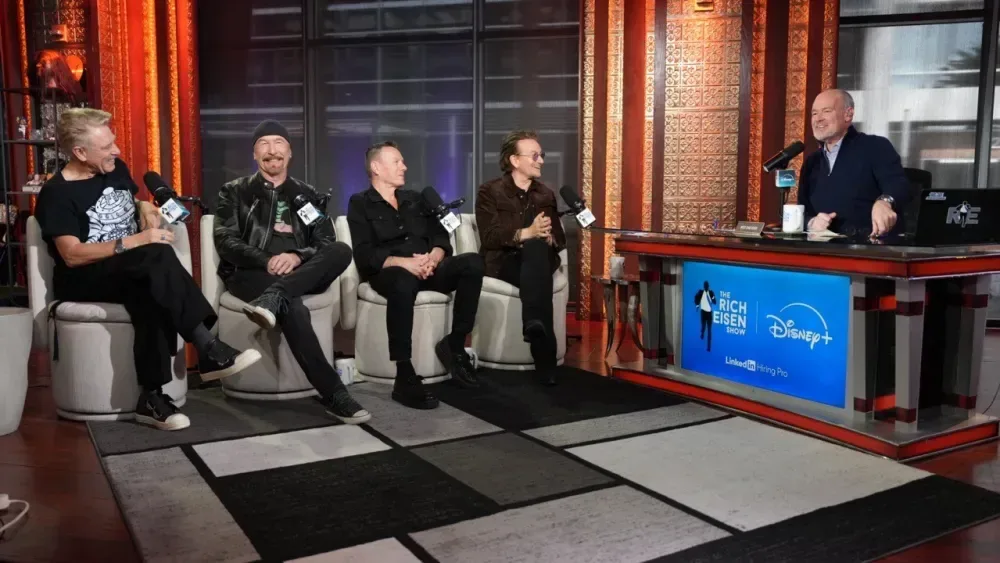
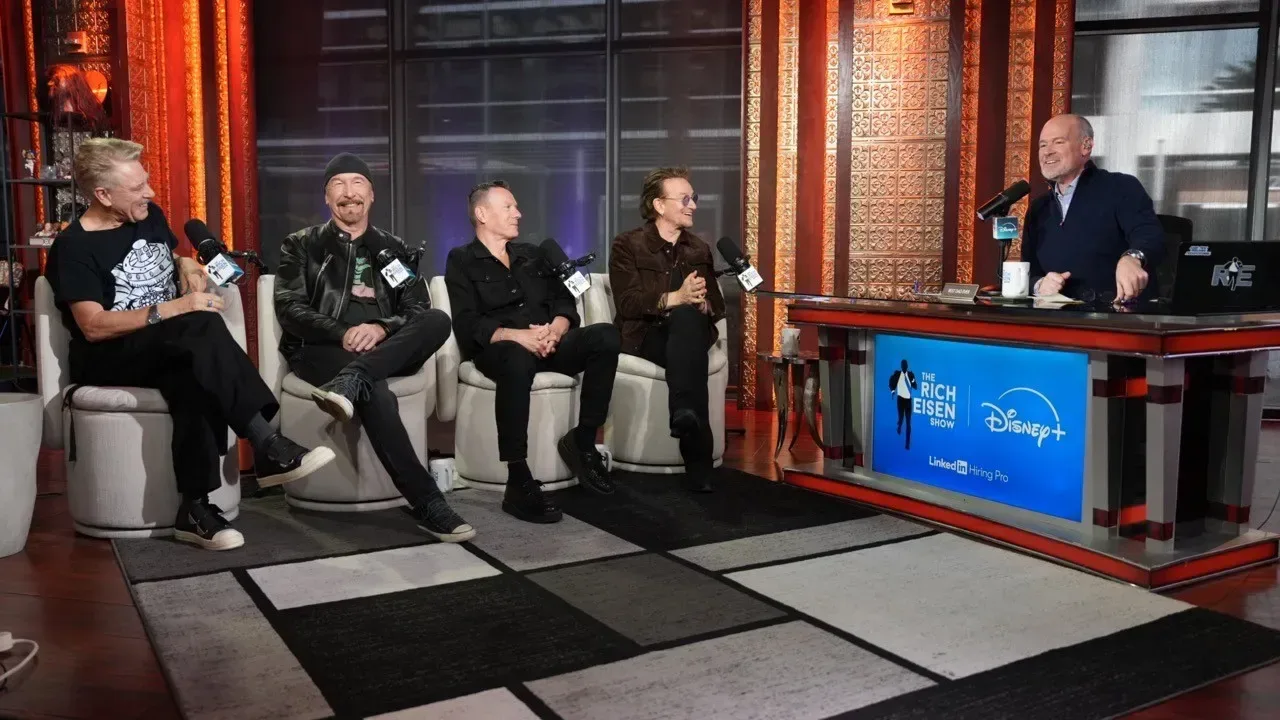
There is a useful visual shorthand for what Rich Eisen wants The Rich Eisen Show to be: Bono recreating the program’s running-man logo on set while The Edge takes the photos. It is the sort of loose, self-aware studio moment that does not fit the narrow stereotype of sports talk, and that is precisely the point.
All four members of U2 are appearing on Eisen’s Friday program, creating a conspicuously music-first detour for a host best known for sportscasting. Yet Eisen’s description of the show leaves little room for the idea that the booking is a gimmick. He calls it a pop-culture show in which sports is only one part of the larger picture. In practice, that means the same program can accommodate athletes and games alongside musicians, actors, comedians and the subjects that surround modern entertainment.
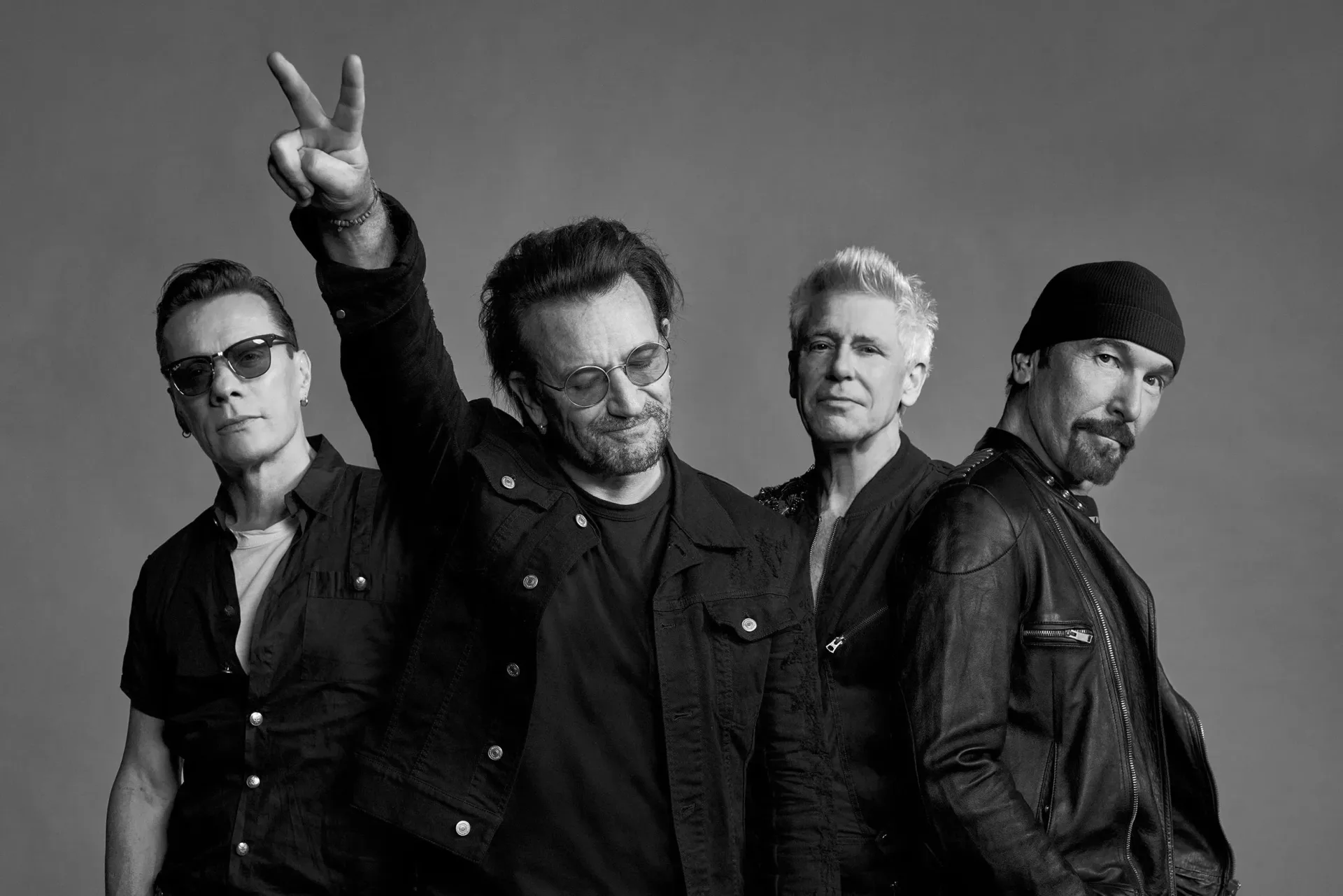
U2 arrive with a timely reason to talk. The group has released Carnaval de Luz, its first full album in nine years, and is scheduled to perform the halftime show during Netflix’s stream of a Thanksgiving Eve matchup between the Green Day Packers and Los Angeles Rams at SoFi Stadium. The proximity of that event to Eisen’s studio helped make the appearance possible: a producer reached out, and the band’s publicist was receptive.
That straightforward chain of events also says something about contemporary media bookings. A high-profile guest appearance no longer has to be confined to a single format. An album, a major streamed sports presentation and a talk-show stop can all sit in the same promotional orbit, speaking to overlapping audiences rather than separate ones.
A sports host with a deliberately wider brief
Eisen has hosted figures including Jon Bon Jovi, Jodie Foster, James Taylor, Will Ferrell, Kenny Chesney and Snoop Dogg over the years. Those names matter because they establish a pattern rather than a sudden format change. The show may be associated with sports programming, but it has repeatedly made space for conversations that start somewhere else.
Its distribution gives that approach additional logic. Since Eisen returned to the ESPN orbit—where he was a regular from 1996 through 2003—the program has streamed on Disney+ and the ESPN App, among other places. Eisen sees that reach as exposure to a broader blend of film, television, music and sports audiences.
That is an important distinction. “Sports talk radio” describes a traditional scheduling and audience category; it does not necessarily dictate every subject a contemporary video-and-streaming show can cover. A show carried across entertainment and sports-focused digital destinations can use sports as its core identity while treating culture as connective tissue. In Eisen’s framing, the audience is not being asked to abandon sports. It is being invited to see sports as part of the same daily conversation as music, movies, television and theater.
The U2 episode is therefore less about a sports show borrowing a celebrity and more about a host following the breadth of his own interests. Eisen has said that he is as invested in movies, music, television and live theater as his audience may be. His long-running outreach to non-sports guests turns that personal curiosity into an editorial approach.
Related coverage includes Rich Eisen Welcomes All Four U2 Members for a Pop Culture Detour.
The value of a “good hang”
Eisen’s stated interview philosophy is notably different from the gotcha-minded version of celebrity interviewing. He did not spend hours trying to identify some microscopic, supposedly unknown piece of U2 history. His aim was to create what he calls “a good hang,” asking questions he genuinely wants answered and letting unexpected details emerge if they happen to emerge.
That can sound casual, but it is a meaningful production choice. An interview built around obscure trivia has one obvious objective: produce a revelation. An interview built around ease, curiosity and rapport has another: let viewers spend time with guests as people, rather than only as the keepers of promotional talking points or the subjects of a fan-wiki test.
For a group as globally recognized as U2, the distinction is particularly relevant. An interviewer is unlikely to exhaust the band’s public record in a single sitting, and trying to do so can turn a conversation into an exam. Eisen’s alternative creates room for the guests’ interaction with one another and for the host’s own perspective. The opening studio gag—Bono as the show’s running-man figure, The Edge behind the camera—already indicates that the members were willing to play in that space.
That does not mean lighter conversation cannot contain substance. It means substance is not treated as a prize that can only be obtained by cornering a guest with a fact they have never been asked before. A relaxed atmosphere may instead reveal how a band relates to a new record, a looming performance, its shared history or even the online stories that have accrued around it.
What the show’s meme segment is trying to solve
Eisen and his team have developed a Q&A segment in which guests confirm or reject stories and memes already circulating online. The format is designed to perform well on YouTube, where a concise, recognizable premise can be easier for viewers to discover and share than a full uninterrupted interview.
It also solves a familiar celebrity-interview problem: digital audiences often arrive with preexisting claims, clips and jokes. Rather than pretending that material does not exist, the segment makes it part of the conversation and gives the guest a chance to address it directly. A meme, in this context, is not automatically a reliable statement of fact. It is a piece of online cultural currency—a repeated image, joke, claim or anecdote that can spread farther than its original context. Asking a guest to validate or knock it down is a way of restoring context without making the interview feel like a correction notice.
For viewers, the practical benefit is clarity. For the show, the advantage is a repeatable piece of programming with a clean digital identity. And for guests, it can be a more engaging alternative to hearing the same biographical questions. Eisen says those exchanges have been popular, suggesting that the audience responds to a format that acknowledges how celebrity information now travels.
Why the timing makes sense for U2 and Eisen
U2’s new album and the planned Thanksgiving Eve halftime performance offer two distinct reasons for the group to sit down together. One is about music; the other places the band inside a live sports-media event. Eisen’s show is unusually well positioned between those two lanes. Its host understands sports television, while its guest strategy makes room for artists whose work extends beyond athletics.
The halftime booking also reflects the ongoing overlap between sporting events and music spectacle. A halftime show is not simply a break in play. It is programming intended to expand the event’s cultural reach, giving music fans another entry point and giving sports viewers a performance built for a large shared audience. U2 discussing that event with Eisen can serve both sides without requiring the conversation to become strictly musical or strictly sports-focused.
There is an instructive contrast with music coverage that is centered only on release cycles. An album interview can concentrate on songs, recording and artistic intent. A show like Eisen’s can place an album in a larger map of public life: live-event performance, online fandom, sports audiences and the kinds of stories people share around famous performers. That wider framing is a plausible fit for a band with a new full-length project after a nine-year gap.
It also illustrates why personality-led shows remain useful in a fragmented media environment. A single booking can create a full conversation for the broadcast audience, short clips for video platforms, and a social-media-friendly segment with a clear hook. The goal is not necessarily to replace dedicated music journalism or sports analysis. It is to build a venue where the categories can meet without either one being treated as an interruption.
Openness is the format
Eisen’s summary of the team’s approach is simple: the show takes the work seriously without taking itself too seriously, and it is “open for business” every day. The U2 appearance puts that idea into unusually visible form. It is a full-band booking tied to a new album and a major streamed game presentation, but it began with a producer making a call and a publicist being willing to explore it.
That openness should not be confused with a lack of identity. The program still benefits from Eisen’s sports background and the audience trust built around it. But the U2 episode suggests that identity can be an anchor rather than a fence. The running-man-logo gag is a tiny example: the guests entered the show’s visual world, and the show met them with enough playfulness to make the exchange memorable.
For audiences whose interests do not stay in a single lane, that may be the real appeal. Sports fans are often music fans; music fans often arrive at live events through sports; and streaming platforms increasingly put those audiences in the same digital space. Eisen’s U2 conversation is built for that overlap. It does not argue that sports has become irrelevant to the show. It argues that sports was never the only thing worth discussing there.
Readers following another music-business story involving legacy artists can also see the dispute over alleged Mobb Deep live and merchandise profits.