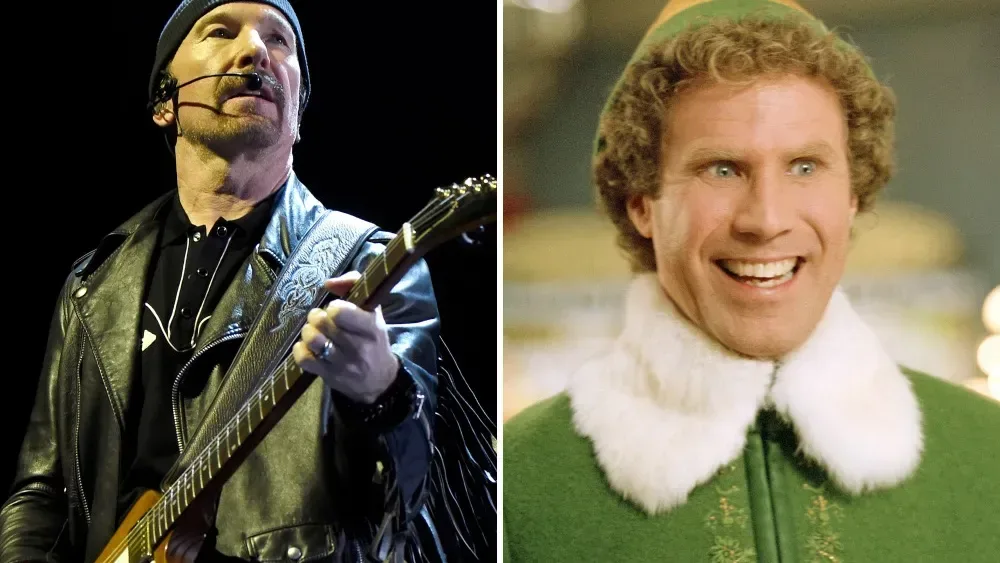
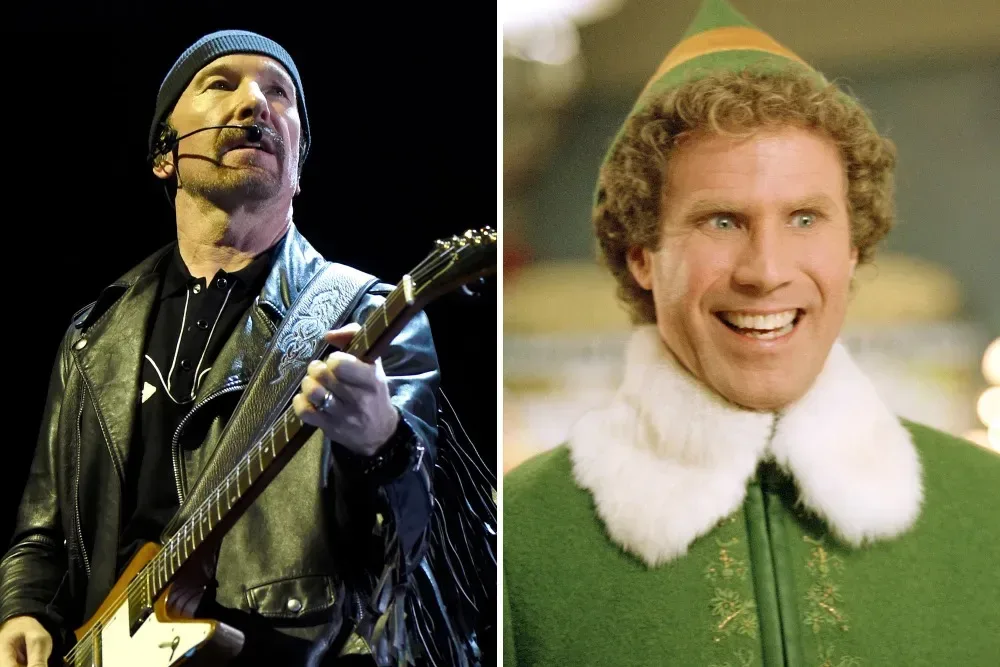
One of the stranger alternate timelines in modern holiday-movie history may involve U2 guitarist the Edge, a fully written Elf 2 screenplay, and a meeting that reportedly went nowhere.
Andy Richter has said that the Edge—whose given name is David Howell Evans—wrote a sequel to Elf. Richter’s account is not a confirmation that the script was bought, developed, or even shared publicly. In fact, that is the essential point: the screenplay is said to exist somewhere, but the proposed follow-up never materialized.
Richter described producer Shauna Robertson, who produced the original film, being contacted with the unusual news that the U2 member wanted to discuss his sequel script. Richter characterized it as fully written, while also explaining that the prospective conversation simply petered out. There is no indication here that the project advanced into production, casting, a release plan, or a public script release.
That makes this less a newly revived sequel than a glimpse at one of entertainment’s most tantalizing “what if” projects: an unmade continuation of a hugely durable Christmas film, written by a musician best known for his work in one of the world’s biggest rock bands.
What is actually known about the alleged screenplay
The available details are narrow, and that distinction matters. Richter says the Edge wrote a script for Elf 2 and that Robertson was approached about meeting him. He also says the project did not happen. Beyond that, there is no provided story outline, no list of characters, no stated title beyond the shorthand Elf 2, and no information about who controlled the script or whether it could ever be released.
In film terminology, a spec script is typically a screenplay written without a production commitment in place. Richter did not label the Edge’s work a spec script, so it would be wrong to declare that it was one. Still, the story illustrates the broader reality behind that term: a completed screenplay is not the same thing as a greenlit movie. A project can have a script, a famous writer, a potential producer meeting, and still never become a film.
The Edge’s screenplay should therefore be treated as an unmade project described by Richter, rather than as an official sequel with known creative or commercial plans. The fun of the revelation is precisely its incompleteness. A script associated with the guitarist is reportedly out there, but audiences do not know what he envisioned for Buddy, New York, the North Pole, or any other part of the original movie’s world.
There was reportedly another sequel idea, too
Richter also spoke about a separate sequel screenplay written by Scot Armstrong. His summary of that idea involved evil South Pole elves kidnapping Santa, though he presented it loosely rather than as a detailed synopsis.
Armstrong’s connection is notable because Richter said he helped write Elf but did not receive screen credit for guild and procedural reasons. That comment adds another layer to the sequel history: the Edge was not the only person to imagine a return to the property, and Armstrong had a reported creative connection to the first film.
Neither script should be confused with the other. They were reportedly distinct projects by different writers, with different premises—or, in the Edge script’s case, no publicly described premise at all. The presence of more than one attempted screenplay also does not mean a sequel came close to filming. It means the idea had creative interest at different points, which is very different from having the approvals and momentum necessary to make a movie.
Why the original remains a difficult film to follow
Jon Favreau directed Elf, which reached theaters in 2003. Will Ferrell stars as Buddy, a human raised among elves at the North Pole who travels to New York City to find his biological father, Walter Hobbs, played by James Caan. Zooey Deschanel and Mary Steenburgen are among the film’s other stars, while Richter appears briefly as one of Walter’s colleagues.
The basic setup gives Elf an unusually clean arc. Buddy arrives in New York with a childlike understanding of the world, collides with his father’s hardened adult life, and becomes the disruptive but sincere force pushing that family toward connection. It is a fish-out-of-water comedy, but it is also a father-and-son story and a Christmas fantasy. Those elements are tightly tied together.
That structural completeness helps explain Richter’s reluctance to pursue a sequel now. His position is uncomplicated: let Elf remain Elf. He argues that the movie has become too special and beloved to justify the risk of altering its standing with a late follow-up.
That is analysis, not a statement that sequels are inherently bad. A sequel can expand an original’s premise, change perspective, or find a fresh conflict. But a follow-up to a holiday staple faces a particular challenge. Viewers often return to such films as seasonal rituals, not merely as installments in an ongoing franchise. The original is revisited because its tone, jokes, emotional resolution, and familiar setting already deliver a complete annual experience.
A second film must therefore do more than repeat candy, Christmas cheer, and North Pole imagery. It would need a reason to exist that does not weaken the finality of Buddy’s first journey. Richter’s concern is that a sequel could make a beloved movie feel less singular without offering enough in return.
A script existing is not the same as a movie needing to exist
Richter’s story is a useful reminder that entertainment history is full of projects that remain at the screenplay stage. The path from an idea to a released feature is long: it may require producer enthusiasm, rights clearance, studio participation, financing, scheduling, casting, and agreement on the creative direction. Any one of those points can stop a project. In this case, Richter’s recollection is that the Edge’s proposed discussion did not progress.
That reality also protects the mystery. Since no plot details have been made public, fans can imagine anything from a quiet continuation of Buddy’s family life to a completely different Christmas adventure. But imagined versions are not evidence of what was on the page. Until the screenplay itself is publicly available, the only responsible description is that Richter says it was written and never became a film.
The story also arrives as Richter revisits the making of the original. He co-wrote Elf Unwrapped: Behind the Scenes of a Modern Christmas Classic, a book released Tuesday. His perspective is consequently unusual: he had a small on-screen role in the movie, has returned to examine its production history, and is nevertheless among the voices arguing against reopening the story on screen.
Musicians crossing into unexpected corners of film is hardly a reason on its own to make a project happen, but the reported Edge script has obvious novelty value. The curiosity is not just “what would an Elf sequel be?” It is “what would an Elf sequel written by the Edge be?” For more music-world crossover news, see this report on Mia X, Birdman and the Cash Money/No Limit Verzuz plans.
The lasting appeal of an unanswered ‘what if’
For now, the Edge’s Elf 2 appears to belong to the category of finished-but-unseen creative work. Richter would like the script to see the light of day, at least in the sense that people could learn what it contained. But he does not make the case for converting it into a movie. On the contrary, he sees the long passage of time as a reason to preserve the original rather than extend it.
That combination is what makes the anecdote so compelling. A lost screenplay can be fascinating without becoming a production demand. Fans can be curious about the South Pole idea from Armstrong, more curious still about the Edge’s unreported premise, and still agree with Richter that Elf does not require another chapter. Sometimes the most fitting sequel to a holiday classic is the yearly return to the first one.