Lee Chang-dong’s Possible Love is a relationship drama whose scale is measured less by plot mechanics than by the emotional distance between people. The film begins from the domestic pressure of a family suddenly cut loose from industrial work, then opens outward into questions of class, longing, humiliation and the unsettling things people reveal when they believe nobody important is watching. At 164 minutes, it has room to observe small changes in posture, speech and expectation—not as incidental detail, but as the substance of its story.
Jeon Do-yeon plays Mi-ok, a woman married to Ho-seok, portrayed by Sul Kyung-gu. Ho-seok has lost his heavy-industry job after an unsuccessful strike at the region’s dominant factory. The layoffs have had catastrophic consequences in the community, including a spate of suicides. Their son, Cheol, played by Jung Seop, is quiet and intensely attentive. He hides in closets and remains near doorways, listening to adults who assume a child is not there. That habit makes him an unusually important presence in a film fascinated by what families say around the truths they cannot confront directly.
The premise has the ingredients of a social drama, and Possible Love does not remove those conditions from view. The story is rooted in the economic damage inflicted by layoffs, the instability faced by workers and the hierarchy separating those with security from those expected to make do without it. Yet Lee’s approach is not built around speeches or easy moral sorting. His characters are not reduced to positions in an argument. Their financial circumstances shape their choices and their self-images, but every interaction retains an awkward, private texture.
Two marriages, divided by far more than money
The route into a more affluent world arrives at a funeral. Ho-seok, drinking soju and estranged from former strike comrades, becomes involved in an altercation. Mi-ok helps defuse it. The episode draws the notice of Ye-ji, an aspiring documentarian played by Cho Yeo-jeong. Well-off and polished, Ye-ji is making a serious-minded documentary about the human toll of corporate downsizing. Ho-seok refuses her invitation to participate. Mi-ok, however, agrees to be interviewed, and an uneven friendship begins.
That relationship holds one of the film’s sharpest tensions. Ye-ji’s project may be framed as compassionate, but the basic arrangement remains uncomfortable: a wealthy filmmaker gains access to another woman’s hardship and can turn it into a narrative she controls. Possible Love appears alert to the ethical complication without turning Ye-ji into a simplistic villain. Good intentions, social curiosity and the urge to make meaning from another person’s suffering can coexist with patronage and intrusion. The movie leaves those competing impulses alive in the room.
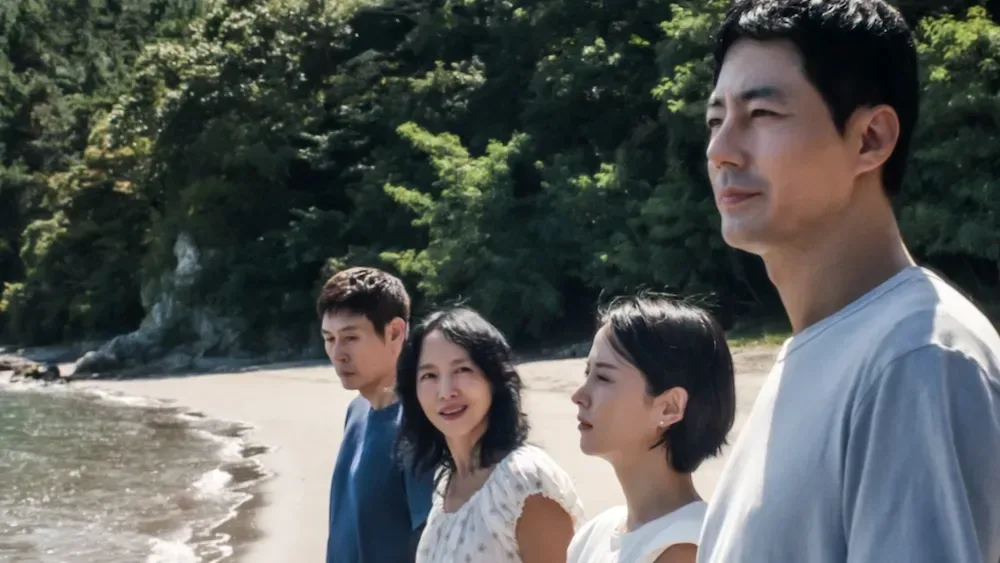
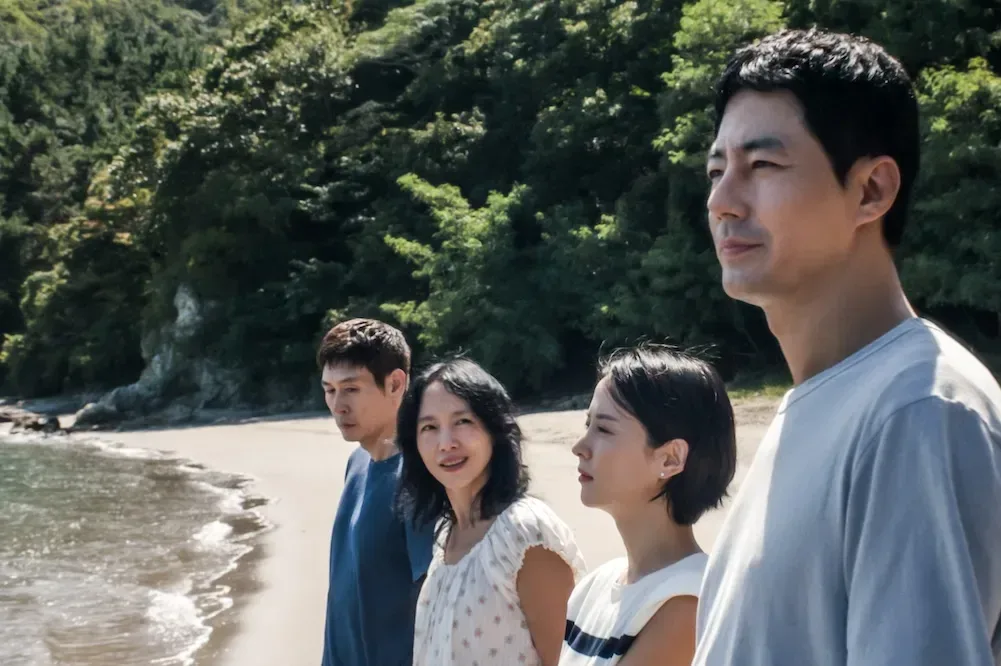
Mi-ok’s connection with Ye-ji also introduces Sang-woo, Ye-ji’s wealthy husband, played by Zo In-sung. He seems supportive of his wife’s ambitions, though that support has a casual, faintly condescending edge. Initially, he treats Mi-ok and Ho-seok with courteous detachment. Then Mi-ok’s interest in him—part fascination, part flirtation, part attraction to what his life represents—alters the emotional weather around both couples.
Meetings at dinner and at the affluent pair’s remarkable seaside home bring the four adults into a web of alliances that can shift with a glance. The property has a wooded path, private shoreline and a guard post staffed by Min-sik, played by Kang Chang-gwon. Min-sik is Sang-woo’s childhood friend, now positioned as his deferential employee. That detail extends the movie’s concern with hierarchy beyond the central marriages: even intimacy from the past can be reshaped by differences in status.
Cheol watches this changing adult world from its edges. His presence gives the film a quietly unsettling perspective. Children may not understand every word, but they absorb tones, desires and betrayals with exceptional clarity. He sees what his parents do not say to one another, and he sees the allure of a life his family has been taught is not for them.
Related coverage includes ‘Possible Love’ Review: Lee Chang-dong Examines Desire, Class and the Cost of Looking Elsewhere.
The ache of wanting what another person has
Possible Love carries a dedication to Dekalog 10, the Krzysztof Kieślowski and Krzysztof Piesiewicz work associated with the Tenth Commandment: “Thou shalt not covet.” The film is part of a planned 10-picture, multi-director project following Asghar Farhadi’s Parallel Tales. Lee’s story is not a retelling of the plot of Dekalog 10; its connection is conceptual. Coveting is an especially apt concern because it is internal. Theft, murder and adultery can be identified as acts. Envy begins as an invisible recognition that someone else possesses a life, an object or a freedom that feels unavailable to you.
Mi-ok’s journey gives that recognition tangible force. She takes pride in her modest home, including a marble picnic table Ho-seok made when he still imagined it would become a place where friends gathered easily. After time in Ye-ji and Sang-woo’s orbit, her own home can no longer look the same. Nothing in it has physically changed, yet the comparison has changed her vision. The film understands that class consciousness is sometimes delivered through a single visit: a beautiful house, a view of the sea, an effortless abundance, and the painful realization that one’s old contentment may have depended on not seeing alternatives.
A memory from Mi-ok’s childhood deepens the theme. Her mother made a living washing cars and reacted harshly when young Mi-ok imitated that work. The adult Mi-ok understands the fear beneath that response. Her mother did not want her daughter to inherit the same limited future. But the film raises a difficult question: when parents teach children to want a larger life, what happens if the social order remains structured to deny them the means to reach it? Is aspiration liberating, or can it become another form of injury?
That question echoes when Cheol spends time with Min-sik at the villa, watering the manicured grounds. Mi-ok sees him and chooses not to stop him. The moment is modest on its surface, yet it speaks to the strange mixture of hope and dread in watching a child imagine a life different from the one available at home.
Performance and craft make the interior visible
Jeon Do-yeon’s performance is central to the film’s ability to make inward movement compelling. Mi-ok can seem bright, agreeable and socially nimble; beneath that exterior, the film locates a much more intricate instability. Her responses to wealth are not confined to resentment. There is admiration, embarrassment, sensual curiosity, self-protection and a desire to preserve dignity even after dignity has become difficult to maintain. The character’s contradictions are not treated as evidence against her. They are treated as human.
Sul Kyung-gu gives Ho-seok a corresponding reserve. His silence can initially register as sullenness, but the story gradually reveals the accumulated hurt inside it. His experiences with the strike, dismissal and loss around him are not background information. They are forces that have changed how he can speak, how he regards friends and how he occupies his own home. The role reunites Sul with Lee after Peppermint Candy and Oasis.
The restrained visual approach is credited to cinematographer Kim Ji-yong, while Kim Da-won edits and Jung Jae-il provides the music. Their work suits a film that gains power by refusing to underline every implication. Spacious homes, guarded landscapes and ordinary rooms are allowed to carry their own social meaning. Lee and co-screenwriter Oh Jung-mi build scenes where an unfinished sentence, an overlooked child or a polite exchange can matter as much as a major confrontation.
For viewers interested in demanding, actor-driven cinema about the stories people invent around status and happiness, Possible Love belongs alongside other recent character-focused film coverage, including this look at Julianne Moore’s community-theater drama The Debut. The settings and sensibilities are very different, but both point toward stories where performance—onstage, onscreen or in everyday social life—becomes inseparable from the self.
A drama that refuses easy consolation
The title Possible Love suggests opportunity, but Lee’s film is equally concerned with possibility’s limits. Mi-ok and Ho-seok do not simply face a choice between being good and being bad, or staying faithful and stepping outside their marriage. They face the harder task of deciding what desires are worth trusting after the world has taught them to see their own lives as insufficient.
Its compassion lies in recognizing that envy does not make someone shallow, just as hardship does not automatically make someone morally pure. Wanting more can be understandable. It can also make people vulnerable to manipulation, disappointment and the fantasy that another person’s house, partner or social standing will resolve wounds that began elsewhere. The film’s strongest idea may be that freedom from coveting is not a command someone can obey on demand. It is a fragile kind of knowledge, earned by seeing illusions clearly without pretending they never mattered.
Possible Love screened in competition at the Venice Film Festival and is a South Korean production presented by Netflix, Pinehouse Film, Anonymous Content and Nowfilm. Lee Joon-dong, David Levine and Chadwick Prichard are producers. The cast also includes Kang Chang-gwon and Jung Seop, with Korean-language dialogue. Its quietness should not be mistaken for smallness: this is a drama built from restrained encounters, but it aims at the enormous question of whether a person can recover gratitude without surrendering the right to dream.