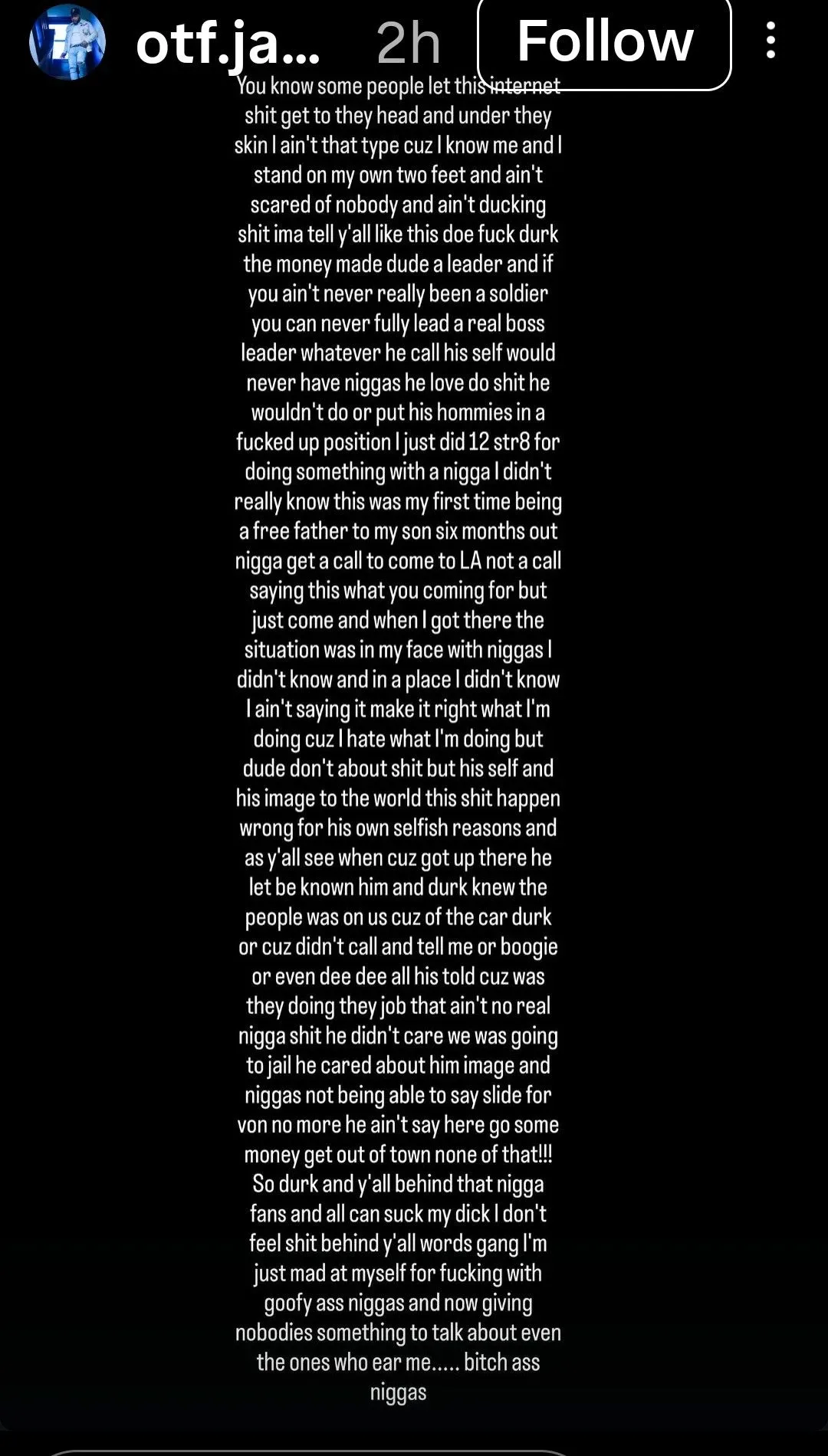
Kacey Hester, known as OTF Jam, has publicly criticized Lil Durk in social-media posts made days after Hester testified in the federal case involving the August 2022 shooting near Los Angeles’ Beverly Center. The posts arrive at a consequential point in the proceeding: both sides have rested, and closing arguments are scheduled to begin Tuesday, September 8.
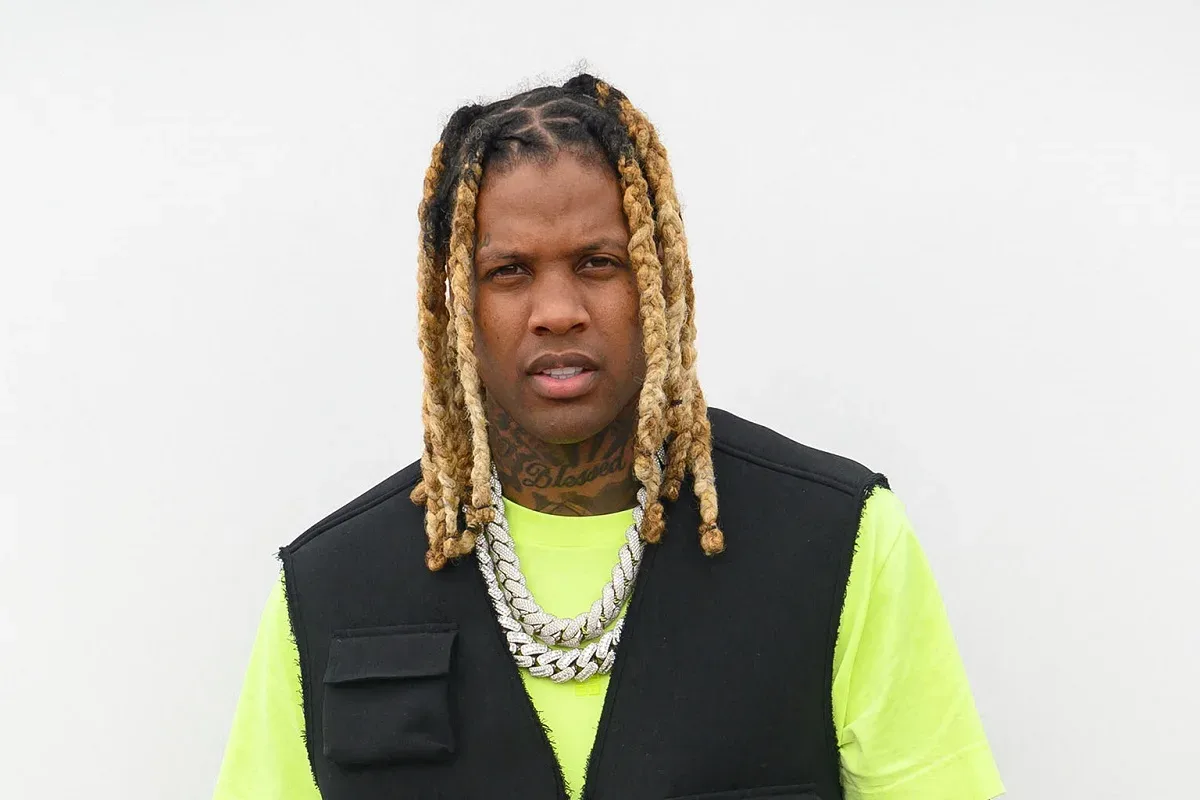
The case concerns an alleged operation aimed at Tyquian “Quando Rondo” Bowman. Bowman survived the shooting, while his cousin, Saviay’a “Lul Pab” Robinson, was killed. Lil Durk has pleaded not guilty to federal stalking and murder-for-hire charges connected to Robinson’s death. Those are allegations in an active criminal case, not findings of guilt.
What Hester said publicly
In posts shared Sunday, Hester directed blunt criticism toward Durk. He argued that money had elevated Durk into a leadership role, then described his own frustrations about becoming involved in the alleged scheme soon after his release from prison.
Hester wrote that he had recently completed a 12-year sentence and was trying to experience life as a newly free father to his son. In his account, he was contacted roughly six months after his release and told to travel to Los Angeles. He said that, once there, he found himself in a situation involving people and surroundings unfamiliar to him.
His posts combined an acknowledgment of personal responsibility with allegations of abandonment and misplaced priorities. Hester said he did not believe his own conduct was justified, while also accusing Durk of caring chiefly about his reputation and the public expectation that associates should retaliate over the November 2020 death of Dayvon “King Von” Bennett.
Hester also claimed that Durk did not provide money or help for him to leave. Those statements are Hester’s public assertions. They should be understood in the context of a pending criminal case, his testimony, and an online dispute—not as independently established facts.
The testimony and the alleged motive
Hester testified about the Los Angeles operation directed at Bowman, who performs as Quando Rondo. His testimony reportedly connected the alleged plan to Bennett’s death in 2020. Bennett, known professionally as King Von, was killed in Atlanta after an altercation outside a nightclub.
The prosecution’s theory, as reflected in the allegations described in court, is that the 2022 Los Angeles shooting was motivated by retaliation for Bennett’s death. Hester said Durk helped put that plan in motion. The defense position is materially different in the most important respect: Durk has entered a not-guilty plea to the federal charges.
That distinction matters. A witness’s account can be important evidence, particularly in a case alleging coordination among multiple people, but testimony is evaluated alongside all other evidence presented in court. The jury is tasked with determining what has been proved beyond a reasonable doubt, while attorneys use closing arguments to frame their competing readings of the record.
Key events described in the case
- November 2020: Dayvon “King Von” Bennett is killed in Atlanta.
- August 2022: A shooting near the Beverly Center in Los Angeles targets Tyquian “Quando Rondo” Bowman, according to the allegations described in the case.
- August 2022 outcome: Bowman survives; his cousin, Saviay’a “Lul Pab” Robinson, is killed.
- September 7, 2026: Hester’s public posts criticizing Durk circulate after his testimony.
- September 8, 2026: Closing arguments are set to begin after both sides rest.
Why the timing is notable
Public commentary from a testifying witness is inherently attention-grabbing, especially when it appears between the close of evidence and closing arguments. Yet the posts do not alter the fundamental procedural picture: the evidence phase has concluded, the lawyers are preparing to address the jury, and Durk remains presumed innocent.
Closing arguments do not introduce a new round of evidence. Instead, prosecutors and defense attorneys use them to explain why the evidence supports their respective positions. The prosecution will seek to show that the alleged acts and intent required by the charges have been established. The defense will seek to highlight weaknesses, alternative interpretations, credibility issues, or reasonable doubt.
Hester’s posts could draw additional scrutiny because they touch on several themes already likely to matter to observers: leadership, loyalty, retaliation, the consequences faced by people around a high-profile artist, and the reliability and motivations of witnesses. But social posts are not a substitute for the court record. What the jury heard in the courtroom—and the instructions it receives from the judge—will govern deliberations.
A high-profile case with personal stakes
The people named in the case occupy overlapping worlds of rap, friendship networks, public identity, and criminal allegations. That overlap can make it easy for online conversation to treat a complicated legal proceeding as if it were a running feud. The reality is more serious and more constrained: the case concerns a fatal shooting, a surviving target, and federal allegations carrying potentially severe consequences.
Hester’s account also foregrounds a personal claim about reentry after incarceration. He says he had served 12 years, had only recently returned home, and had hoped to be present for his son. His description of those circumstances is his own, but it helps explain why his posts emphasize regret, resentment, and a sense that he was left to absorb the consequences alone.
At the same time, Hester’s criticism of Durk is part of a broader narrative he has advanced after taking the stand. Readers should resist converting that narrative into a verdict before the legal process reaches its next stage. The charge is not proof, a witness’s accusation is not automatically conclusive, and a public post—however emotional or direct—is not a judicial finding.
The wider music world has frequently had to navigate the uneasy boundary between public persona and legal reality. Hip-hop’s material culture often captures its celebratory side, from recordings to memorabilia; for example, interest in Lil Wayne’s 1999 handwritten lyrics and their ownership dispute reflects how closely fans follow artists’ history beyond new releases. This case, however, is not a collectible-market story or a question of legacy alone. It is an unresolved federal criminal matter involving the death of Robinson.
What comes next
With testimony complete, the immediate milestone is closing arguments on September 8. After the lawyers finish their presentations and the judge instructs the jury on the applicable law, jurors will weigh the admissible evidence and deliberate.
For now, the most precise reading of developments is limited but important. Hester has testified and then publicly rebuked Durk. He has described regret about his own alleged involvement and alleged that Durk placed image and retaliation above the welfare of associates. Prosecutors contend that the 2022 operation was connected to revenge for King Von’s death. Durk denies the federal charges through his not-guilty plea.
As closing arguments approach, attention will naturally intensify around every statement from the people involved. Still, the controlling questions remain legal ones: what the evidence establishes, whether witness testimony is credible, whether the government has met its burden, and whether the jury finds reasonable doubt. Those answers will come from the courtroom process rather than the latest round of social-media posts.