Content note: This article discusses Nazi persecution, Auschwitz-Birkenau and Josef Mengele.
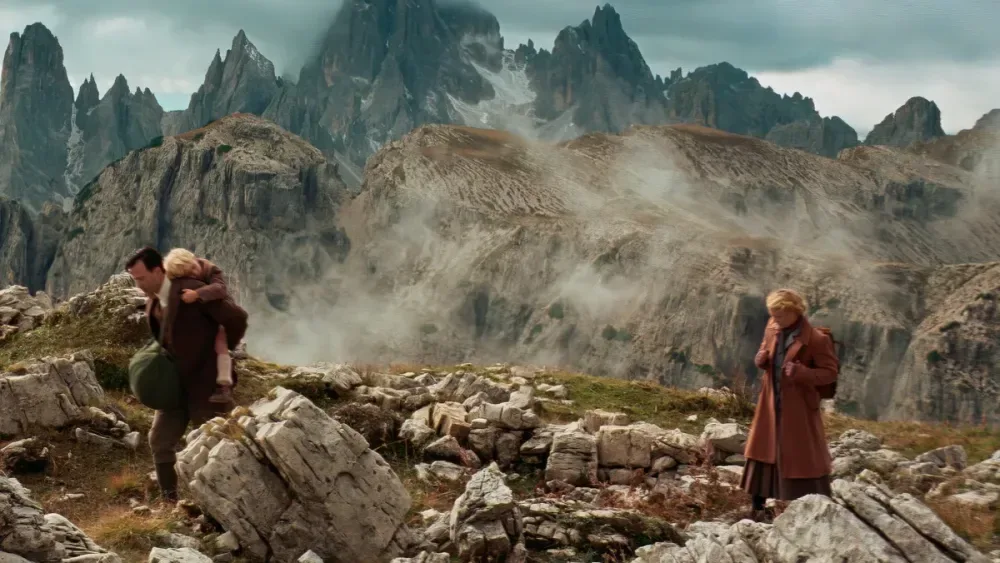
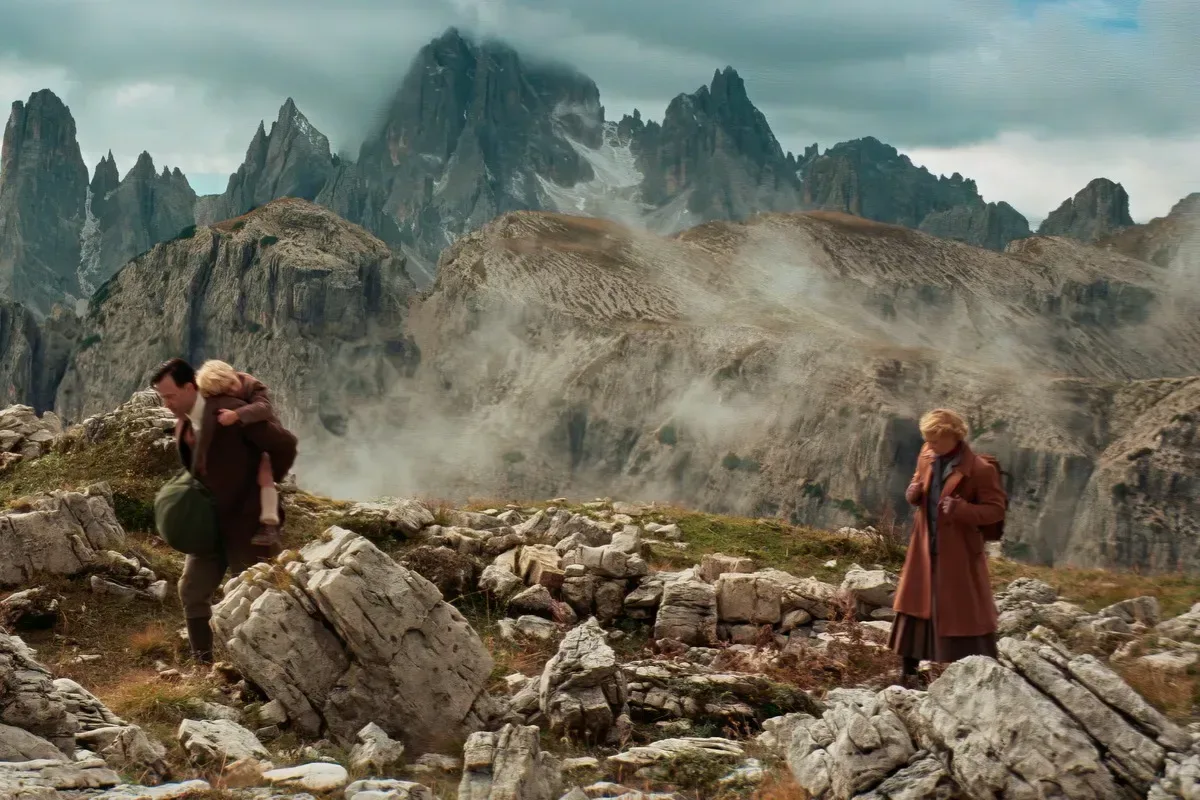
Harald Swinkels’ Odessa begins by inviting a swift, instinctive response: concern for a tired family moving through an Alpine landscape with a young child. Their circumstances look precarious. The setting is quiet, the peaks and meadow picturesque, and the parents appear intent on getting their exhausted son somewhere safe.
That initial identification is not incidental. It is the dramatic mechanism at the center of this 1949-set film. Swinkels, who wrote and directed Odessa, constructs the opening around an uncomfortable question: what happens when an audience extends empathy before it has enough information to understand whom it is empathizing with?
The answer arrives through the word O.D.E.S.S.A., an acronym the family uses while seeking food and shelter at a Catholic church. In the film, the reference points to the long-rumored Organization der ehemaligen SS-Angehörigen, purportedly a clandestine network that helped former SS officers escape Europe after World War II. The family’s flight is then recast: the man at its center is Josef Mengele, the Auschwitz-Birkenau doctor associated with brutal experiments on prisoners and known as the “Angel of Death.” Bastian Beyer plays Mengele, while Magdalena Müller plays his first wife, Irene.
It is an intentionally destabilizing reveal, and one that makes the film’s apparent simplicity matter. A family seeking refuge is among cinema’s most recognizable appeals to compassion. Odessa uses that familiar setup not to dismiss empathy, but to examine the visual and social shortcuts that can shape it.
A thriller built around recognition arriving too late
Swinkels has described his approach as an “empathy trap.” The phrase is provocative, but it identifies a clear storytelling choice: viewers are asked to emotionally align with people before their moral identity is disclosed. That delay turns the film’s early images into a test of assumptions about innocence, danger and appearance.
The director’s stated starting point was a discussion during the Syrian refugee crisis about whether people’s willingness to receive refugees might change if those refugees resembled themselves. A subsequent election result in the Netherlands also sharpened his concern that charisma can be confused with character. Those modern impulses do not change the film’s postwar setting; rather, they explain why Swinkels chose this particular historical frame.
The practical implication of that structure is important. Odessa is not using history as distant costume drama alone. It is designed to make an audience feel the gap between a sympathetic first impression and later knowledge. Swinkels’ warning is directed at the ease with which a person can seem ordinary, caring or persuasive while concealing monstrous acts and beliefs.
“If history has taught us one thing, it’s that monsters don’t come dressed as monsters,” Swinkels has said.
That idea also places substantial responsibility on the film’s framing. A story about a Nazi perpetrator can easily drift toward fascination or unearned rehabilitation if it mistakes domestic tenderness for moral complexity. Swinkels’ stated intention is the opposite: the moments of apparent kindness are meant to make the eventual recognition of Mengele’s crimes more sickening, not more forgivable.
The historical reality behind the family’s escape
Odessa is set in 1949 and draws on the period in which Mengele hid in Europe with Irene and their child. The film depicts a farewell in a meadow before he leaves on his own for South America. Swinkels said he transposed an account of a supposed farewell in Bavaria to the Dolomites, and incorporated Irene’s reported wish to live a “normal, open life” rather than join him in South America.
The boundaries here matter. A historical drama can be grounded in documented circumstances while still using reconstruction and interpretation to create scenes. The meadow farewell is presented as a dramatized version of material Swinkels encountered in his research, not as a claim that a camera-recorded original event exists. The film’s period setting and escape narrative, meanwhile, are anchored in the known fact that Mengele evaded capture.
He ultimately escaped justice during his lifetime. Mengele died in Brazil in 1979 after suffering a stroke while swimming. That outcome gives Odessa a particularly grim backdrop: its suspense does not lead toward a promised courtroom reckoning. The historical endpoint is that one of the perpetrators of Auschwitz-Birkenau lived free for decades after the war.
Swinkels said he spent nearly a year researching the project, including a visit to Auschwitz, because he did not want to assign a superficially positive trait to Mengele without basis. His research led him to accounts that Mengele could behave kindly toward children before sending them to their deaths. The horror in that contradiction is central to the film’s argument. Small gestures of warmth do not offset crimes; they underscore how inadequate charm, manners and isolated acts are as measures of a person’s character.
Why the opening landscape is meant to feel wrong
The visual strategy begins with contrast. Swinkels chose a meadow associated with The Sound of Music, a cultural reference that carries an immediate suggestion of Alpine beauty and musical warmth. Yet Odessa removes the expected uplift. Birds are the key sound in the opening, and the resulting quiet is intended to nudge the scene toward unease rather than nostalgia.
That is a useful example of how a thriller can use tonal dissonance. The term describes a mismatch between elements that normally belong together: a beautiful pastoral view paired with dread, or an apparently loving family paired with a hidden history of atrocity. In Odessa, the mismatch is not a decorative flourish. It supplies information before the plot openly does. Something is misaligned, even if the viewer cannot yet say why.
The film reportedly intensifies that discomfort by cutting to black-and-white images of the central figure walking between railway tracks. At first he is distant and out of focus; later, the Nazi uniform comes into close view. The technique turns an image from implication to confrontation. Black-and-white photography can evoke archival imagery and the period itself, but its function here is more direct: it brings the visual reality of the regime’s insignia into a narrative that has initially presented a private family drama.
Swinkels has said the production used period costumes throughout, including the uniform Beyer wears as Mengele. His response to seeing it during a dress rehearsal—closing the curtains at his Amsterdam home—speaks to the ethical weight of working with such imagery. The uniform is not simply production design. It is a symbol inseparable from the system of persecution and murder it represented.
35mm and 4-PERF: what the format adds
Odessa was shot on 35mm film in 4-PERF. In straightforward terms, 35mm is a physical motion-picture film format rather than a digital capture format. “4-PERF” refers to four perforations—the sprocket holes that advance film—per frame in a traditional camera format. Swinkels pursued it for a vintage visual character appropriate to a story set shortly after World War II.
The choice affected the work as well as the image. Swinkels said each roll ran for roughly four minutes, requiring cast and crew to remain particularly alert. That limitation is a concrete production pressure: takes cannot continue indefinitely, and every setup carries the knowledge that the available film is moving quickly. It does not automatically make a performance better, but it can change a set’s rhythm and concentration.
The Dolomites themselves supplied another challenge. The location shoot lasted six days and encountered sharply changing weather, from conditions requiring sunscreen to a snowstorm only days later. Such instability has obvious logistical consequences, but it also suits a film whose visual world is meant to feel beautiful, exposed and inhospitable. The mountains do not function as a tourist postcard; they are part of the family’s precarious route and the setting for a moral unmasking.
Empathy is not absolution
There is an essential distinction in the premise of Odessa: understanding the emotional mechanics of a fleeing family is not the same thing as absolving the person being protected by that family. A child’s exhaustion, a wife’s fear or the urgent need for shelter can all be emotionally legible. None erases Mengele’s responsibility for his crimes.
That distinction may be the most productive way to approach the film’s difficult setup. Swinkels is not asking viewers to regard Mengele as misunderstood. He is asking them to notice how rapidly storytelling cues—an endangered child, an attractive landscape, a parent’s reassuring manner—can establish trust. The later revelation is meant to make those cues feel insufficient, not deceptive in a way that turns the audience into the real villain.
It also makes Irene’s position consequential. The supplied account identifies her as someone who wanted a normal, open life rather than flight to South America, and who later divorced Mengele. In a narrative organized around a notorious historical figure, that detail offers a separate tension: the difference between proximity to a criminal and a willingness to continue living as a fugitive beside him. The available information does not support reducing her experience to a simple answer, and the film’s historical situation is necessarily fraught.
For audiences, the central challenge is therefore less about solving a mystery than confronting a method. Odessa begins with empathy because empathy is powerful and often necessary. Its warning is that empathy based solely on appearance, familiarity or charm can be manipulated. The film’s period detail, muted Alpine opening and eventual visual shock all serve that one unsettling proposition.
Swinkels has said he hopes the end credits leave viewers silent and more willing to scrutinize the people who charm them—especially those seeking their votes. That ambition gives Odessa a contemporary edge without requiring it to turn its real historical subject into a metaphor. Mengele’s crimes remain the intolerable reality beneath the thriller’s construction. The film’s modern concern is about recognizing that moral danger rarely announces itself in advance.
For more entertainment coverage on this site, see our report on the next chapter of Invincible.