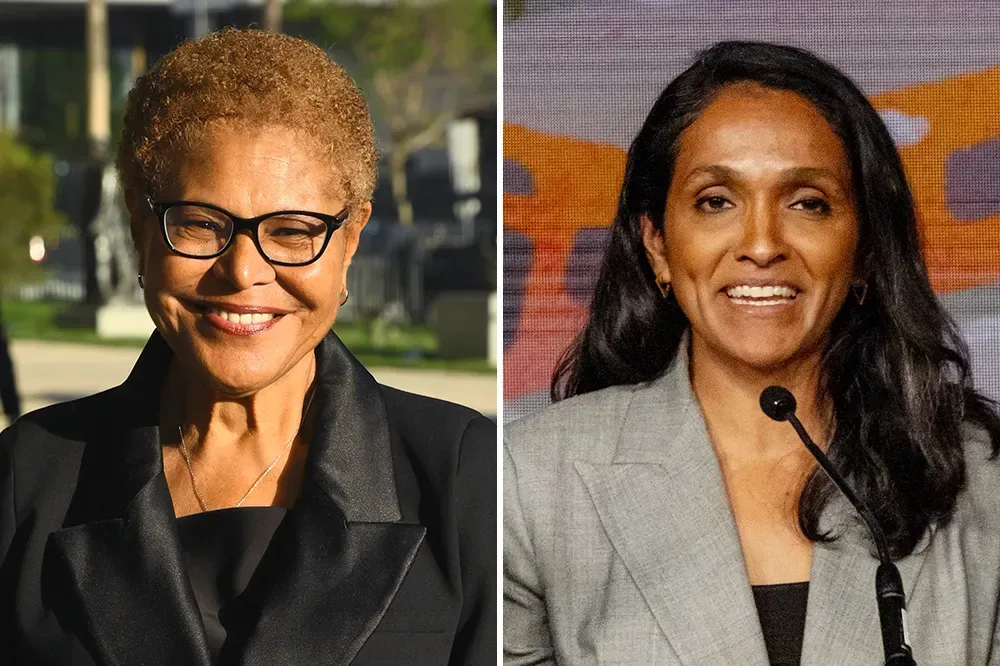
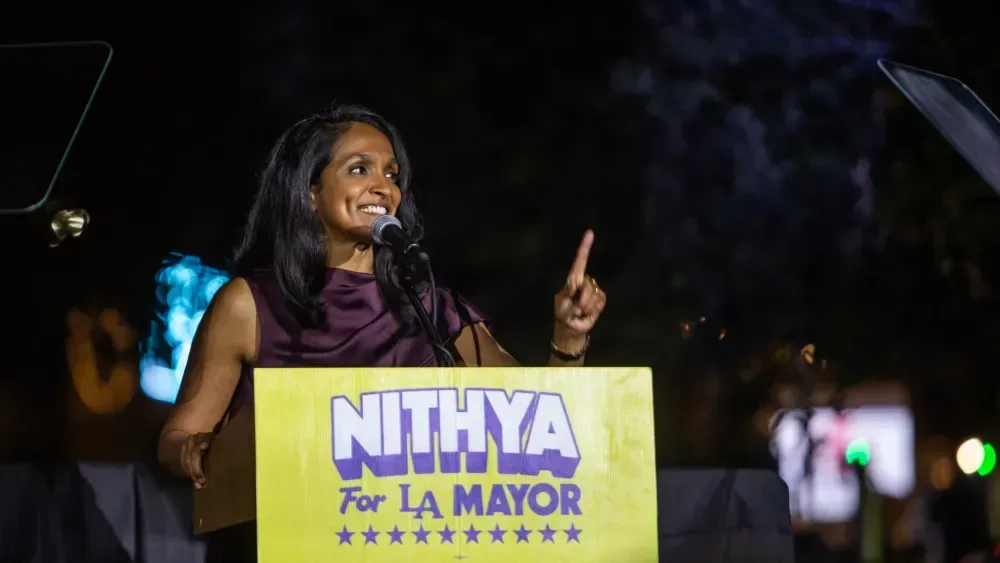
Nithya Raman will be Los Angeles’ next mayor after incumbent Karen Bass conceded the race, bringing a hard-fought campaign to a close even as thousands of ballots remained to be counted.
Bass said she had called Raman to congratulate her and pledged to support a smooth transition. Raman’s lead stood at 4.2% in a Thursday-morning update, after she moved ahead late on election night. The result puts a City Council member who entered the contest in February at the head of one of the country’s most consequential municipal governments.
For Los Angeles’ entertainment community, the outcome is notable not because the campaign was a Hollywood production, but because entertainment-industry figures were unusually visible among Raman’s backers. Tina Fey, Adam Scott, Mindy Kaling, Mike Schur, Colin Jost, Nicholas Stoller, Cord Jefferson and David Mandel were among the figures identified as endorsing or contributing to her campaign. That support did not substitute for a citywide coalition, but it made the contest a clear example of how the city’s creative world can participate in local political life.
A late entry who outlasted the expected script
Raman’s path to victory was not presented as inevitable. She entered the race late, in February, and for much of the primary appeared likely to finish third behind reality television personality Spencer Pratt. Instead, she consolidated voters looking for a Democratic alternative to Bass and ultimately passed the incumbent after the first election-night tallies.
Early results gave Bass a narrow advantage. That margin, however, was not large enough to offset Raman’s expected strength among later-arriving ballots, which skewed toward younger voters and renters. Raman took the lead later in the evening and expanded it as counts continued.
That sequence matters because election-night numbers are snapshots rather than final verdicts. A ballot count can change as later-returned ballots are processed and added. In this race, the reported pattern of younger voters and renters appearing more heavily in late-arriving ballots helped explain why a slim initial Bass lead did not hold.
The October 28 Berkeley IGS/L.A. Times poll had underscored how close the final stretch was: it found both candidates at 40%. Raman had led in several other fall polls, but the tie in that survey captured the uncertainty heading into voting.
At an election-night gathering in the plaza of Los Angeles’ Greek Theatre, Raman told supporters shortly after 11 p.m. that she was “very hopeful.” The eventual result turned that guarded optimism into a victory over a sitting mayor.
Related coverage includes Nithya Raman Wins Los Angeles Mayoral Race as Karen Bass Concedes.
The issues that defined the campaign
Public safety, homelessness and civic disorder were central to Bass’s attempt to retain office. Bass argued that Raman had opposed police funding and opposed anti-camping zones. Anti-camping zones generally refer to restrictions intended to prevent camping in specified public places; in the context of Los Angeles politics, the phrase connects directly to the broader dispute over homelessness policy, public space and enforcement.
Raman’s case was framed differently. She argued that Los Angeles needed new leadership and that City Hall should not be captive to its existing relationships. That message connected a set of voter frustrations—over homelessness, civic disorder and Bass’s handling of the 2025 Palisades fire—to a broader argument for change rather than simply a dispute over one policy.
The contrast was therefore both practical and institutional. Bass emphasized public safety and challenged Raman’s positions on policing and camping restrictions. Raman emphasized independence from entrenched City Hall ties and the need for a fresh direction. Voters delivered their answer in a race where neither candidate began with an overwhelming polling advantage.
What “City Hall establishment” means in this contest
The phrase City Hall establishment is often used loosely, but here it points to the network of established political relationships and expectations around municipal government. Raman’s late candidacy was striking precisely because it disrupted that expectation. She was already an elected official, but her campaign’s message positioned her as an alternative to the incumbent administration and to the governing relationships it represented.
That is a meaningful distinction. An anti-establishment message does not necessarily mean a candidate has no government experience. Raman had served on the Los Angeles City Council since 2020 and won reelection in 2024. Rather, the campaign made an argument about how power should be exercised and whose concerns City Hall should prioritize.
Raman’s background before the mayoral win
Raman joined the Los Angeles City Council in 2020, becoming the first Asian-American woman and the first South Asian person to serve on the body. She was elected to a second term in 2024.
Before entering politics, Raman worked as an urban planner. She holds degrees from Harvard and MIT, and her public work also included service as co-chair of the Silver Lake Neighborhood Council Homelessness Committee. She co-founded the SELAH Neighborhood Homeless Coalition.
Those details help explain why housing and homelessness were not peripheral topics for her campaign. Urban planning concerns how places are organized and developed, including the relationship among housing, transportation, land use and public infrastructure. It does not, on its own, dictate a political platform, but it provides relevant professional context for a candidate making the case for new approaches to some of Los Angeles’ most persistent civic challenges.
Her neighborhood-level homelessness work is similarly relevant. It places her prior public engagement close to one of the issues that dominated the mayoral contest, rather than treating the subject solely as a campaign talking point.
Hollywood support, and what it does—and does not—show
Los Angeles is inseparable from the screen industries that operate within it, yet celebrity involvement in local elections can be overstated. The endorsements and contributions Raman received from notable writers, performers and filmmakers were a high-profile part of her campaign, but the victory still depended on the city’s electorate, including the younger voters and renters associated with the late ballot shift.
The supporter list is nevertheless revealing. Fey, Scott, Kaling, Schur, Jost, Stoller, Jefferson and Mandel represent a mix of comedy, television, film and writing. Their participation put recognisable creative-industry names behind a municipal candidate whose campaign centered on governing questions: public safety, homelessness, City Hall relationships and leadership after a difficult period for the incumbent.
That distinction is worth keeping intact. A celebrity endorsement can draw attention, help broaden a campaign’s network and signal cultural affinity. It cannot by itself answer questions about how a mayor will handle policing, homelessness or civic disorder. Raman’s win rests on the electoral coalition she built around those issues—not merely on a list of well-known supporters.
For readers who follow the business and culture around Los Angeles entertainment, the result is a reminder that the city’s creative community is also a constituency of residents, workers and voters. The same city that anchors major film and television work also makes decisions about public space, transportation, housing and safety that shape everyday life around that work. Joking Joystick has recently covered how screen figures remain active in the broader culture, including Jason Momoa’s discussion of a fight sequence in Dune: Part 3; the mayoral campaign shows the civic side of that larger Los Angeles ecosystem.
Bass leaves office after a difficult reelection bid
Bass has served as Los Angeles mayor since 2022. Her reelection effort faced sustained voter unhappiness over homelessness and civic disorder, as well as criticism concerning her handling of the 2025 Palisades fire.
In conceding, Bass said the people of Los Angeles had spoken and committed to a seamless transition. That pledge is consequential in a city where the incoming administration will immediately inherit public expectations shaped by the very issues that dominated the campaign.
The concession also settles the immediate political question despite the ongoing count. Raman’s margin had grown to 4.2%, and Bass’s statement recognized the outcome. Remaining ballots may still refine the final margin, but they do not alter the fact that Los Angeles is preparing for a new mayor.
What the result signals—and what remains unknown
Analysis: Raman’s victory signals that a meaningful segment of Los Angeles voters wanted a change in leadership after Bass’s term, and that message proved broad enough to overcome the advantages usually associated with incumbency. The movement in late-counted ballots also suggests that turnout and ballot-return patterns were especially important to the race’s final shape.
It would be premature, however, to treat the election as a detailed blueprint for every decision Raman will make as mayor. The campaign established broad contrasts over policing, anti-camping zones, homelessness and City Hall influence. It did not, in the information available here, provide a full account of implementation plans, timelines or budget choices. Those are questions for the incoming administration and the city’s governing process.
What is established is the historic and political shape of the moment: Raman, a two-term City Council member with an urban-planning background and prior homelessness-advocacy work, has defeated Bass and will become the next mayor of Los Angeles. Her rise from late entrant to winner reshaped a contest that at one point seemed likely to produce a very different result.