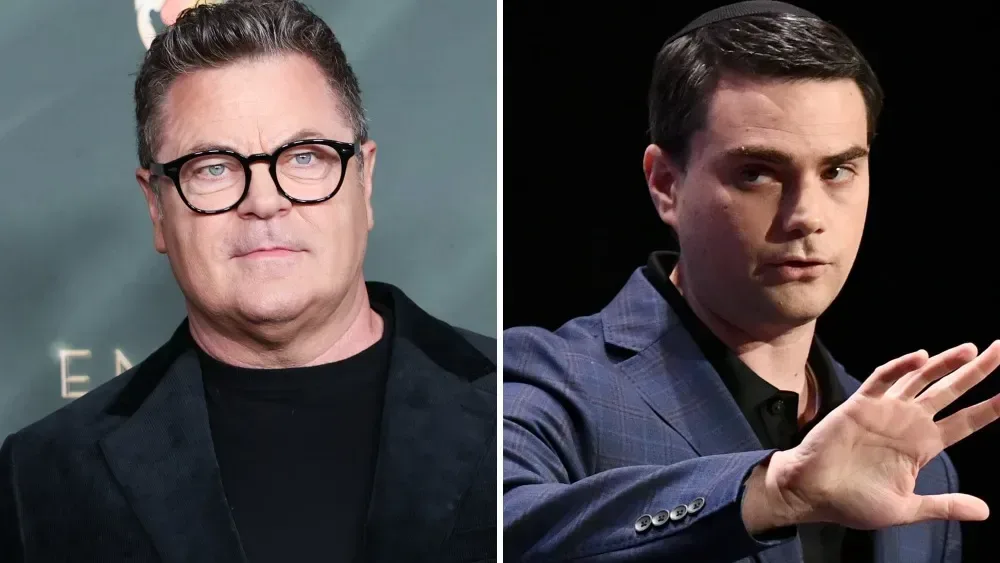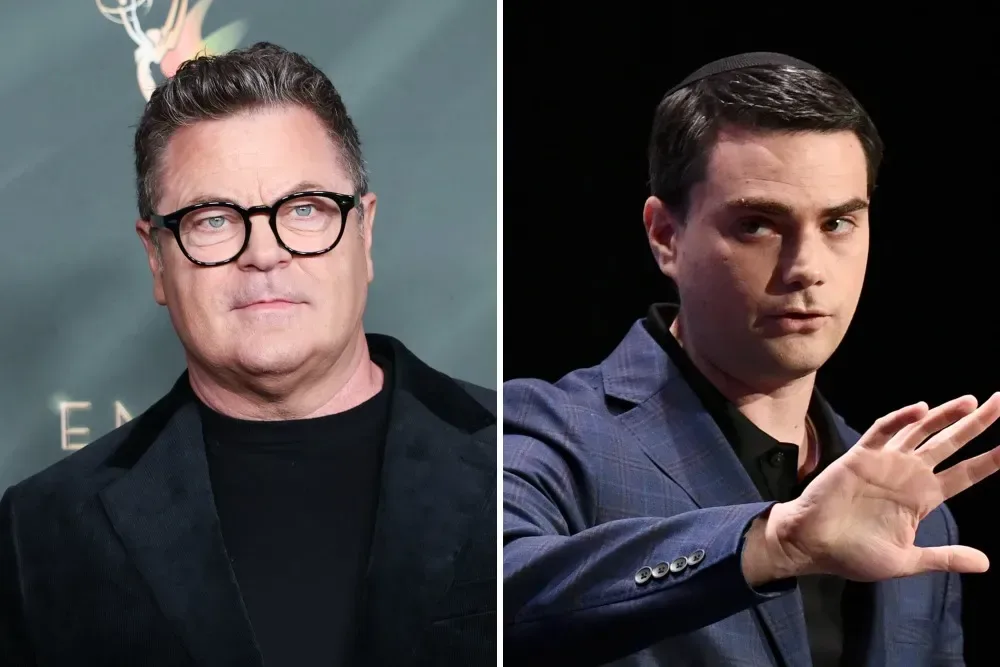
Nick Offerman has offered a blunt response to Ben Shapiro’s criticism of The Last of Us episode “Long, Long Time,” characterizing the commentator’s remarks as homophobic and arguing that his description of the episode badly misunderstood its story. The exchange centers on one of the first season’s most celebrated detours: the standalone, decades-spanning romance between Bill, played by Offerman, and Frank, played by Murray Bartlett.
Offerman addressed a video of Shapiro discussing the episode while appearing on the Talk Easy With Sam Fragoso podcast. Seeing the clip for the first time, Offerman said he was struck by the inaccuracies in Shapiro’s account as well as the hostility directed at a same-sex relationship. Offerman said Shapiro got “eight things wrong” in his summary, beyond what Offerman called “rampant homophobia.”
It is an unusually direct answer from an actor who has repeatedly made clear that he does not want online outrage to set the terms for how he views his work. But it also reflects why “Long, Long Time” became such a consequential episode for audiences, critics, and the broader conversation around an adaptation of a major video-game series. It was not simply a plot pause between infected encounters. It made room for intimacy, routine, grief, survival, and commitment inside a world defined by collapse.
Why “Long, Long Time” stands apart in The Last of Us
“Long, Long Time” appears in the first season of HBO’s The Last of Us, a series adapted from the game franchise. Rather than following the main journey for its entire runtime, the episode follows Bill across years after a devastating fungus-driven outbreak reshapes the world. Bill begins as an isolated survivalist, fiercely capable at maintaining defenses and suspicious of almost everyone. Frank’s arrival changes the direction of his life.
Their relationship develops through small, consequential acts: a shared meal, music, gardening, domestic work, arguments, compromise, and a gradually built home. The strawberries specifically matter because they are one of many understated signs that these characters have created something tender and abundant where the rest of the world has become harsh and depleted. Reducing that arc to a dismissive list of events misses the episode’s actual design.
There are no conventional action set pieces driving every minute, and the episode is notably less focused on infected threats than other portions of the series. That is a creative choice, not an absence of stakes. Its drama is rooted in the question that matters to Bill and Frank: what does it mean to build a life worth protecting when disaster has stripped away ordinary assumptions about the future?
The answer is not presented as a novelty because the pair are gay. Their relationship is treated with the same seriousness, complication, affection, and tragedy a drama might give any central love story. Offerman has long framed the episode in precisely those terms: it is a love story, not a lesser category of story that needs to defend its presence.
Offerman’s response targets the framing, not merely a disagreement
In the video discussed on the podcast, Shapiro criticized the episode’s focus on Bill and Frank and referred repeatedly to Offerman through the lens of his character Ron Swanson from Parks and Recreation. The commentary also offered a reductive account of the story’s final act. Offerman’s response pushed back on both the factual account and the premise behind it.
That distinction matters. Media criticism can involve disagreement over pacing, adaptation decisions, tone, or where an episode fits within an ongoing story. “Long, Long Time” is especially easy to discuss on those grounds because it takes an ambitious structural departure from the central plot. Yet treating a gay romance as inherently objectionable is a different proposition from debating whether a serialized drama should devote an episode to a supporting character.
Offerman’s reaction was therefore not a dispute about whether everyone must enjoy the episode. It was a response to language and framing that he understood as contemptuous toward the relationship at its center. In his view, the critique did not meaningfully engage with what Bill and Frank’s story was trying to say.
A performance recognized far beyond the game’s usual audience
The episode earned broad critical acclaim, and Offerman’s work as Bill was recognized with both an Emmy and an Independent Spirit Award. Those honors underscore the scale of the performance’s impact. Offerman had become deeply familiar to many viewers through comedy, especially the reserved, meat-loving, hyper-competent Ron Swanson. Bill gave him an opportunity to use a related exterior toughness while exposing an entirely different set of vulnerabilities.
His performance makes Bill’s guardedness feel lived-in rather than merely eccentric. The character has plans, tools, walls, and contingency systems; what he does not initially have is a willingness to imagine his life as shared. Bartlett’s Frank challenges that isolation without turning the pair into simplistic opposites. Frank wants beauty, connection, and comfort. Bill learns that keeping someone safe can also mean allowing room for those things.
That emotional specificity is a significant reason “Long, Long Time” traveled beyond the audience that came to the show primarily for post-apocalyptic tension or for familiarity with the game. It functioned as a self-contained drama while remaining thematically connected to the wider series, where characters repeatedly confront the cost of love in a brutal world.
The adaptation’s reach also points to a larger trend in entertainment. Game worlds increasingly move across TV, film, music, merchandise, and other formats, meeting audiences who may never pick up a controller. As major game properties expand beyond controllers, adaptations are often judged not only as companion pieces for existing fans but as television in their own right. That raises the importance of character work, accessibility, and emotional storytelling alongside recognizable lore.
Online backlash was never the measure Offerman chose
Offerman has previously spoken about the toxic responses that followed his role in the series, including homophobic abuse on social media. He described that pattern as sad and humiliating, while also making clear that he does not intend to organize his career around the demands of trolls or the mood of a social platform.
Instead, he has said that his personal compass comes from the work of writer Wendell Berry and the values passed on by his parents. That perspective helps explain the consistency between his prior comments and his latest reaction. The goal is not to win an endless fight with online antagonists. It is to reject the idea that prejudice gets to define the cultural meaning of the work.
At the Independent Spirit Awards, Offerman addressed attacks on the decision to tell Bill and Frank’s story. His answer was concise and deliberately confrontational: the episode is a love story, and the objection itself helps reveal why such stories still need to be told. That sentiment has become closely associated with the reception of “Long, Long Time,” because it identifies the core issue without treating queer representation as an abstract talking point.
What the episode’s legacy says about adaptation
For players familiar with The Last of Us, the episode also demonstrated that adaptation does not have to mean mechanically recreating every beat from a game. It can preserve an emotional purpose while changing the route. The show’s version of Bill and Frank expands their story substantially, using television’s ability to move across long stretches of time and linger on ordinary life.
That choice carried risk. Some viewers expect a game adaptation to foreground recognizable missions, antagonists, and plot progression at every turn. “Long, Long Time” asks viewers to accept a different kind of payoff. It argues that the world of The Last of Us is not defined only by what its heroes fight; it is also defined by what people choose to make, nurture, and remember.
Offerman’s latest comments return attention to that central idea. The lasting power of Bill and Frank’s episode is not that it paused the apocalypse for a romance. It is that it showed romance, companionship, and dignity as part of what survival means in the first place.