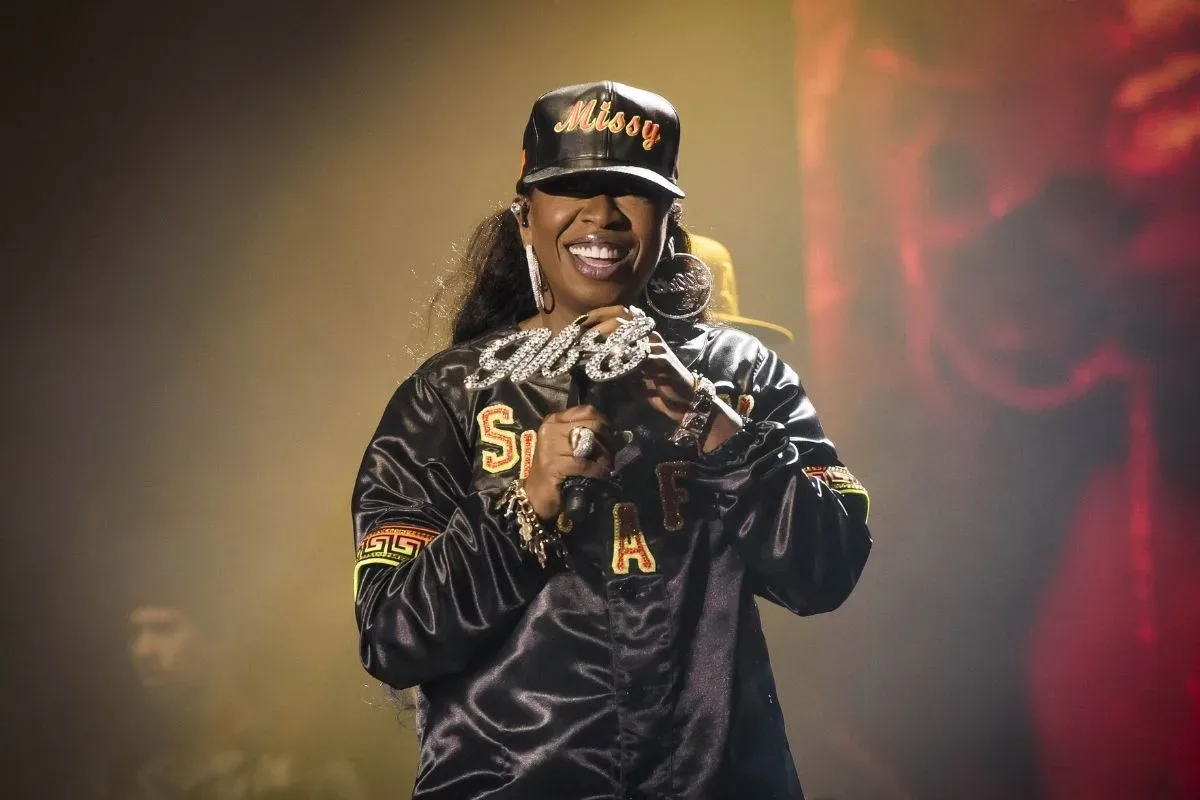
Missy Elliott used her Icon Award moment at the October 22 Gala of the Stars to make a clear case for the people often positioned behind a headlining performer: dancers are artists in their own right, not decorative extras in somebody else’s spotlight.
The gala, held at The Beverly Hilton in Beverly Hills, California, raised more than $760,000 for Dancers Against Cancer. Organizers said the funds will help dancers, choreographers, educators and their families who have been affected by cancer.
Janet Jackson presented Elliott with the Icon Award, having received the same honor in 2025. The pairing made sense not merely as a meeting of major music figures, but as a recognition of how performance can depend on a creative exchange between recording artist, choreographer and dancer. Elliott’s speech put that exchange at the center of the evening.
“Y’all are artists too”
“Dancers are not just props on a stage behind artists,” Elliott said. “What y’all give is energy, emotion, expression, excitement, entertainment to an artist’s show. You bring life to an artist’s lyrics on that stage. Y’all are artists too! Because it takes incredible skill, dedication, discipline, practice and passion to do what you do.”
It is a straightforward statement, but it speaks to a distinction that can get blurred in pop-performance culture. A song may be the starting point for a live number, but choreography and dance performance turn recorded music into something physical, spatial and immediate. Dancers communicate rhythm, mood and narrative through timing, movement quality, formations and individual expression. Their work can shape what an audience remembers long after a performance ends.
Elliott specifically named the labor behind that result: skill, dedication, discipline, practice and passion. Those words matter because polished choreography can make preparation invisible. A finished stage sequence may look effortless, while the process needed to reach that point requires rehearsal, endurance, precision and collective coordination.
Jackson’s presentation reinforced the same idea. She said Elliott “helped make dancers impossible to ignore,” and credited her with raising choreography’s profile while encouraging performers to embrace individuality. That framing treats dancers not as a uniform visual backdrop, but as people whose artistry contributes meaningfully to a performance’s identity.
Why the recognition carries weight
In a conventional concert or televised music performance, the lead artist naturally receives the bulk of public attention. That is the person whose name sells the ticket and whose song anchors the production. But “behind” does not mean unimportant. In stage terminology, a performer’s placement is a matter of blocking: the planned arrangement and movement of people across a performance space. It does not determine the value of the work being done.
Related coverage includes Missy Elliott Honors Dancers at Gala of the Stars.
Elliott’s remarks challenge the casual language that can reduce dancers to “props.” A prop is an object used by a performer. A dancer is a collaborator making interpretive choices in real time. Even when dancers execute set choreography, their performance involves technique, timing and expression. Those contributions are central to whether a number feels energetic, emotional, theatrical or memorable.
That does not diminish the role of the music artist or choreographer. It clarifies a collaborative chain. The recording provides sound and lyrics; choreography organizes movement; dancers embody that choreography; costume, lighting and staging can amplify it. A strong performance usually relies on those pieces working together rather than on one component operating alone.
The gala’s focus is therefore especially fitting. Dancers Against Cancer is directed toward members of that wider creative community, including dancers, choreographers and educators, as well as their families. The more than $760,000 raised at this event represents support aimed at people whose work is essential to performance culture but whose needs may not always be foregrounded during award-season or headline-driven entertainment coverage.
A night of honors and tribute
The evening included a dance tribute to Elliott performed by Anthony Kanec. Maks Chmerkovskiy hosted the benefit.
Other honorees included Toni Basil, who received the Lifetime Achievement Award, and Vincent Paterson, who received the Vanguard Award. Paula Abdul presented the Paula Abdul Legacy Award in a posthumous tribute to Chita Rivera. Hilaria Baldwin was named Philanthropist of the Year.
The range of awards reflects a broad view of dance as both art and community. A lifetime-achievement honor recognizes sustained accomplishment. A vanguard award suggests forward-looking influence or leadership. A legacy award, in this case presented in tribute to Rivera after her death, ties present recognition to an enduring contribution. The philanthropist award, meanwhile, points to the practical need for fundraising and support around the people who make creative work possible.
These awards do not all mean the same thing, but together they show that dance culture is larger than a single performance credit. It includes those who perform, those who create movement, those who teach, those whose careers established new standards and those who help make resources available when a community faces illness or financial strain.
Fundraising with a defined purpose
The gala’s reported total is more than $760,000, not a precise final dollar figure. That distinction is worth keeping: the available information establishes that the benefit exceeded that threshold, while organizers described the intended beneficiaries broadly as dancers, choreographers, educators and their families affected by cancer.
At its most practical level, a benefit gala turns visibility into financial support. Honorees and presenters attract attention; performances give the event its emotional center; donations and fundraising convert that attention into help for people dealing with cancer’s impact. Elliott’s speech connected those layers particularly well. It was not only a tribute to dance as an art form, but a recognition of the people the event was organized to assist.
There is also an important difference between celebrating dancers symbolically and centering them materially. Praise can bring welcome validation, but financial support addresses real needs for individuals and families navigating a serious illness. The gala’s stated mission joined both ideas: honoring the contribution dancers make to entertainment while raising money for members of the dance world who need assistance.
For readers interested in the wider conversation around the people who create entertainment, Joking Joystick has also covered recent performer-industry leadership news.
What Elliott’s speech puts into focus
The lasting takeaway from Elliott’s acceptance speech is not a claim that dancers should replace headlining artists at the center of a show. It is that recognition should reflect collaboration honestly. Pop music is often presented as a singular star’s achievement, but live performance regularly depends on many specialists whose creativity is visible even when their names are not.
Jackson’s remarks made a related point by describing Elliott as an artist who helped dancers become impossible to ignore. Elliott then used a major honor to redirect attention back toward dancers themselves. That combination gave the Icon Award presentation a fitting focus: influence is not only about personal success, but also about the space an artist creates for collaborators to be seen.
With Anthony Kanec’s tribute performance, honors for Basil and Paterson, Abdul’s tribute to Rivera, and more than $760,000 raised for Dancers Against Cancer, the Gala of the Stars placed dance’s artistic and human stakes on the same stage. Elliott’s message summed up why that mattered: dancers bring life to the music, and their work deserves to be regarded as art.