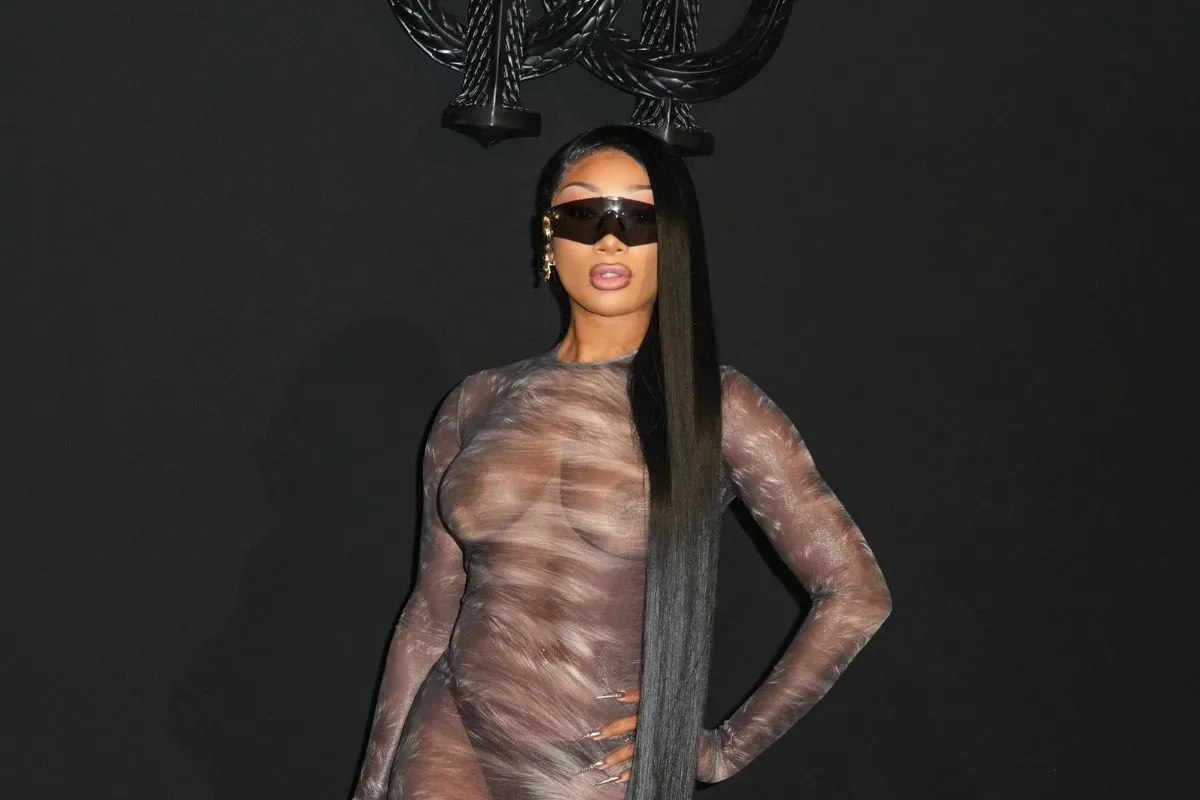
Megan Thee Stallion closed the 2026 Victoria’s Secret Fashion Show on October 18, ending the Culver City event in silver wings and putting a rap performance in the night’s final slot for the second year running.
The show was held at Sony Pictures Studios in Culver City, California. Megan performed on the runway in a lace bra, black thong and glittering stockings, after arriving on the pink carpet in a sequined gown with a fuchsia feather train and blonde hair. Her appearance paired the traditional winged imagery associated with the production with a performance role rather than a conventional runway-only turn.
Megan was one of several music headliners on the bill, alongside Tate McRae, KATSEYE and country singer Megan Moroney. The range of performers made the show less about a single musical genre and more about using distinct pop, rap and country identities as part of a larger fashion presentation.
A finale spot with recent rap history
Closing a show matters because it is the final image and performance viewers take away from the event. Megan’s placement carries an especially clear point of continuity: Missy Elliott closed the 2025 edition with a medley including “Lose Control,” “Get Ur Freak On” and “Work It.” Elliott performed with dancers on a lineup that also included Karol G, TWICE and Madison Beer.
That does not mean the 2026 finale was a repeat. Megan’s silver wings, wardrobe and placement made it her own moment. But the back-to-back closing assignments underline an evident recent willingness to place women in rap at the most prominent point of the show’s musical program.
Rap has appeared in the event long before these recent finales. Nicki Minaj performed “Super Bass” during the 2011 edition, whose musical roster also included Jay-Z and Kanye West. Those bookings established that hip-hop has had a place within the fashion broadcast for years, even if the final performance position has taken on a more pointed association in the last two editions.
The broader point is not that fashion shows suddenly discovered rap. Rather, Megan’s slot shows how a familiar format can use an artist’s public identity, performance style and fashion connections to frame its closing sequence. For a runway production, music is part soundtrack, part staging device and part statement of who the presentation is intended to reach.
“Get her wings” becomes literal
When her booking was announced last month, Megan shared her excitement directly with fans, writing, “HOTTIES MY DREAM HAS FINALLY COME TRUE!!!!” She also told them to watch her get her wings. The silver-wing finale turned that earlier anticipation into a literal visual centerpiece.
Related coverage includes Megan Thee Stallion Takes the Victoria’s Secret Runway in Silver, Pink and Angel Wings.
That detail is useful context because it suggests the booking held personal significance for her beyond a standard guest-performance credit. The wings are a recognizable part of the show’s iconography, so wearing them positioned Megan within the event’s most visible visual language while still keeping the focus on a live musical finale.
There is also a difference between appearing at a fashion event and closing one as a headline performer. A red-carpet look can generate attention before the show begins; a finale has to help shape how the entire production is remembered. Megan did both on the night, with the pink-carpet sequins and feather train serving as one fashion statement before the contrasting silver-wing runway performance.
Runway experience beyond the guest slot
Megan arrived with prior experience on the fashion side of the runway as well. She presented her Hot Girl Summer swimwear brand at PARAISO Miami Swim Week in 2025. She returned to the Miami runway in 2026 in a swimsuit she designed.
That background matters because it places this appearance in more than one professional context. She has participated in runway presentations while also working on the product and collection side through her own swimwear label. In simple terms, a performer hired for a fashion-show set and a designer presenting a collection have different responsibilities, but both roles require understanding how clothing, movement, staging and audience attention meet on a runway.
For viewers, that crossover can make the appearance feel more natural than a detached celebrity cameo. Megan’s career connection to swimwear design does not make this a Hot Girl Summer runway presentation, and the supplied details do not identify her Victoria’s Secret performance wardrobe as her own design. Still, it helps explain why a high-profile runway-performance setting fits within her existing fashion work.
Los Angeles-area return and a wider viewing plan
The 2026 show brought the production back to the Los Angeles area following two editions in New York. Its previous Los Angeles staging was in 2007, making the Culver City location a significant geographical shift for this edition.
It was also distributed beyond a single in-person venue. The show streamed globally through Victoria’s Secret’s YouTube channel, and the company offered live screenings at 10 AMC theaters. That cinema component was its first presentation of this kind.
Streaming and theatrical screenings serve different audiences. A global stream makes the presentation accessible to viewers who cannot attend, while a theater screening turns a fashion broadcast into a shared event for people watching away from the runway. Neither format replaces the live audience at Sony Pictures Studios, but together they extend the show beyond the room.
The full 2026 program remains available through the brand’s official channel. That availability is particularly relevant to a finale performance: viewers can revisit Megan’s segment after the immediate live-show conversation has passed, rather than relying solely on short social clips or red-carpet photos.
Why the booking fits the show’s current shape
The available details point to a production built around contrasts: silver wings and fuchsia feathers; a performer with both rap and swimwear-brand credentials; and a lineup spanning pop, global pop, country and hip-hop. Megan’s closing role ties several of those ideas together. She is a music headliner, a fashion presence and a designer with prior runway experience.
It also places the event’s long-running visual shorthand—the wings—in conversation with an artist who had publicly treated earning them as a dream. In an entertainment format where the strongest moments need to read quickly on a runway and on video, that clarity has practical value. Audiences did not need an elaborate explanation to understand the image: Megan Thee Stallion closed the show wearing silver wings.
For more on rap artists defining their work on their own terms, see Rapsody’s discussion of faith, labels and a wider truth-telling vision.
Megan’s 2026 finale therefore stands as both a specific fashion-show moment and part of a continuing pattern. The show has featured rap artists for years; now, for two consecutive editions, a woman in rap has occupied the closing musical position. In Culver City, Megan took that place with a look designed to make the association unmistakable: glittering runway styling, a final performance, and silver wings.