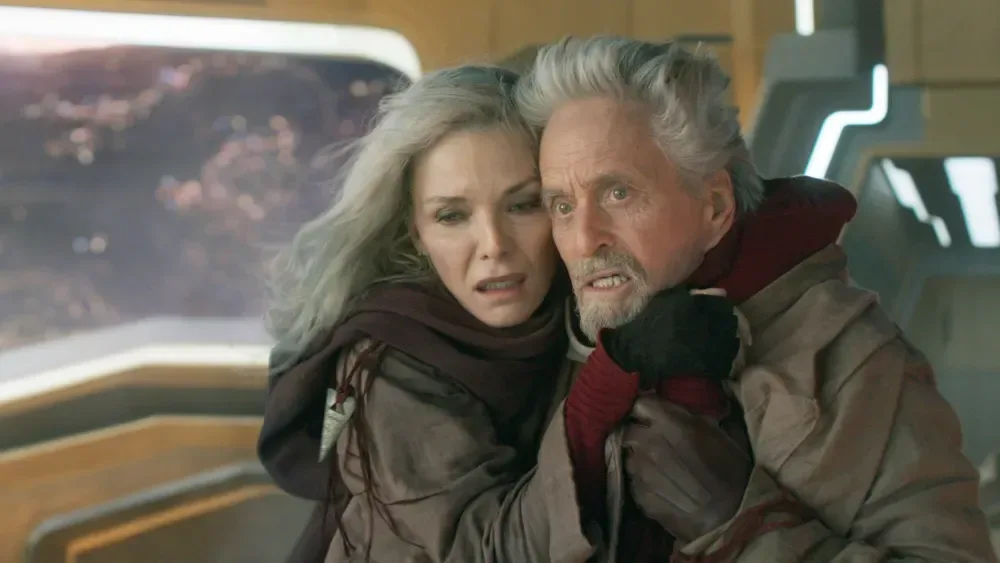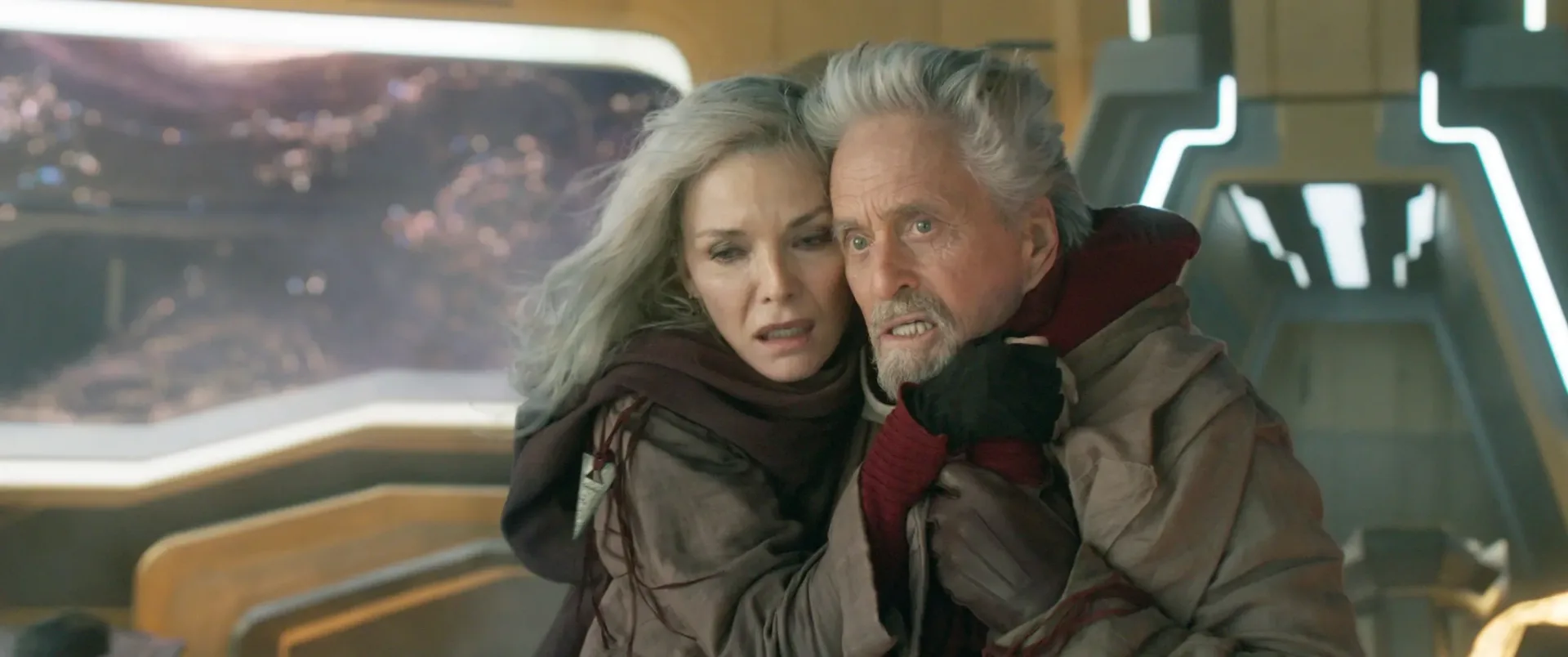
Michael Douglas says he was ready for Hank Pym’s Marvel Cinematic Universe exit far earlier than the character received one—if he receives one at all. In a recent interview on Happy Sad Confused, Douglas confirmed that he wanted Pym killed off after his second Ant-Man film, but said the studio would not agree to it.
“I would have been killed off after the second one, but they wouldn’t let me,” Douglas said.
That brief answer clarifies a point Douglas had previously raised in 2024: he had asked for a substantial on-screen death in Ant-Man and the Wasp: Quantumania, the third standalone Ant-Man feature. His idea was not a quiet disappearance. It was a deliberately outsized superhero-movie farewell that would make use of the franchise’s visual-effects toolbox.
“I said I’d like to have a serious [death], with all these great special effects,” Douglas said in 2024. “There’s got to be some fantastic way where I can shrink to an ant size and explode, whatever it is. I want to use all those effects.”
A role that remained open-ended
Douglas first played Hank Pym in 2015’s Ant-Man. Pym is presented as the original Ant-Man and as a central figure in the technology that allows characters to shrink or grow. Douglas returned for 2018’s Ant-Man and the Wasp, 2019’s Avengers: Endgame, and 2023’s Ant-Man and the Wasp: Quantumania.
That makes four released MCU appearances for Douglas’s version of Pym. His comments concern a desire to end the commitment after the second Ant-Man movie, rather than a claim that he only made two Marvel films. He ultimately continued through the third film and also appeared in the wider MCU ensemble story Avengers: Endgame.
The distinction matters because a character death is one of the clearest ways for a performer and a franchise to establish an ending. A living character can be brought back whenever a story wants them, whether in a direct sequel, a crossover, or another form of franchise continuation. Douglas’s description—“then you can’t get out of it”—frames his proposed death as a way to place a definite full stop on Pym’s screen future.
Marvel’s decision not to follow that request did not, by itself, establish any announced future appearance for Douglas or Pym. It simply means the requested exit did not happen in the films he has already made. Douglas said in 2024 that he did not think he would return for a fourth Ant-Man film, but that was phrased as his expectation, not confirmation of a future production plan or a final casting decision.
Related coverage includes Michael Douglas Says He Wanted Hank Pym Killed Off After ‘Ant-Man’ Sequel.
Why the proposed death fits the Ant-Man visual language
Douglas’s pitch was notable because it leaned into the exact special-effects premise that drew him to the series. He said he wanted to try a “green screen movie” and had told his agents that he wanted to see what that kind of filmmaking was like. He described the unusual gap between an actor’s working environment and the completed image: performers may be surrounded by green screens and later shown illustrations or visual references indicating the finished setting.
Green-screen acting generally means a performer works in front of a colored backdrop that is replaced in post-production with a digital or separately filmed environment. The technology allows filmmakers to combine actors with settings, objects, creatures, scale changes, and action that are not physically present on set. That is especially relevant to Ant-Man, whose stories depend on abrupt shifts in size and perspective.
Douglas did not portray green-screen work as effortless novelty. “It’s hard acting,” he said, describing the challenge of responding to action occurring in different directions and to elements that may be added later. The point is practical as well as technical: an actor still has to make reactions, movement, eye lines, danger, and emotion feel coherent while some of the scene’s most important visual information exists only as a plan.
His proposed tiny-scale explosion would have taken that production method to its logical extreme. It would have used the fictional mechanics associated with Pym while making the exit visually inseparable from the franchise. It was not merely a request to remove a character between movies; it was a request for a spectacle-driven final beat.
Douglas’s experience with the MCU machine
Douglas’s remarks contain two ideas that can sit together without contradiction. He praised his colleagues, calling Paul Rudd “a wonderful actor,” and described the group as lovely. At the same time, he expressed reservations about the long tail of franchise participation.
That tension is familiar to the structure of a connected cinematic universe. A role can begin with a self-contained creative attraction—here, Douglas’s curiosity about effects-heavy filmmaking—then become part of a continuing web of characters and stories. Hank Pym’s MCU role was not limited to the first film: he returned in sequels and crossed into Avengers: Endgame.
For audiences, that continuity can be the appeal. Familiar characters can reappear in new situations, and earlier relationships retain meaning over multiple films. For an actor who wants a clearly bounded assignment, the same openness can be less appealing. Douglas’s comments make the latter perspective unusually direct: he was interested in doing the work, admired his collaborators, and nevertheless wanted the character to have an unmistakable endpoint.
It is also a reminder that the largest visual set pieces are not necessarily the simplest assignments for performers. The finished scene can present a complete fantasy environment, but the actor’s job begins much earlier, amid placeholders and direction intended to help them locate an imagined world. Douglas’s account offers a compact explanation of why a veteran performer might be curious to experience the process once, while also finding the process demanding.
What is confirmed—and what is not
- Douglas says he wanted Hank Pym killed off after his second Ant-Man film.
- He said the request was not accepted.
- He also publicly proposed a major visual-effects death for Pym in Ant-Man and the Wasp: Quantumania.
- Douglas has appeared as Pym in Ant-Man, Ant-Man and the Wasp, Avengers: Endgame, and Ant-Man and the Wasp: Quantumania.
- His 2024 comment that he did not think he would appear in a fourth Ant-Man movie was not an announcement that such a film was planned, nor proof that he can never return.
Those limits are important in a franchise where audiences often treat survival as a clue to future plot developments. Douglas has explained a past preference and an unrealized exit idea. He has not announced a new project, a new contract, an upcoming death scene, or a definitive retirement from the MCU.
A performer’s request for an actual ending
There is a comic edge to Douglas’s desired send-off: shrinking to ant size and exploding is not the conventional language of a solemn dramatic farewell. But it is also a sensible request within the heightened rules of an Ant-Man story. It would have been memorable, technically ambitious, and final—the three qualities Douglas’s comments suggest he was looking for.
Instead, Hank Pym remained alive through Quantumania, preserving the possibility of future use while leaving Douglas’s preferred ending unrealized. For now, the actor’s comments stand less as a tease of what comes next than as a candid look at the trade-off behind a long-running screen universe: continuity keeps doors open, even when one of the people behind the door would rather close it with an explosion.
Douglas’s description of effects-heavy performance also arrives amid broader conversations about how entertainment industries use technology and performers’ work. Questions of creative involvement, consent, and control are similarly central to recent guidance on unauthorized AI voice use, though Douglas’s comments here are specifically about his MCU character and the experience of filming against green screen.