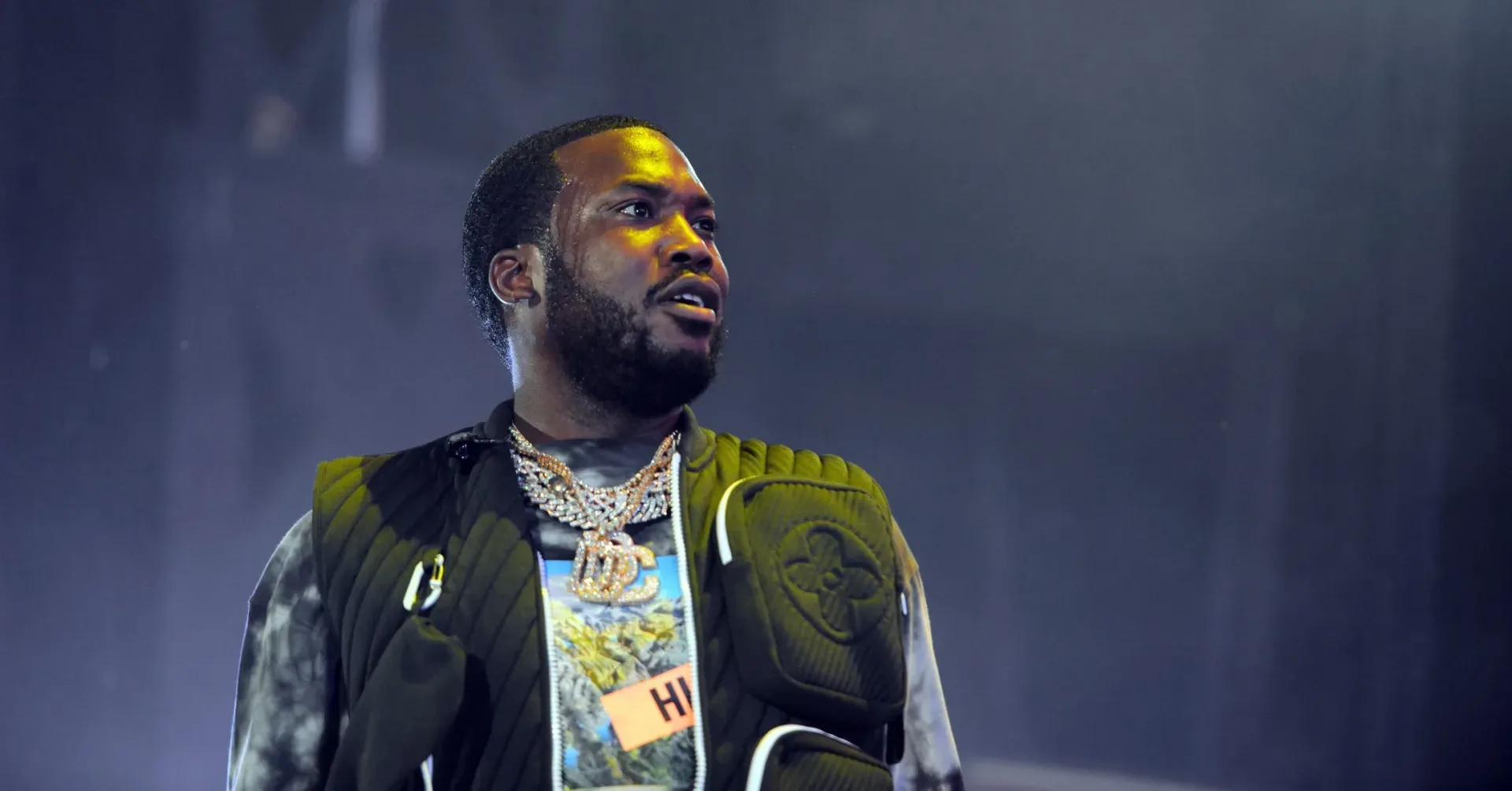
Meek Mill is asking listeners to find him somewhere more direct than the usual release-day maze. The rapper has pointed fans to DC Club, an app built around his Dream Chasers orbit, saying it will be a place for podcasts and new music as well as conversations with supporters and prize giveaways.
The move is more than a link to another social profile. It is Meek’s latest public argument that artists need a closer route to their own audience at a time when music discovery is heavily influenced by streaming-platform systems and playlist placement. His pitch is simple: rather than asking fans to search across multiple services for the next drop, bring them into a dedicated space that he can update himself.
In posts shared on November 20 and November 22, Meek framed DC Club as an answer to the difficulty of reaching fans directly. He also pushed back on the assumption that every artist has to follow the same Friday release schedule.
“come to the dc club we will stream podcast drop new music”
That wording establishes an intention, not a detailed calendar. There are no specific podcast episodes, release dates or prize terms confirmed in the information currently available. But the app’s listed features show how Meek is attempting to make the destination useful between major music releases rather than treating it as a one-time promotional landing page.
What DC Club offers now
DC Club is listed as a free download for iPhone and iPad. Some material is available without payment, while a monthly Premium subscription is described as including unreleased music, members-only releases, a group chat and early access to concert tickets. The app also offers updates from Meek and a shop for Meek Mill and Dream Chasers merchandise.
That combination makes DC Club a fan hub with several distinct functions:
- Music access: Premium members are promised unreleased music and releases reserved for members.
- Community: A group chat is positioned as a channel for fans to interact within the same app.
- Ticket access: Early access to concert tickets is listed as a Premium benefit.
- Merchandise: The built-in store provides a direct retail route for Meek and Dream Chasers products.
- Updates: Fans can receive communications from Meek without relying entirely on a social-media feed.
“Premium” in this setting means a paid recurring tier rather than a separate app. The important practical distinction for fans is that downloading DC Club does not automatically mean access to every feature or every piece of music. The listing says some content is free, while the subscription tier carries the more exclusive music, chat and ticket-related benefits.
Ticket early access can be meaningful to fans, but it should not be confused with a guaranteed ticket. Early access generally concerns when a person can attempt to purchase, while ticket availability, venue restrictions, quantities and any additional conditions can still affect the outcome. Anyone considering the subscription primarily for concert access should pay close attention to the terms shown in the app when an event is announced. Ticket access has become a frequent source of confusion across fan communities, as seen in this look at what unclear ticket details can mean for fans.
A platform built around direct access
Meek has said it had become difficult to access fans, describing DC Club as part of building his own world. The phrase captures the strategy behind an artist-owned or artist-centered platform: instead of leaving every point of contact to outside social networks, music services, retailers and ticketing systems, the artist gathers several of those functions under one branded roof.
For listeners, the potential appeal is convenience and proximity. A fan can use one app to look for updates, music, merchandise, group discussion and possible ticket benefits. For an artist, the appeal is greater control over how releases and messages are presented and when they reach the people who have opted in.
There is a trade-off. Direct-to-fan spaces work best when fans have a clear reason to return. An app cannot simply exist; it needs regular updates, worthwhile exclusives or useful community features to become part of a listener’s routine. Meek’s stated plans for podcasts, new music and giveaways suggest an effort to create those reasons, while the subscription offering adds an ongoing members-only layer.
It is also worth separating a direct fan channel from a replacement for every public platform. Meek has urged listeners to come to DC Club, but the available details do not establish that all future music will be exclusive to the app or that conventional streaming services will be abandoned. The confirmed point is narrower: he intends to use DC Club for new music and podcasts, and he is encouraging fans to meet him there.
Why streaming and playlists are part of the conversation
The app push follows Meek’s wider criticism of how modern music discovery works. In a discussion about the transition from the mixtape era to streaming, he addressed the role algorithms now play in surfacing songs. He has also argued that landing on a major playlist is difficult and that large streaming numbers do not necessarily ensure an artist is paid by a label.
An algorithm is a system that uses signals and rules to decide what it may recommend, rank or show to a user. On a music service, those signals can include listening behavior and other platform activity. A playlist, meanwhile, is a collection of tracks, and high-profile playlists can place a song in front of listeners who were not already looking for the artist.
Those tools can be powerful for discovery, but the concern voiced by Meek is about dependency. If an artist’s visibility relies on decisions made by a third-party platform or label structure, the artist has less control over how a release reaches existing supporters. A proprietary fan app changes the relationship: it is designed for the audience that has already chosen to follow the artist closely, not chiefly for winning discovery from strangers.
The approach has roots in a point Meek raised after Doe Boy discussed the role sites including LiveMixtapes and Spinrilla played in helping listeners discover rappers. The underlying contrast is between an earlier online mixtape environment, where audiences actively sought out hosted projects, and a streaming environment where recommendations and major playlists can be central routes to attention.
That does not make one system automatically better for every listener or musician. Streaming can offer reach and low-friction listening, while a dedicated fan platform can give an artist more control over presentation and fan communication. DC Club appears designed to operate on the latter side of that equation: a focused place for people already interested in Meek Mill and Dream Chasers.
Dream Chasers remains central to the app’s identity
The DC name naturally connects to Dream Chasers, the banner associated with Meek’s mixtape history. That history includes Dreamchasers 2, released in 2012. The name also remains part of his more recent independent output.
His four-track Indie Pack (Vol. 01) lists DreamChasers as the label and Stem as distributor. The project includes “4TH OF JULY,” which features fellow Philadelphia artist Fridayy. Its presence in the current picture matters because it shows the Dream Chasers identity is not merely archival branding from the mixtape era; it continues alongside his independent releases and now the DC Club app.
In music-business terms, a label is the entity associated with releasing and managing recorded music, while a distributor handles delivery of releases to listening services and stores. The provided credits identify DreamChasers as the label for Indie Pack (Vol. 01) and Stem as its distributor. Those credits do not by themselves explain every business arrangement behind the project, but they do clarify the named roles attached to it.
What fans should watch for next
The app was already receiving updates before the latest push: version 1.0.32 appeared in its version history on November 3. That is a modest but relevant signal that DC Club is being maintained, rather than simply presented as a static announcement page.
For now, the clearest expectations are the ones Meek himself has set: podcasts, new music, supporter interaction and giveaways, alongside the free and Premium features currently described in the app listing. The practical question is how frequently those promises translate into activity and whether the exclusive material becomes compelling enough for fans to make DC Club a regular stop.
Meek’s broader point is already clear. In an industry where artists can be spread across social platforms, streaming services, ticketing pages and online shops, DC Club is an attempt to make the path shorter: one branded destination, a direct line to followers and more room to decide how new material arrives.