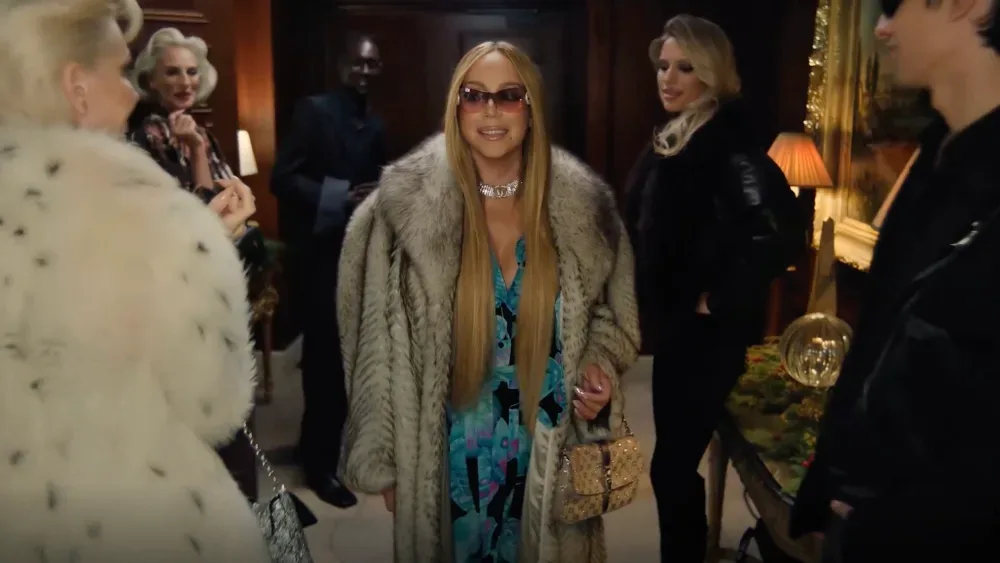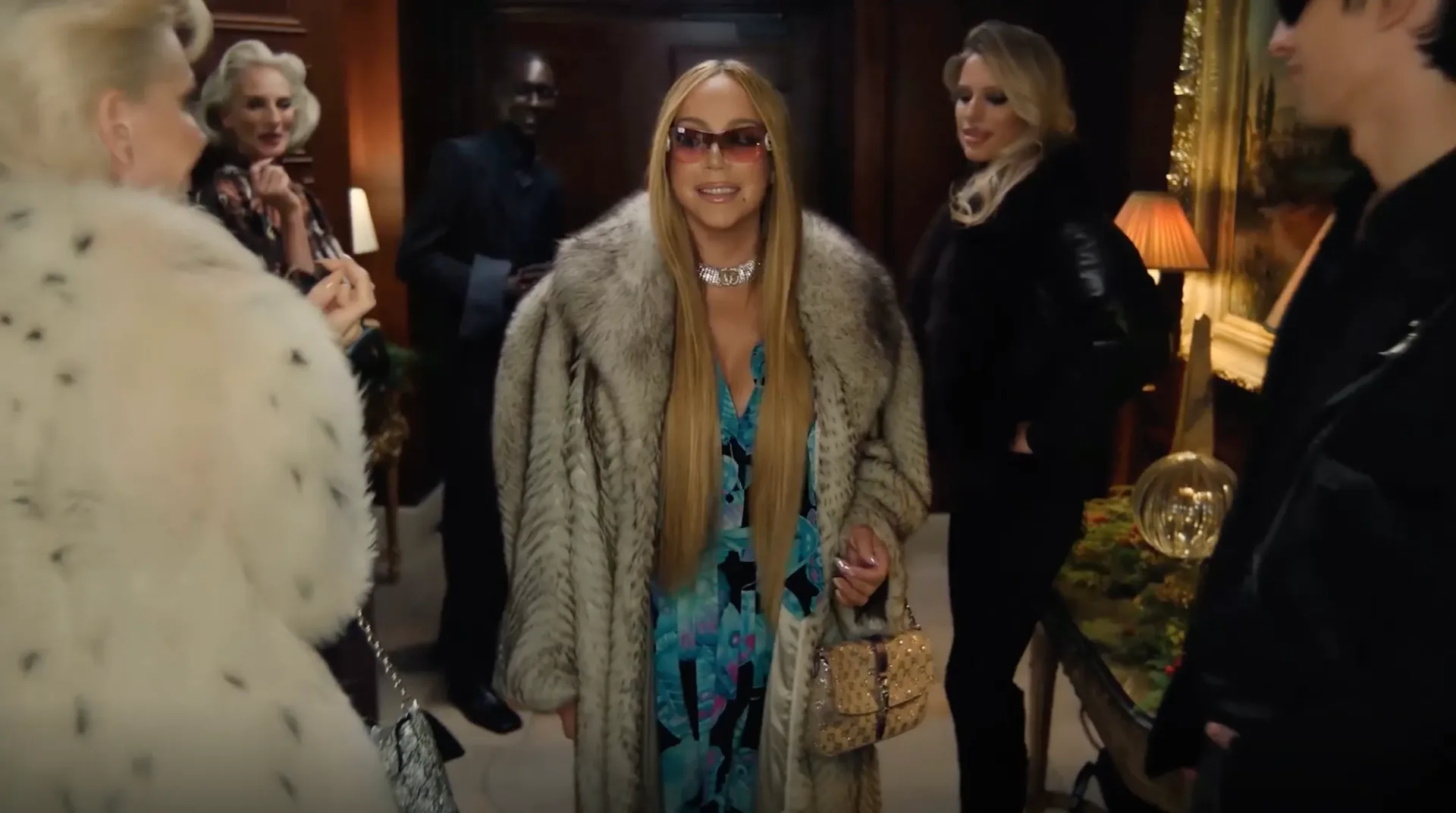
Mariah Carey is bringing her yearly Christmas-season presence to Gucci’s 2026 holiday campaign, fronting a new film set to her 1994 hit All I Want for Christmas Is You. Directed by Harmony Korine, the campaign places Carey at the center of an extravagant hotel scenario built around staff preparing for her arrival.
It is an unusually direct collision of two established identities: Carey’s decades-long association with the festive season and Gucci’s luxury gift-season presentation. The campaign also has a personal visual hook for the singer. Carey wears items from Gucci’s Butterfly special collection, which references both her stated fondness for butterflies and her 1997 album Butterfly.
A hotel holiday spectacle built for Carey’s arrival
The campaign film follows hotel workers amid increasingly elaborate seasonal preparations before Carey appears. That setting gives the advertisement a theatrical premise rather than presenting its fashion pieces as a straightforward product lineup. The hotel functions as a stage for heightened decorations, anticipation and glamour, all calibrated to the scale of Carey’s holiday persona.
Using All I Want for Christmas Is You makes the association immediately legible. The single was released in 1994 and has repeatedly returned to the top of the charts in the Christmas period, more than three decades later. Its annual resurgence has made the song an enduring part of Carey’s public identity, rather than simply a catalog track that reappears on a playlist every few years.
That matters for a holiday campaign because the music does much of the scene-setting work at once. A familiar seasonal song can establish the mood quickly, while Carey’s presence connects that sound to a performer audiences already associate with the start of the Christmas period. Gucci is therefore using a recognizable music-and-personality combination, then extending it through the Butterfly imagery and a high-fashion hotel fantasy.
The Butterfly collection connects fashion to Carey’s catalog
The campaign’s Butterfly special collection has a more specific connection than a generic holiday motif. Butterflies have long been part of Carey’s personal imagery, and Butterfly is the title of her 1997 album. By dressing her in pieces from the collection, Gucci ties the campaign’s product focus to an established part of the artist’s creative iconography.
In this context, a special collection is a named grouping of products presented around a shared theme. Here, that theme is not detached from the campaign star: the winged-insect reference gives the fashion imagery a link to Carey while the Christmas song supplies the seasonal anchor. The result is a campaign with two recognizable Carey reference points, one musical and one visual.
Gucci has also released holiday campaign images featuring its seasonal gift selection. The lineup includes shimmering versions of the Starlet, Gucci duffle and GG Marmont bags, along with the suede Paparazzo bag. Footwear shown in the selection includes GG Monogram boots, Horsebit loafers, Ace sneakers and Vittoria pumps. Hats and scarves round out the winter accessories.
Related coverage includes Mariah Carey Fronts Gucci’s 2026 Holiday Campaign.
These names identify distinct Gucci product lines rather than a single uniform collection. The bag, footwear and cold-weather accessory mix is significant because it frames the campaign as a broad seasonal gift presentation, not only a showcase for the Butterfly pieces Carey wears in the film. Consumers encountering the imagery are being presented with several kinds of fashion item suited to holiday gifting and winter styling.
Harmony Korine brings an unexpected filmmaking credit
Korine is an unconventional director choice for a traditional Christmas luxury advertisement. He is known for films including Gummo, Spring Breakers and The Beach Bum, works that give his name a markedly different association from polished, conventional holiday marketing.
However, this is not his first work with Gucci. Korine previously collaborated with the fashion house on the 2019 project Duck Rock. That existing relationship helps explain why Gucci would pair his filmmaking perspective with a campaign built around such a mainstream seasonal standard.
A campaign director’s role is different from merely selecting an artist to appear in photographs. In a film-led fashion campaign, the director shapes the visual setting, pace and dramatic idea that hold the brand, the featured performer and the products together. In this case, the supplied premise is clear: a lavish hotel, staff in the middle of over-the-top preparations, and the eventual entrance of Carey. Korine’s involvement signals that Gucci is treating that premise as a stylized short-form film rather than only a commercial backdrop.
It also creates a notable balance. Carey represents a highly familiar Christmas ritual, while Korine’s filmography makes him a less predictable creative partner for that ritual. The details available do not establish how far the film departs from conventional holiday advertising, so it would be premature to characterize its style beyond its hotel setting and elaborate preparations. Still, the credit adds an authorial element to a campaign whose music and star are already instantly recognizable.
Part of Carey’s wider annual Christmas rollout
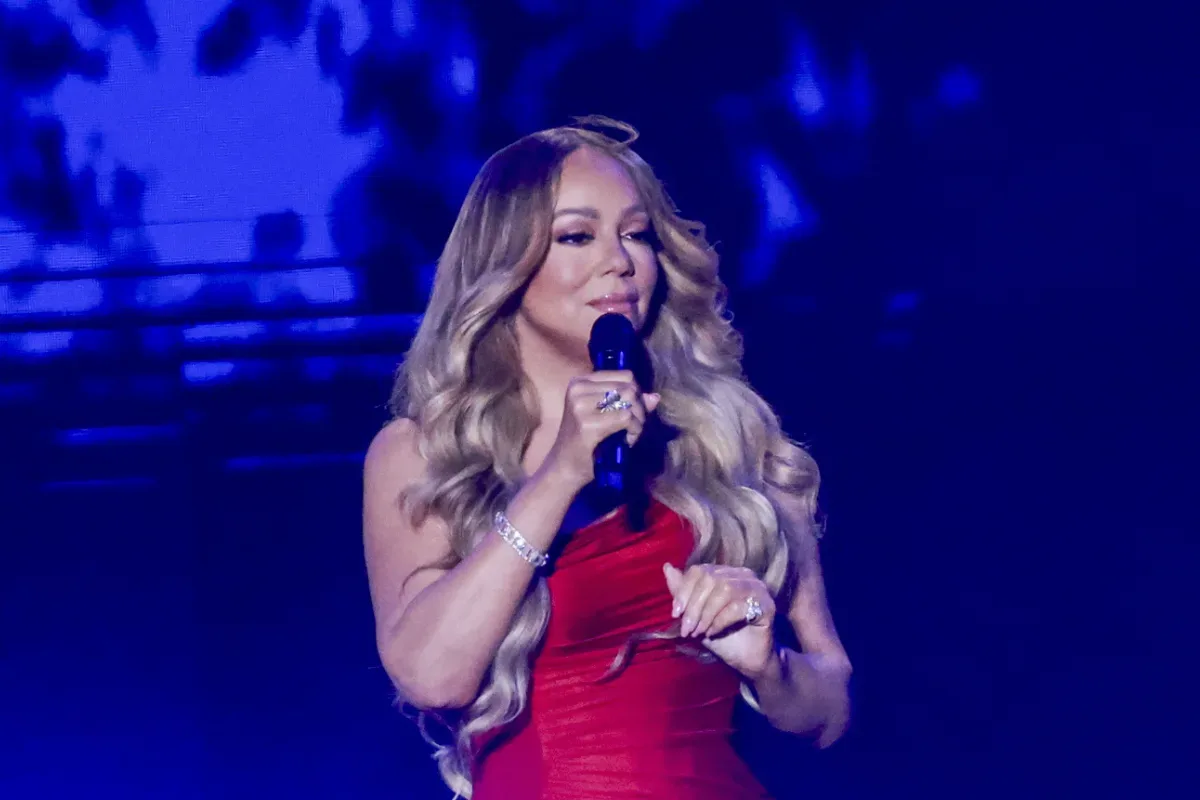
The Gucci film arrives as Carey begins her annual transition into Christmas programming. On November 1, she released a new It’s Time video, part of an annual tradition marking the move from Halloween into the holiday season. This year’s edition starts with a reference to Chick, Carey’s lesser-known alternative-rock project from the 1990s, before shifting into a Christmas spectacle accompanied by her signature seasonal song.
The Chick nod is a reminder that Carey’s holiday image does not encompass every part of her recording history. Its inclusion before the video becomes a festive event creates a small contrast between an obscure creative detour and the globally familiar Christmas persona that follows. The Gucci campaign similarly draws on the latter persona, but adds the Butterfly reference to bring another chapter of her catalog into the visual mix.
Carey is also scheduled to take her 2026 Christmastime tour overseas. The run begins November 27 in Birmingham, England, followed by London’s O2 Arena on November 30 and Manchester’s Co-op Live on December 2. A Malta date is scheduled for December 8.
Together, the video, fashion campaign and tour dates show how Carey’s Christmas period spans several formats: recorded music, promotional video, live performance and luxury fashion imagery. That does not mean each project is the same kind of release. The It’s Time clip marks a recurring seasonal handoff, the tour is a live concert schedule, and Gucci’s work is a branded campaign. Their shared timing, though, means each reinforces the visibility of Carey’s holiday identity during the same window.
Why the collaboration fits the moment
Carey’s holiday prominence rests substantially on the repeated return of All I Want for Christmas Is You to chart-leading status nearly every December. For Gucci, using that song does more than supply a soundtrack: it places the brand’s seasonal images beside one of pop music’s most durable modern holiday fixtures.
The campaign’s practical retail message remains centered on products. The named bags, shoes, hats and scarves provide the seasonal selection, while the hotel film supplies atmosphere and a recognizable lead. Carey’s Butterfly connection makes the partnership feel more tailored than a celebrity appearance with no personal thematic link, and Korine gives the visual project a filmmaker with prior Gucci history.
This kind of celebrity-fashion campaign also demonstrates how a long-running music legacy can be activated without a new single or album being the focus. The 1994 song remains the seasonal entry point, the 1997 album provides a collection reference, and the 2026 tour extends the live side of Carey’s Christmas calendar. The fashion campaign occupies a separate lane, but it benefits from the same annual attention cycle.
There is a wider entertainment-marketing parallel in the way music can support a narrative or visual project beyond a conventional release; for another recent example of an artist turning a music project into screen-oriented storytelling, see Daddy Yankee’s Puerto Rico microseries project.
For this campaign, Gucci’s ingredients are specific: Carey, a hotel full of holiday preparation, Korine behind the camera, Butterfly collection looks and a set of seasonal accessories and leather goods. Its timing also slots neatly into an annual Carey ritual that now includes a November kickoff video and a December international tour itinerary. The result is a holiday fashion presentation built around a performer and song whose connection to the season remains unusually resilient.