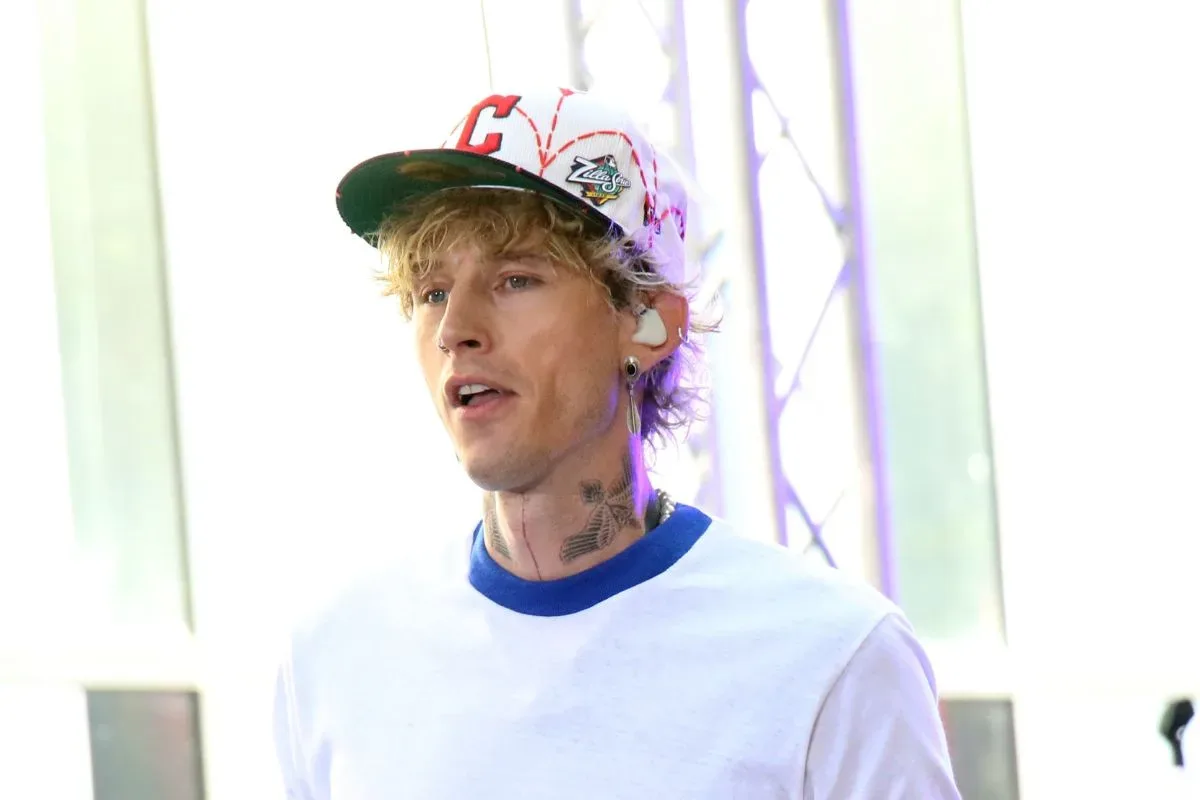
Machine Gun Kelly has publicly rejected a fabricated social-media post that was designed to look as if he had written an emotional statement about former fiancée Megan Fox. The image circulated on X using his account name, handle and a blue check-style marker, presenting a personal message of regret as though it came directly from him.
His response was unambiguous. “that tweet is faker than a pair of tits,” he wrote in reply to the image.
The denial matters because the fake post did not merely make a vague claim about the pair. It presented an intimate, first-person account of a relationship, suggesting that fresh photos of Fox had prompted an extreme emotional response and that he blamed himself for the end of the romance. That sort of wording is built to travel: it gives viewers a dramatic headline, an apparent confession and a familiar celebrity narrative in one screenshot.
A convincing-looking account label is not verification
The image reportedly included several visual details that commonly persuade people to treat a screenshot as authentic: Machine Gun Kelly’s display name, his @ handle and a blue verification-style check. None of those elements, by themselves, establishes that the text was posted by the person named in the image.
A fabricated post is an image or other media altered or assembled to imitate a real social post. It can reproduce the basic look of a platform while adding words that never appeared on the account. Unlike a parody that clearly identifies itself as a joke in the post itself, this kind of material can be especially misleading when it borrows the visual cues audiences use for quick credibility checks.
The account that shared the screenshot, @moidsexposed, identifies itself as a satire account in its profile. Its accompanying caption insulted Machine Gun Kelly. The post had drawn more than 1.3 million views on X, demonstrating the scale a piece of unverified celebrity material can achieve before — or even after — a direct denial reaches the same audience.
Calling an account “satire” does not turn an imitation screenshot into a real post. It may signal an intended comedic or provocative framing, but it is still important to distinguish the account’s framing from the alleged statement itself. In this case, Machine Gun Kelly’s reply supplies the clearest available answer about authorship: he says he did not write it.
Why the claim found an audience
The fake message played into a relationship story that has remained visible in public. Fox and Machine Gun Kelly began dating in 2020 after meeting on Midnight in the Switchgrass. They became engaged in January 2022. Their relationship ended in late 2024, ahead of the birth of their daughter in March 2025.
That timeline gives false emotional claims an easy hook. A breakup, an engagement and shared parenting are all real parts of the pair’s public history. But true background details do not authenticate a purported new statement. The gap between “these two people have a complicated, widely discussed history” and “this individual posted these exact words” is where misleading screenshots often do their work.
There has also been reporting based on unnamed sources that the former couple’s contact is centered on their daughter and co-parenting logistics. Those reports described the relationship as platonic and said they were living separately, while also characterizing Machine Gun Kelly as having continuing affection for Fox. Such descriptions are not the same as a direct statement from either person, and they do not validate the fake post’s claims of anguish or self-reproach.
Machine Gun Kelly has made one relevant public comment in a more verifiable setting: during a 2025 appearance on The Jennifer Hudson Show, he praised Fox as a “phenomenal mom” and spoke positively about having a child with her. That is a materially different message from the one presented in the viral screenshot. His documented comments emphasized parenting rather than an attempt to restart the relationship.
The practical problem with screenshot-first celebrity news
Social platforms reward speed, reaction and familiarity. A screenshot can be shared without asking readers to leave an app, open an account page or inspect a post’s reply chain. That convenience also strips away much of the context that would help establish whether something is genuine.
For readers, a few checks are more useful than treating a blue check or a familiar handle as final proof:
- Open the alleged post on the account itself. A screenshot should lead to a live post that can be viewed from the purported author’s profile. If there is no post to find, that is a major warning sign.
- Check whether the image is being shared as a screenshot only. An image can be edited; a direct platform link provides more information to inspect.
- Separate an account label from the claim. “Satire,” “fan,” “commentary” or “parody” in a profile describes the account’s positioning. It does not verify every image the account posts.
- Look for a direct correction. Here, the person impersonated replied to the circulating material and denied it. That should outweigh assumptions based on a screenshot’s design.
- Be cautious with emotionally neat narratives. Material that perfectly fits an expected breakup arc can be more tempting to share, not more likely to be true.
Verification badges can also be misunderstood. In a fast-scrolling feed, users may interpret a badge as proof that every screenshot bearing it is authentic. Yet a badge displayed inside an image is only pixels in an image. It is not a live platform signal that can be clicked, inspected or tied to a specific post.
A denial is the key update, not a clue to decode
There is a tendency in celebrity coverage to turn every reaction into a second round of speculation: perhaps the denial is strategic, perhaps it hints at private feelings, perhaps it changes the status of a former relationship. The available facts do not support that leap here.
What Machine Gun Kelly addressed was narrow and specific: a post represented as his was fake. His response does not establish a new relationship status, disclose private discussions with Fox or confirm any of the screenshot’s dramatic details. It rejects the screenshot’s authorship.
That distinction is especially important in a story involving co-parenting. Public interest in celebrity relationships often encourages audiences to treat a personal separation as an ongoing serialized plot. But the confirmed public information here is more limited: Fox and Machine Gun Kelly share a daughter, and he has publicly spoken warmly about Fox’s role as a parent. Claims beyond that need their own evidence rather than being inferred from an edited-looking image or an account’s caption.
What this episode says about online authenticity
The incident is a small but clear example of how impersonation-style content exploits the grammar of social media. A handle, a verification-like icon, a short block of emotionally charged text and a timely photo can create the appearance of access. The format asks readers to accept an attribution before they have had a chance to confirm it.
It also shows why reach is not corroboration. More than 1.3 million views indicates that the post was seen widely; it does not turn the underlying screenshot into evidence. A large audience can amplify an error just as efficiently as it can distribute accurate information.
For musicians and other public figures, that is an ongoing reputational issue. A false first-person post can attach a person’s name to words they never chose, then invite reactions to a version of events they did not describe. The correction may be direct, as it was in this case, but it still has to compete with a provocative image that was built for sharing.
The wider entertainment business is grappling with different kinds of pressure as well, including the label-side changes covered in this look at major U.S. and U.K. music-industry cuts. That is separate from the false-post episode, but it is a reminder that a public musician’s online identity exists alongside professional realities that deserve clearer evidence than viral gossip can provide.
In this instance, the most responsible reading is also the simplest one. The screenshot purported to show a Machine Gun Kelly post about Megan Fox; Machine Gun Kelly said it was fake. The viral image should be treated as fabricated, not as an authentic update on their relationship.