One word was enough for Lupe Fiasco: “diabolical.”
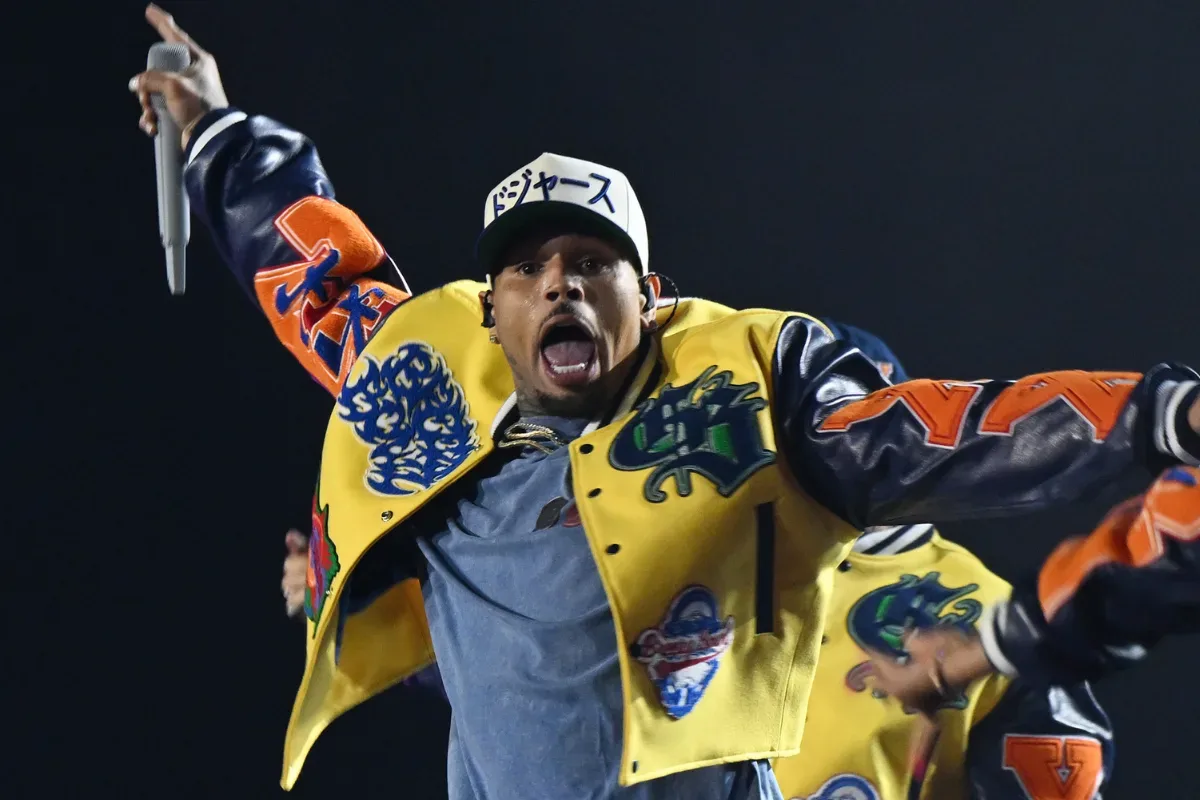
That was the rapper’s succinct response after Chris Brown brought Ms. Joyce, an older concertgoer, onstage during “Take You Down” at SoFi Stadium in Inglewood, California, on November 15. It is the kind of concert clip built to travel: a sharply dressed fan, a major arena stage, a highly theatrical R&B performance, and reactions that range from affectionate disbelief to outright comedy.
Ms. Joyce arrived in a zebra-print coat, hat and sunglasses, carrying a red cane. Brown’s staging for the song included a pole and red couch; Ms. Joyce reclined on the couch while he danced above her. Brown later posted photos from the encounter to Instagram with the caption, “LOVE HER.”
The moment’s tone matters. The basic fact pattern is not simply “fan appears on stage.” It is a knowingly over-the-top performance routine meeting a guest whose poised wardrobe and unbothered presence gave the spectacle its punchline. Lupe Fiasco’s “diabolical” reads less like a literal condemnation than an amused acknowledgement of the audacity: Brown turned an audience interaction into a full arena production number, and Ms. Joyce became the scene’s unexpected star.
A viral-ready arena moment, powered by personality
Concert clips frequently strip context down to a few seconds, so the visual language has to do much of the work. Here, every reported element is immediately legible: the zebra print, the sunglasses, the red cane, the couch, and Brown’s choreography. The contrast between polished R&B stagecraft and the guest’s calm composure is precisely why the interaction drew attention.
Other entertainers responded in similarly playful terms. Taraji P. Henson praised Brown for giving Ms. Joyce a night she would never forget. Ray Vaughn made a joke about a Life Alert device. Those reactions, alongside Fiasco’s deadpan verdict, show how the clip landed as a shared bit of pop-culture theater rather than a conventional performance recap.
There is also a useful distinction between a viral moment and a manufactured controversy. The reported responses frame the exchange as celebratory, though humor can naturally be broad when a performer’s sensual staging is paired with a surprise onstage guest. Brown’s own social post emphasized affection, while Ms. Joyce’s memorable styling helped make the clip feel centered on her presence rather than treating her as anonymous audience scenery.
Lupe Fiasco’s entire review: “diabolical.”
Related coverage includes Lupe Fiasco Calls Chris Brown’s Ms. Joyce Serenade ‘Diabolical’.
That economy is part of the joke. Social platforms reward a quick, adaptable line, especially when viewers already understand the clip’s premise at a glance. Fiasco supplied one that can function as praise, shock, teasing or all three at once.
The larger takeaway is that live shows now have two audiences: people in the building and people encountering fragments afterward. The stage interaction was designed for the former, but its visual clarity made it ideal for the latter. That doesn’t reduce the moment to content; it explains why it spread so easily. A distinctive guest can transform a routine segment into the night’s most discussed image.
That changing relationship between performances and online reaction is part of a broader entertainment pattern. Viewers increasingly approach media as participants, judges and co-conspirators, and concert highlights are no exception. A performer supplies the setup, the audience responds, and the internet collectively supplies captions, verdicts and running jokes.
The SoFi dates also carried some practical tour friction
The viral Ms. Joyce moment came during a Los Angeles run that also included disruption for ticket holders. A scheduled November 16 SoFi Stadium concert featuring Brown and Usher was canceled, with buyers receiving refund notices. The Sunday show still took place.
For fans, that distinction is important. A cancellation with refunds is not the same situation as a postponed date, rescheduled performance, or a show that goes ahead with major changes. The available information establishes that refunds were communicated to purchasers for the canceled November 16 date; it does not provide a reason for the cancellation or additional details about its operational circumstances.
Earlier, attendees at the November 5 Atlanta concert raised complaints about timing and expectations. Some ticket holders said the show began at approximately 10 p.m., rather than the advertised 7:30 p.m. start, and were unhappy that Brown and Usher did not perform joint songs at that stop. A petition called for refunds or another concert.
That episode illustrates a frequent issue with co-headlining events. Fans may buy a ticket expecting two separate full sets, a special collaborative set, or some mixture of both. Unless a joint performance is explicitly promised, those expectations can vary considerably. But when the public framing of a tour makes the pairing its central attraction, the absence of a shared onstage moment can still feel like a mismatch between what some buyers imagined and what they received.
Brown and Usher later did perform together again in Atlanta, including “Back to Sleep” and the remix of “It Depends.” Those appearances addressed the specific kind of collaboration some attendees had been hoping to see, though they do not change what earlier ticket holders said they experienced.
Why the distinction between “late” and “advertised” matters
Live-event schedules are complicated by production changes, opening acts, venue operations and other variables. Yet an advertised start time is still the reference point customers use to plan transportation, work, childcare and the rest of an evening. When a performance begins substantially later than that posted time, frustration is predictable even if the headlining performance itself is lengthy.
The reported Atlanta complaints were about both time and format: a delayed start plus no joint songs. Separating those issues makes the response clearer. One is an event-timing concern; the other is a programming-expectations concern. They may overlap emotionally for a ticket buyer, but they are not identical problems.
Strong sales put the online debate in perspective
Despite the complaints and the canceled SoFi date, the tour’s commercial showing has been substantial. Billboard Boxscore counted $77.4 million in grosses and 423,000 tickets sold across 10 September shows, making it that month’s top-grossing and best-selling tour.
“Grosses” refers to ticket revenue before the many costs involved in mounting a large tour, while “tickets sold” measures the number of admissions purchased. Neither figure tells the entire story of audience satisfaction, and strong sales do not erase the concerns raised by individual attendees. They do, however, establish that demand for the tour has been significant on a large scale.
That is the odd duality of a major tour in the social-media era. The same run can produce an enormously successful sales report, a petition from dissatisfied fans, a cancellation that requires refunds, and an onstage interaction that becomes a widely shared feel-good spectacle. None of those facts necessarily cancels another out. They describe different parts of the same touring reality.
Brown and Leon Thomas enter a new Grammy category
Beyond the live dates, Brown is also headed into the next Grammy Awards race with Leon Thomas. Their song “Fallin’” is nominated in Best R&B Collaboration or Duo/Group Performance, a new category that separates collaborative records from solo performances.
The category’s structure is straightforward: it recognizes R&B work performed by more than one credited artist or by a group, rather than placing those records in the same lane as solo vocal performances. Its arrival gives collaborations a more specific competitive home and underscores how central shared credits have become in contemporary R&B releases.
“Fallin’” will compete alongside Jill Scott and JID, PJ Morton and Keyon Harrold, Lalah Hathaway and J. Ivy, and Kehlani with Thomas on “Sweet Nuthins.” Thomas appears twice in the category, through his collaboration with Brown and his appearance on Kehlani’s nominated track.
The Grammy ceremony is scheduled for February 7, 2027, at Crypto.com Arena in Los Angeles. The main broadcast will air across ABC, Disney+ and Hulu.
For now, though, the awards conversation and the business metrics share space with an entirely different kind of headline: Ms. Joyce’s night at SoFi. In an arena-scale production usually built around performers with exact choreography and tightly controlled visual cues, she supplied something less programmable: personality. And, in Lupe Fiasco’s efficiently dramatic assessment, the results were diabolical.