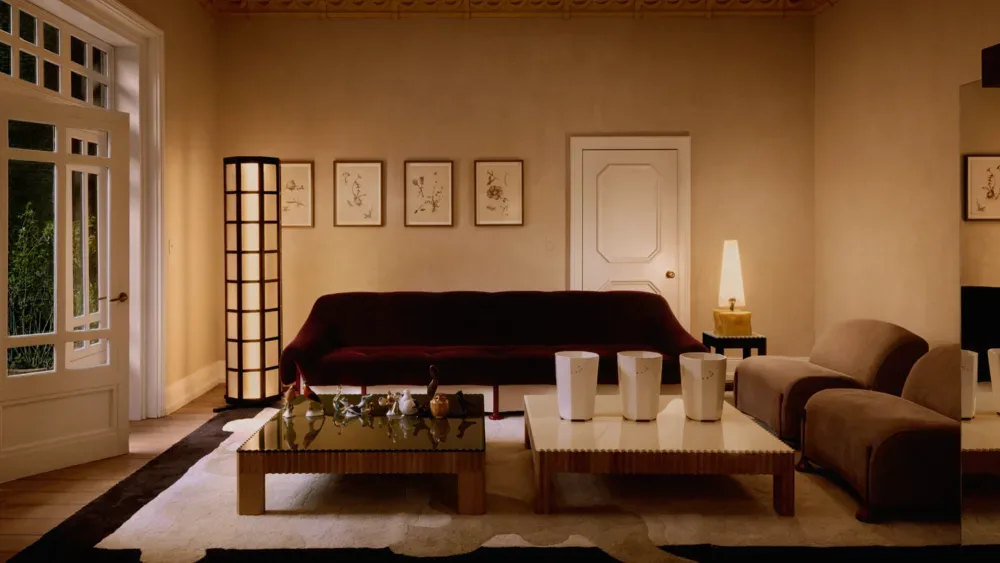
A room can be a stage before anyone says a word. Luca Guadagnino has made that principle central to his films, where an apartment, villa, restaurant or carefully arranged desk can communicate longing, friction, status and memory as clearly as dialogue. Now he is taking that visual language out of the cinema and into domestic design through Baisi Guadagnino for Zara Home, a large-scale collaboration with production designer Stefano Baisi.
The collection is scheduled to launch worldwide on Sept. 26 through Zara Home and Zara’s websites. It includes more than 200 pieces across furniture, lighting, tableware, textiles, rugs, mirrors and scented candles, plus a gender-fluid ready-to-wear range. A temporary public presentation will accompany the release during Milan Fashion Week, making this less like a routine celebrity-branded product drop and more like an attempt to build a fully inhabited aesthetic world.
That approach makes sense for the pair. Guadagnino’s work has long made interiors feel active: not mere backdrops, but zones where characters expose their tastes, conceal their intentions or drift through emotional weather. Baisi has helped realize several of those environments on screen, and their new home collection appears to extend their shared practice into objects made for actual spaces rather than soundstages.
A production-design partnership moves into the home
Baisi is one of Guadagnino’s significant behind-the-scenes collaborators. He worked as production designer on 2024’s Queer, featuring Daniel Craig and Drew Starkey, and later on After the Hunt as well as Guadagnino’s upcoming Artificial. His work on Queer involved helping create its stylized version of 1950s Mexico City, largely at Cinecittà. On After the Hunt, he shaped the densely considered interiors occupied by the academic couple played by Julia Roberts and Michael Stuhlbarg.
Guadagnino’s own possessions have also informed his filmmaking. A substantial portion of the apartment seen in After the Hunt was furnished using objects from the director’s personal collection. That detail helps explain why this Zara Home project does not read as a disconnected licensing exercise. It grows from a process in which collecting, arranging and filming objects are already closely connected.
The collaboration is a useful reminder that production design often carries some of the most durable world-building in cinema. Costumes tell viewers who a character may be; set decoration can reveal what they have held on to, inherited, bought impulsively, cherished or failed to replace. In that sense, moving from a film set to a sofa, lamp or rug is not a radical change of subject. It is an expansion of the same vocabulary.
For readers following the visual afterlives of film sets and their makers, our look at the rediscovery of Derek Jarman’s Edward II set footage offers another perspective on how design work can become an enduring part of a movie’s cultural record.
Four design lineages, one deliberately theatrical room
The home collection takes its visual cues from a broad but coherent group of design movements: Viennese Secessionism, French Art Deco, Brazilian Modernism and Italian Radical Design. Those references point toward decorative geometry, polished glamour, modernist ease and forms that are allowed to be a little strange. Rather than settling into one historical period, the collection seems built around the productive friction between them.
The reported assortment includes curved sofas, chairs designed to envelop the sitter, graphic rugs and sculptural lamps. These are the kinds of pieces that can impose a mood even when the rest of a room is comparatively quiet. A curved couch changes how people face each other. A large graphic rug makes the floor part of the composition. Sculptural lighting can behave as both utility and punctuation.
This does not mean the project is limited to maximalism. The key idea appears to be intentionality. Film sets often arrange objects so that every surface has an emotional temperature, whether it is lush, chilly, bohemian, severe or slightly off-kilter. A home cannot be expected to operate exactly like a set, of course, because people need to live in it rather than merely be photographed there. Still, the collection’s premise invites shoppers to view domestic objects as expressive tools rather than neutral equipment.
That is especially relevant to collectors and pop-culture fans who enjoy the overlap between film language and material culture. A chair can be functional without being anonymous; a candle can be used up, but its vessel and name can still participate in a broader visual system. The project treats those everyday categories as parts of an environment with a point of view.
An “atlas of desire” with named objects
Each item in the collection has been assigned an individual name. Among the names are Purkersdorf, Nape, Ophiuchi, Blinking and Sacred Spring. Guadagnino and Baisi characterize the group as an “atlas of desire,” a description that gives the range an almost archival or cartographic quality.
Naming objects can do more than dress up a product list. It gives them roles within a shared fiction. “Purkersdorf” evokes a place; “Ophiuchi” has celestial associations; “Sacred Spring” suggests ritual and renewal. The names encourage associations before an observer has even settled on what a particular piece does. That is a classic cinematic maneuver: create a title, a color and a fragment of atmosphere, then let the audience complete the story.
The collaborators’ mood board also reached beyond furniture history. They drew on the 1980s work of Jean-Luc Godard, along with Edward Yang and Nagisa Ōshima, in developing the collection’s color and atmosphere. It is a stimulating trio of reference points. Godard’s later work is often associated with vivid color, collage-like composition and a willingness to make visual artifice visible. Yang’s films can make urban spaces, architecture and distance between people feel extraordinarily precise. Ōshima’s work offers its own formal boldness and intensity.
None of that guarantees that a specific rug or mirror will recreate the sensation of a particular film. Nor should it. The more interesting promise is that the collection has been formed through a design process in conversation with cinema, rather than simply decorated with film-adjacent branding. It is about composing a space, not putting posters on a wall.
Clothes designed with the same interest in silhouette
The partnership does not stop at household goods. Its ready-to-wear component is gender-fluid and begins with an amplified interpretation of men’s tailoring. Loose proportions, tweed and fresco wool are part of the material and structural direction, alongside sculptural dresses and shapes informed by Belgian color relationships and Japanese ideas about volume.
The clothing mirrors the interiors in a fundamental way: both are concerned with the outline a body makes in space. In a movie, the architecture around a character and the drape of their clothing operate together. A broad shoulder, a roomy trouser, a sharply colored coat or a dress with architectural volume all alter the picture’s balance. Here, those concerns are carried into garments that sit alongside the home line instead of being treated as a separate add-on.
The gender-fluid framing is also consistent with the collection’s larger refusal to sort objects too rigidly. Furniture can be sculptural; lighting can be decorative; clothing can borrow from tailoring without adhering to a narrow gendered category. The point is not that every piece serves every taste, but that the project approaches identity, interiors and dressing as related forms of composition.
Milan pop-up brings the installation to life
Before the collection has to function in thousands of individual homes, it will be placed within a single authored environment. Zara Home is set to host a two-day public pop-up at La Pelota in Milan on Sept. 26 and 27. The installation will be designed by Guadagnino and Baisi themselves and will run from 11 a.m. to 9 p.m. on both days.
The timing places the event within Milan Fashion Week, where presentation can be as meaningful as the merchandise being presented. A site-specific installation gives visitors a chance to see the objects in the sort of deliberate relationships that inspired them: lamps with rugs, seating with textiles, apparel against a particular color field, and all of it within a space made to establish rhythm and mood.
For a collaboration rooted in set construction, that physical debut is an essential piece of the concept. The online release can make the collection available worldwide, but the Milan installation will demonstrate the intended grammar: how individual pieces interact, where visual tension belongs, and how a room can feel like it is waiting for its characters to enter.