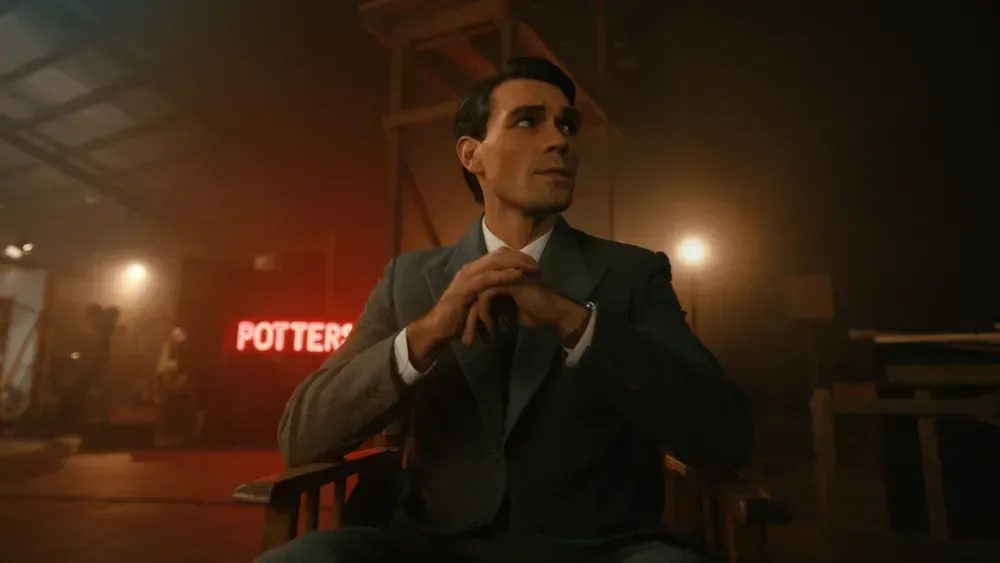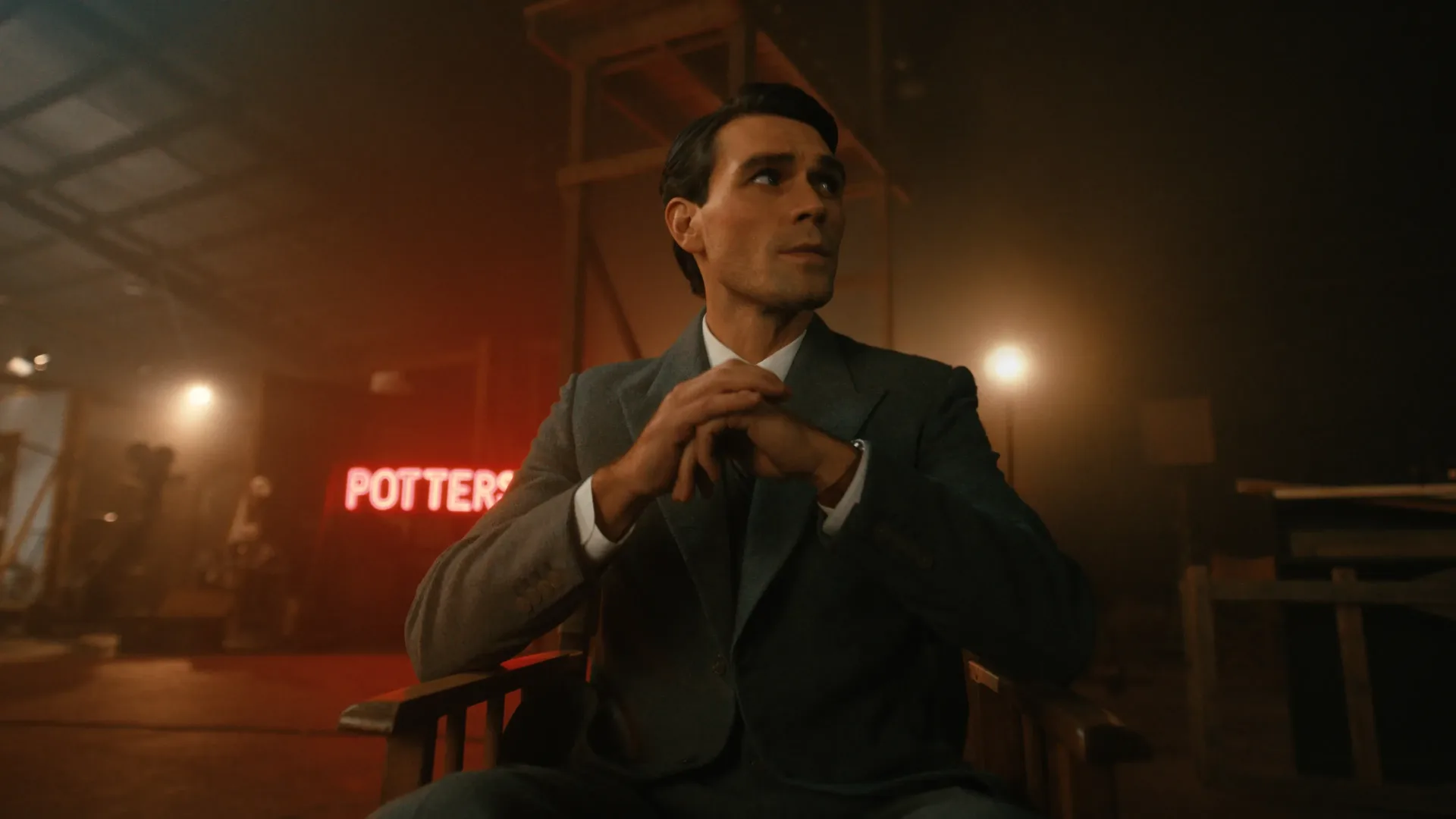
KJ Apa has received unusually meaningful early praise for Jimmy, the forthcoming biopic about actor and military aviator Jimmy Stewart. Kelly Stewart-Harcourt, Stewart’s daughter, appears in the film and says seeing Apa in character was “eerie.” More importantly, she believes the performance avoids an obvious trap: reducing one of classic Hollywood’s most recognizable voices and mannerisms to a two-hour impersonation.
Jimmy is set for a Nov. 6 theatrical release. Aaron Burns directs, with Apa taking on a role that covers a major span of Stewart’s life: his Academy Award win for The Philadelphia Story, World War II service, and his return to movies as George Bailey in It’s a Wonderful Life.
Why the family response matters
Family approval is not a substitute for an audience response or a critical assessment of a film. It is, however, particularly relevant when the portrayal concerns a performer whose public identity was so closely tied to his sound. Stewart’s hesitant rhythms, warm drawl and idiosyncratic phrasing are instantly familiar to many film viewers. That familiarity creates a difficult line for any actor playing him.
Get the accent too far from Stewart and the portrayal may not feel convincing. Push it too hard, and the performance can become a collection of recognizable vocal tics. Stewart-Harcourt’s comments suggest Apa has aimed for a third option: conveying Stewart’s personality and presence rather than merely reproducing the surface details.
“You don’t want to sit there and listen to a Jimmy Stewart impersonation for two hours,” Stewart-Harcourt said, adding that Apa channels her father and brings him to life without simply doing an impersonation.
That distinction gets to the central acting challenge behind biopics. An impersonation is primarily an act of replication, often built around an identifiable voice, face, gait or gesture. A dramatic performance has to do more: it must make choices feel motivated in the moment, especially across personal and historical events. In a film covering Stewart’s movie career and wartime service, the task is not just to sound recognizable. It is to create a believable through-line between those chapters.
The story ‘Jimmy’ is telling
The film’s stated scope begins with Stewart winning an Academy Award for The Philadelphia Story. It then moves into his World War II service, during which he flew 20 missions over Europe and rose to the rank of colonel. On returning home, Stewart resumed his screen career and played George Bailey in It’s a Wonderful Life.
Those milestones give the project a clear dramatic structure: fame before the war, service during it, and a return to the work that made Stewart a screen icon. They also put different demands on the lead performance. The material calls for a character who is both a celebrated actor and a serviceman, then someone attempting to resume civilian and professional life after wartime duty. The supplied details do not reveal how the screenplay handles those transitions, but the breadth of the period is clear.
Related coverage includes KJ Apa Earns Family Praise for ‘Jimmy’ Performance.
Apa previously described Stewart as an American hero and emphasized themes of sacrifice, freedom, strength, purpose, love, honor, fame and war. That framing signals an admiring portrait. For viewers, the key question will be how the film balances that reverence with the human-scale behavior that keeps a historical figure from becoming a monument.
A supporting cast built around a Hollywood-era ensemble
The announced cast places Stewart among figures associated with his family life, filmmaking career and wartime experience. Kara Killmer plays Lady Julia, while Neal McDonough plays Stewart’s father, Alexander. Jen Lilley portrays Gloria Stewart.
Several performers take on names connected to the movie business surrounding Stewart. Max Casella plays director Frank Capra, Jason Alexander plays studio executive Louis B. Mayer, Christopher McDonald plays actor Lionel Barrymore, and Sarah Drew plays columnist Hedda Hopper. Glenn Miller is also represented, with Marc Malkin appearing as the bandleader.
On the military side, Rob Riggle plays Colonel Terrill and Julian Works plays Second Lieutenant Martinez. The collection of roles indicates that Jimmy is not confined to a single event or set of relationships. Instead, it appears designed to move through overlapping worlds: family, studio-era Hollywood, military service and a postwar screen return.
That approach can be productive in a biopic, but it also makes focus essential. Famous supporting figures can quickly become cameos if they exist only to mark a historical moment. Their strongest function is usually to sharpen the protagonist’s choices or illuminate the pressure of a particular period. Since the film has not yet opened, whether these characters receive that kind of dramatic weight remains to be seen.
What audiences should look for in Apa’s portrayal
Stewart-Harcourt’s reaction provides a useful lens without revealing the movie’s full shape. Rather than treating it as a blanket verdict, prospective viewers can watch for the qualities she identifies: whether Apa’s Stewart feels inhabited, and whether the voice supports the character rather than taking over each scene.
That matters most in quieter moments. A famous cadence can land immediately in a trailer or a short clip. Sustaining a feature-length portrayal requires variation—changes in confidence, fatigue, restraint, warmth or tension that arise from the story rather than from an actor repeating a familiar sound. A biopic audience often arrives with a mental version of the real person already in hand. The performance has to acknowledge that recognition while creating room for discovery.
The role also puts Apa in a distinctly different register from contemporary franchise or youth-oriented screen work. Here, recognition may depend less on instant transformation makeup or a single headline moment than on maintaining character across changing decades and circumstances. Stewart-Harcourt’s description of the experience as eerie suggests the transformation registered at close range, not only through edited promotional footage.
Context for a classic-Hollywood biopic
There is a natural pop-culture link between a film such as Jimmy and the ongoing fascination with Hollywood’s institutional history. Stewart’s story intersects with the studio system through Louis B. Mayer, with influential filmmakers through Capra, and with a wider constellation of actors, columnists and entertainers. Those connections make the film more than an actor biography in outline; they position it within a period when cinema, celebrity and national events repeatedly met.
For those following other film-industry stories, our coverage of Alex Gibney’s comments on the international plans for the ‘Musk’ documentary offers a contemporary example of how filmmaking questions can extend beyond the camera to distribution and public presentation. Jimmy, by contrast, is presented as a theatrical narrative feature centered on a historical figure.
At this stage, the most concrete reason to watch is the combination of the film’s ambitious timeline and an endorsement from someone with personal knowledge of the man at its center. Stewart-Harcourt does not suggest Apa has copied her father. She says he has found a way to evoke him without letting imitation become the entire performance. For a role as vocally distinctive as Jimmy Stewart, that may be the most promising early sign possible.