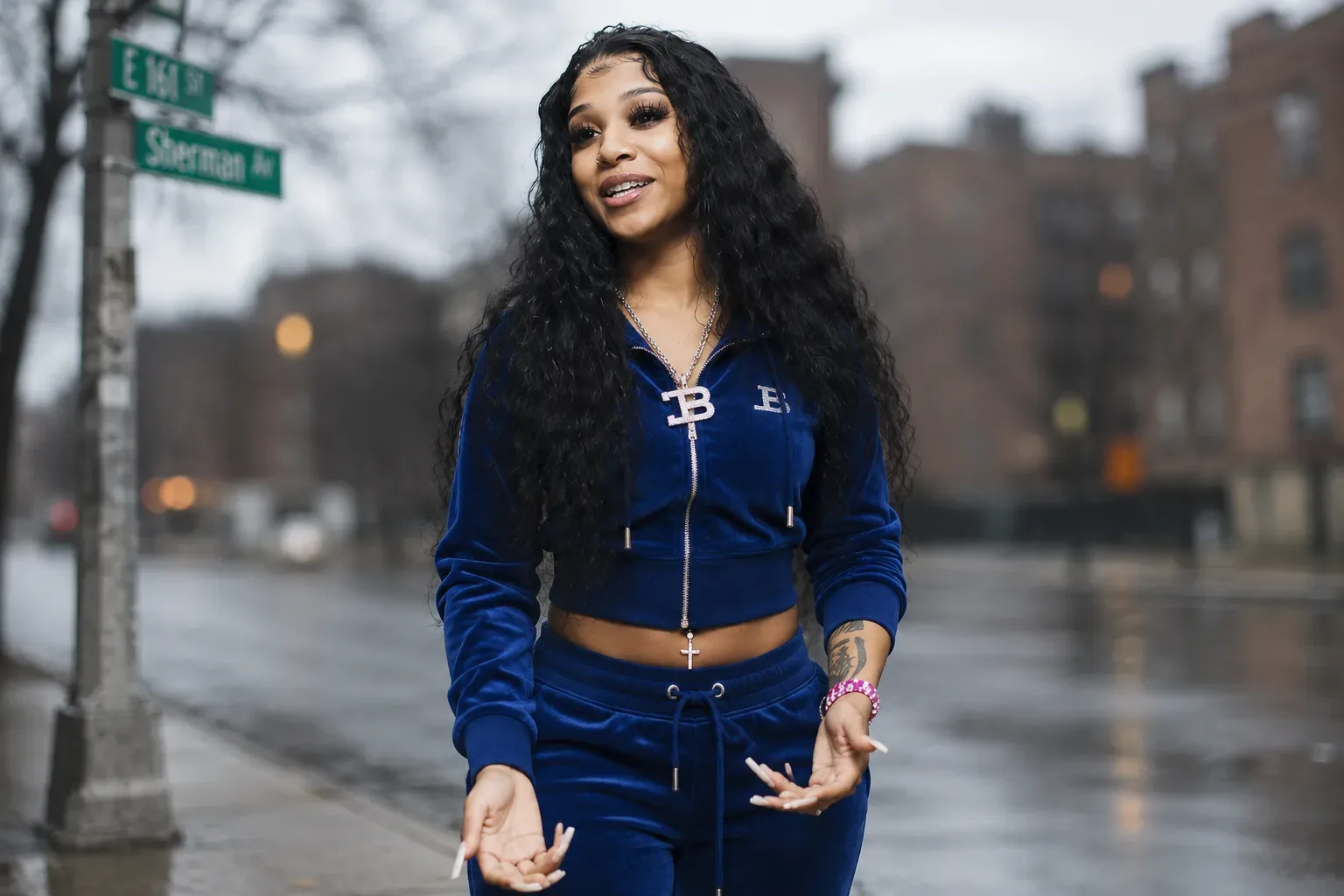
Kenzo B is drawing a clear line between the music she once made and the artist she wants to be now. The Bronx rapper said motherhood reinforced a change she had already begun to make: stepping away from drill records and from writing about a lifestyle she feels she has moved past.
Speaking in a November 15 interview with Gabe P on The Frequency, Kenzo B did not frame the decision as a rejection of drill listeners or of the music as a whole. She said she still hears drill songs she likes. The distinction is personal: she no longer wants to perform that perspective herself.
“Like I feel like I’ll be disgusted if I did a drill song right now,” Kenzo B said.
That is unusually direct language for a discussion of artistic reinvention. Kenzo B explained that she was already distancing herself from the mindset before becoming a mother, while the arrival of her son made the decision more concrete. Rather than suggesting motherhood instantly rewrote her creative identity, her comments describe it as the event that strengthened an existing conviction.
“DeadGame” marks the endpoint she identifies
Kenzo B named “DeadGame” as her final drill track. She said she was already questioning whether that direction fit her when she made it. The song was released in March 2023 through Coke Boys/Warner Records, after her 2022 debut mixtape Top Dawg.
The chronology matters because it places her reassessment within an active run of releases, rather than treating the shift as an abrupt change after a lengthy absence. Top Dawg included “Hood Love Story,” and “BFFR” followed in June 2023 under the same label partnership. She later released the six-track Top 2, Not 2, which included “Chapters,” “Disrespectful,” “N.B.L.,” “BFFR,” “Gotta Go” and “Get Got.”
Those releases provide a practical map for listeners curious about the transition: the older catalog remains part of Kenzo B’s recorded history, but it should not automatically be read as a promise of where her next material will go. Her stated goal is not to replicate an earlier phase because it is familiar or expected.
What moving away from drill means in this case
Drill is a rap style commonly associated with stark, forceful production and intensely local narratives. But Kenzo B’s comments are less a technical argument about tempos, drum patterns or beat selection than an argument about subject matter and personal viewpoint. She said she does not want to rap about that lifestyle anymore.
That difference is important. An artist can continue to appreciate a genre without wanting to embody every lyrical posture associated with it. Kenzo B’s position leaves room for audiences to enjoy drill while recognizing that an artist’s relationship to its themes can change. It also avoids an overly neat idea that artists must either remain permanently in one sound or disown every part of their earlier catalog.
Her challenge now is one many developing artists face: making space for growth without losing the connection that brought early listeners in. Kenzo B said she is trying to balance what she wants to communicate with the sounds people expect from her.
Analysis: That balance may be harder than simply changing genres. Expectations are built through a rapper’s voice, delivery, songwriting and musical associations as much as through a label placed on a record. A move away from drill could therefore still preserve recognizable elements of Kenzo B’s work, even if the perspective and themes become different. The available comments do not specify a new genre, a new producer direction or the content of her next songs, so it would be premature to label the upcoming music as a complete stylistic break.
A writing foundation built before the releases
Kenzo B’s move is also rooted in an artistic foundation that predates her label-era mixtapes. Her early catalog includes “Bump It,” which sampled Dick Dale, and “The Realest,” released while she was still in high school. She developed her writing alongside her brother Bando, with the pair competing over borrowed beats before she shared her own songs more widely.
That detail gives the current shift a useful context. Her development was tied to writing and competition at home, not solely to one marketable scene identity. A performer who has spent years testing verses over whatever beats are available has a base for adaptation—even though adaptation itself does not guarantee that every listener will follow.
Sampling is also worth separating from a simple genre label. A sample is a portion of an existing recording incorporated into a new song. The fact that “Bump It” sampled Dick Dale points to an early willingness to work with material beyond a narrow drill template. It does not, on its own, establish a blueprint for the music to come, but it does show that her catalog has not always been confined to one sonic reference point.
Consistency is part of the comeback plan
Kenzo B said she has spent time away and wants to return with a more reliable release pace. “I’m not going to disappear, y’all,” she told Gabe P. She is working toward another project, although she does not see an album as the immediate right move for artists in her position.
That is a measured plan rather than a grand announcement. No title, release date, track list or format beyond the idea of another project was identified. Her comments nevertheless establish two priorities: releasing music consistently and making sure the new work reflects where she is now.
Explanation: A project can mean several formats, including a mixtape, EP or album, depending on how an artist and their team choose to present it. Kenzo B’s remarks specifically indicate that she is not currently treating an album as the necessary next step. That does not rule out an album later; it only describes her immediate thinking.
Her latest release offers a recent marker for listeners waiting for what follows. The On The Radar freestyle “back on the radar” reached streaming services on November 2 through On The Radar Records. A freestyle is often understood as a performance centered on rapping over a beat or demonstrating lyrical skill, though the term can be used differently across rap contexts. In this instance, the release stands as a current entry in her catalog, but it does not come with a detailed statement of a future album sound.
Collaborations show a catalog broader than solo releases
Kenzo B’s recorded work also extends beyond her own projects. She appeared on Sha Gz’s RUTHLESS GZ on the track “Cheeks,” and she joined 2Rare and DJ Smallz 732 for the remix of Zeddy Will’s “You.” Collaborations can give an artist a route into different audiences and musical settings without requiring their solo work to abandon its own identity.
For Kenzo B, those credits sit alongside the central point of her interview: her next chapter should not be dictated solely by the music that first established her. The move away from drill is not presented as a disappearance from rap, nor as a claim that drill itself has no value. It is a decision about what feels truthful for her to say now.
That personal framing is the most meaningful takeaway. Kenzo B’s older releases—including Top Dawg, Top 2, Not 2, “DeadGame” and her collaborations—remain available markers of different moments in her career. But the artist herself is signaling that listeners should expect her future work to follow her present life rather than preserve an old role indefinitely. For another look at how musicians are shaping personal stories into new creative formats, see Big Boi’s “Bloodlines & Basslines” podcast project.