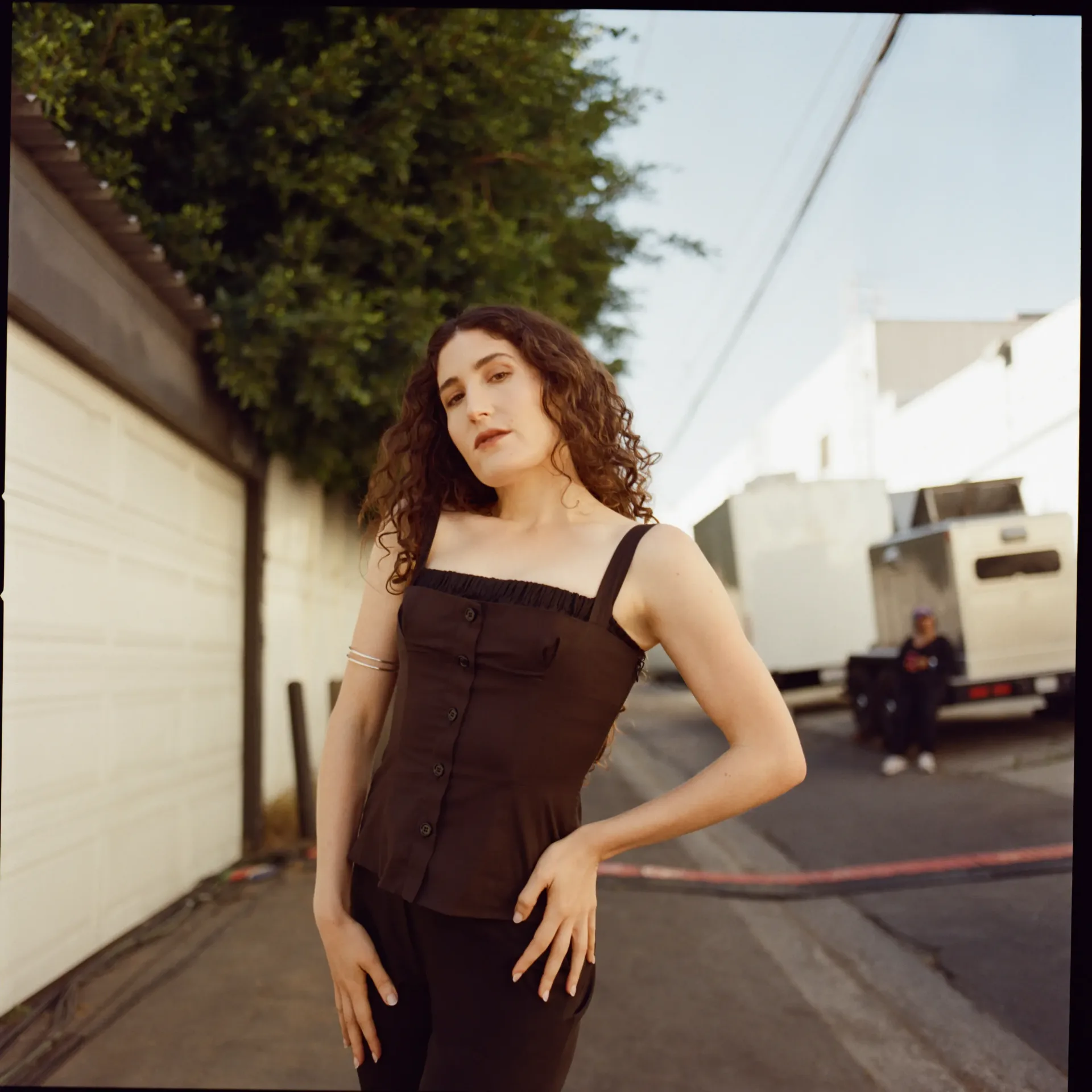
Kate Berlant’s new HBO comedy special Parmesan arrives with a title that gestures toward one of the internet’s peculiar little rituals: commenting a designated word to receive a recipe link. But the central subject is much bigger than social-media food bait. Berlant uses the special to examine the phone as a machine for procrastination, self-surveillance, distraction and a particularly modern form of loneliness.
Parmesan premieres on HBO and HBO Max on October 16 at 10 p.m. PT. Its hour of material reportedly begins from a blunt admission of phone addiction, then follows the tiny behaviors and enormous anxieties that accumulate around life online. Berlant’s approach is not simply to complain about apps or declare that the pre-smartphone era was better. Instead, the comedy seems rooted in the awkwardness of recognizing oneself in habits that are mundane, compulsive and hard to quit: endless scrolling, seeking a tiny chemical reward from attention, and consuming alarming material as a strange version of relaxation.
That makes the special’s apparent premise timely without requiring it to become a lecture. The internet is full of jokes about being terminally online; the more interesting challenge is finding the comic texture inside that shared condition. Berlant’s stated interest in physical comedy and broad performance gives this material a useful tension. The subject may be intangible feeds and online personas, but stand-up itself is immediate: a person on a stage, reacting in real time with an audience in a room.
A special about scrolling, made for an audience that showed up
Berlant frames the phone problem as complicated rather than purely moral. She wants to remain conversant with culture and attentive to what younger people are seeing, but has not found an “ambient” relationship with social media—one in which she can understand it without letting it take over her consciousness. That distinction gets to the practical difficulty behind calls to log off. For many people, the goal is not ignorance or total withdrawal. It is preserving enough distance to be able to focus, create and relate to other people without an always-on feed directing attention elsewhere.
In Berlant’s account, the cost includes procrastination and diminished concentration. She says her focus has been badly affected and that getting reoriented takes discipline. She also describes taking a six-week break from social media, returning when news of the special gave her an understandable reason to want the approval and excitement of online attention, and then deleting it again after the experience became overwhelming.
That cycle is important because it avoids a simplistic split between an artist virtuously rejecting promotion and a captive audience mindlessly consuming it. Releasing a special is itself part of the attention economy: audiences need to know that the work exists, while the same platforms used for outreach can become mentally exhausting. Parmesan is therefore positioned inside the system it critiques, not outside it.
Berlant’s observations also connect phone use to isolation. She contrasts solitary numbing through a screen with the older social image of people gathering at a bar, an environment that comes with its own risks but at least requires human contact. Her point is not that the past offered a clean answer. It is that co-presence—being around other people and having to respond to them—can matter even when the social situation is messy.
That helps explain why live comedy is central to her thinking. A stand-up show has roles that everyone recognizes: the performer comes out, the audience watches and responds, and eventually the performer leaves. The format is structured, but its value comes from the fact that the people involved are actually there. Berlant sees this encounter as a meaningful counterweight to a culture mediated by screens, including current anxiety about artificial intelligence.
Why Berlant thinks live comedy remains distinct
Berlant is emphatic that people will continue to want people, even amid worries about AI-generated entertainment. That is not a technical claim about what AI can or cannot produce; it is a claim about the appeal of a live event. In the context of Parmesan, the human element is not only the performer’s authorship. It is the uncertainty of shared space, the audience’s collective timing and the fact that a joke lands differently because everyone in the room has temporarily agreed to participate in the same experience.
Her account of modern stand-up also pushes back on one popular online assumption: that comedy clubs are routinely chaotic arenas for hecklers and confrontations. Berlant says heckling is far less common than social clips may suggest, although a person in the front row spoke to her during the special’s taping and she had to ask them to stop. The exception became funny partly because it ran against the normal expectation.
The difference matters. Short-form clips often elevate confrontations, rapid-fire crowd work and audience exchanges because those moments travel easily outside their original context. A viewer who mainly encounters stand-up through those clips may reasonably but inaccurately conclude that attending a comedy show means being invited to participate. Berlant’s view is that crowd work is a genuine craft, naming Todd Barry and Moshe Kasher as comedians who do it especially well, but it is different from treating a set as an open call for interruptions.
For an audience, the practical implication is simple: a live comedy room has a social contract even when the performer’s act disrupts conventions. Being responsive is not the same as inserting oneself into the show. That distinction becomes especially relevant for Berlant, whose work is interested in making the audience conscious of its own role.
The anti-closer is a formal joke with a serious premise
The most striking structural decision described around Parmesan is its “anti-closer.” Instead of finishing with the expected final punchline and leaving on a big laugh, Berlant stays onstage while the audience departs. The bit grew from what she calls a chronic difficulty with getting offstage and from a suggestion by the special’s director, Doron Hagay, that the hour needed a major closer.
In a conventional stand-up closer, the comic delivers a final high-impact joke, the room peaks, and the exit confirms that the performance is done. Berlant’s alternative uses refusal as the punchline. It leaves the customary exit in place for the audience, but not for the performer. The people watching have to become people being watched.
It is an example of what performance studies often examines: the relationship between performer and audience, and the usually invisible rules that make a show feel normal. Berlant has a master’s degree in Performance Studies, and she describes being drawn to disrupting the familiar choreography of live entertainment. That does not mean the anti-closer is merely academic. Its comic force comes from how quickly a simple deviation can make a room feel strange. Everyone knows the normal ending, so everyone can feel the awkwardness when the performer does not supply it.
The device also echoes an earlier Berlant project, the off-Broadway show Kate, in which she spent time in the lobby before the show with a sign telling people to ignore her. In one case, she is conspicuously present as attendees arrive; in the other, she remains present as they leave. The setup reverses the usual directional flow of a performance, and in both instances the supposed observer and observed roles become unstable.
That wider interest in screen storytelling and audience expectations has parallels with how performers use familiar forms to make viewers notice form itself. For another perspective on an actor using pop-culture structures as a way into performance, see Inde Navarrette’s discussion of studying Jujutsu Kaisen timelines for screen storytelling.
From caricature to autobiography
Parmesan also represents a change in Berlant’s writing approach. She says it is her first time doing openly autobiographical stand-up and working through questions that genuinely concern her. The special includes material about her sexuality, alongside the phone-focused material and wider fears about contemporary life.
That shift followed Kate, a show that deliberately played with a figure who was not simply Berlant herself. She notes that the work included an invented abusive Irish mother, for example. After spending years inside a performance designed not to be straightforward autobiography, returning to stand-up without acknowledging personal changes no longer felt viable. The result, by her description, was not that autobiographical writing was harder or easier; it was the logical next move.
There is a useful distinction here between autobiography and confessionalism. Autobiographical material uses aspects of the performer’s real life. It does not necessarily mean dispensing with theatricality, character work or exaggeration. Berlant has often been labeled “weird,” “alt” or “left of center,” labels she regards with some confusion because she sees herself principally as a physical comedian whose work can be broad. Crossing her eyes and leaning into slapstick are not abandoned by personal material; they are part of how that material is delivered.
She does, however, warmly embrace “character actress,” even suggesting it should be an Oscar category. The contrast is revealing. Labels can shrink an artist into an assumed audience niche, but “character actress” describes an active performance tradition: transformation, comic specificity and the ability to inhabit a role. Berlant’s comments suggest she is less interested in being deemed edgy or alternative than in being legible as a performer capable of reaching different kinds of audiences.
What actually crosses a line can be unpredictable
Berlant says she has not been motivated by a desire to be perceived as edgy and has not felt that she has gone too far with a joke. Yet the material that prompted one of the strongest reactions was not the kind of subject that is typically treated as obvious taboo-breaking. A joke comparing fathers to family friends led two attendees to leave one performance; Berlant later learned that a man had made an obscene gesture and thrown a glass of wine in the lobby.
The incident underlines an old but useful truth about comedy: audiences do not respond according to a universal list of forbidden topics. A joke can meet personal history, shame, identity or unresolved tension in ways a performer cannot predict. Berlant was surprised precisely because she did not anticipate that line touching such a nerve. That does not establish a general rule about the joke or the audience member’s motives, but it does show why “edgy” is often an insufficient description of what makes material provocative.
For Berlant, the larger atmosphere is shaped by existential fear, though she resists calling herself a pessimist. She says she has hope and sees beauty in the world, while also finding it dishonest to avoid the fears saturating the present moment. This lets Parmesan include dread without being defined only by darkness. The phone, social isolation, online performance and AI anxiety all become contemporary conditions that comedy can acknowledge—and then make stranger, more physical and more communal.
A possible next chapter with John Early
Beyond Parmesan, Berlant says she and John Early are writing and exploring an idea for television. The pair collaborated on Early’s film Maddie’s Secret this year, and Berlant says television is currently the medium they are investigating, while making clear that the project remains early and that no further details have been shared.
They have previously had television projects that did not move forward, including pilots that were not picked up and one production that was in pre-production when COVID halted it. The current work should therefore be read as an intention and a development effort, not a completed series or a formal announcement. Still, it signals the continuation of a creative partnership Berlant describes as ready for television.
In the immediate term, though, Parmesan is the clearer statement: a special about how hard it is to stop looking at a screen, built around the irreplaceable oddness of looking at another person in a room. Its most defiant gesture may be an ending that denies the conventional release of an exit. In an era built around feeds that never end, Berlant’s joke is to make the audience confront the far more unusual possibility that they, not the performer, have to decide when to leave.