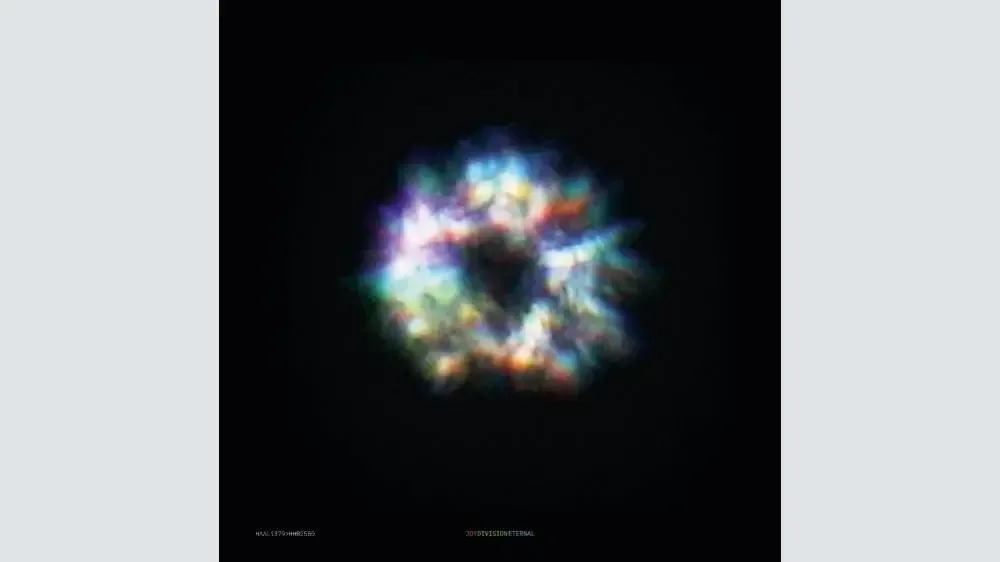
Joy Division’s Eternal is a collection built for listeners willing to trade polish for proximity. Across 14 CDs and two DVDs, the box gathers 18 performances—including a pair of soundchecks—from the Manchester quartet’s 14-month creative peak. It is enormous by design, occasionally sonically compromised, and far more valuable as a record of development than as a conventional live album.
That distinction matters. Joy Division’s two studio albums, Unknown Pleasures and Closer, are inseparable from producer Martin Hannett’s unusual, atmospheric approach. Guitars could feel mechanical or insect-like rather than simply amplified; distant industrial sounds, effects and other disruptions made the recordings seem to arrive from somewhere outside a normal rock room. On the records, Ian Curtis’ voice can be doubled in a way that intensifies the unease, including passages where a whispered second vocal shadows the main one.
Eternal strips much of that studio architecture away. What comes through instead is a harder, more immediate group: Bernard Sumner’s abrasive guitar, Peter Hook’s forceful bass, Stephen Morris’ powerful drumming and Curtis’ vocal pushing against the limits of the available recording equipment. The result can be startling for anyone who chiefly knows the band through the stark atmosphere of the studio work. This was not merely a band whose songs sounded dark in isolation; it could be a punishing, direct rock band onstage.
A live archive, not an entry-level introduction
The set’s scale also defines its audience. Sixteen discs of material, much of it assembled from audience recordings, soundboard cassettes and other period sources, is unlikely to be the cleanest route into Joy Division. Several tapes remain rough despite restoration efforts. That is not a minor caveat. A listener expecting modern concert-album clarity will encounter distortion, imperfect balance and recordings that preserve the urgency of a room more successfully than they preserve every instrumental detail.
But rough sound is not the same as useless sound. In archival music, an audience recording generally means a tape captured from within the crowd, often with portable cassette equipment. Its strengths are atmosphere and the accidental truth of the venue; its weaknesses can include crowd noise, distance and overloaded peaks. A soundboard recording, by contrast, is taken from the mixing desk, which can offer more separation and presence, although it may still lack a balanced final mix. Eternal includes material from both worlds, alongside more professionally sourced recordings.
That variety means the box is best approached as a chronological documentary. It captures good nights and bad ones, evolving arrangements and the unusually broad stock of original songs Joy Division could draw on despite its brief lifespan. The performances are arranged in sequence, allowing the listener to hear new songs enter the set and take shape rather than treating the band’s catalog as though it arrived fully formed.
For collectors and completists, the provenance is part of the appeal. Much of this music circulated in bootleg form for decades, following the old cassette-trading culture surrounding English concerts. Some shows had previously seen release, while many were long known among devoted fans in unofficial form. Eternal does not erase that history; it organizes it into a substantial official-scale archive, accepting that the recordings’ imperfections are part of the document.
Where the music is strongest
Not every disc carries equal technical weight. The Amsterdam, Birmingham and Factory in Manchester recordings stand out as the strongest combination of sound quality and performance, even though each has flaws. The DVDs add BBC material alongside concert and soundcheck footage that is likely to be of greatest interest to the most dedicated viewers rather than casual fans.
The changing setlists prevent the collection from becoming a simple repetition exercise. Joy Division might begin with an obscure instrumental, with “I Remember Nothing,” or with “Love Will Tear Us Apart,” a song that was not released until after Curtis’ death. The band often retained arrangements once they had settled on them, but the archive still catches instructive deviations.
An early “The Eternal,” for instance, is markedly more uplifting musically than the eventual version. That contrast illustrates why a chronological live collection can be more revealing than a pile of alternate takes: it catches a song before its final identity has hardened. Elsewhere, “Love Will Tear Us Apart” becomes an imperfect but human moment when Curtis attempts rhythm guitar while Sumner plays keyboards, seemingly realizing mid-performance that singing and playing the part together are not working. His closing remark that the group had not rehearsed in some time, followed by laughter, punctures the solemn image that can overwhelm discussion of the band.
Those instances do not make Eternal lighthearted. They do, however, restore motion and uncertainty to a catalog often treated as if it emerged under glass. Joy Division’s legacy has frequently been reduced to monochrome iconography—the familiar Unknown Pleasures image on a shirt, the bleak mythology around the group, the notion of an almost preordained tragedy. The live tapes show working musicians making choices, changing orders, battling limitations and occasionally letting awkwardness remain audible.
The shadow over the final performance
The collection’s final concert, recorded in Birmingham on May 2, 1980, is inevitably its most difficult material. The performance had appeared previously on the posthumous compilation Still. Reports from people in attendance said Curtis was in poor health and struggled to complete the show. He was 23 and died by suicide two weeks later.
That knowledge changes how listeners hear songs such as “New Dawn Fades,” especially its language of exhaustion and distress. Still, the archive demands some restraint from its audience. It is impossible to cleanly separate what is present in the performance itself from the meaning listeners attach afterward because they know the outcome. The music is intense without needing retrospective myth to make it so; Curtis’ death also undeniably fixed much of the band’s public image around despair.
That tension is why the liveliness elsewhere in Eternal is so important. Even songs commonly treated as Joy Division’s most beautiful—“Atmosphere” and “Love Will Tear Us Apart”—are steeped in unease, while “Means to an End” pairs a formidable groove with a threatening mood. Yet the concert context brings rhythm, attack and forward momentum to the foreground. This is music that can feel physically propulsive even as its emotional center remains unsettled.
Why the archive has a wider cultural value
Joy Division’s influence has extended well beyond one lane of post-punk. Its work helped inform indie rock, goth, industrial music and, less obviously, strands of electronic dance music. The studio recordings were central to that influence, particularly their refusal to make guitar music sound traditionally “rock” in the expected way. Onstage, however, the band’s fundamentals become clearer: Hook’s bass carries melodic and physical force, Morris drives songs with unusual precision, Sumner supplies jagged guitar texture, and Curtis is an overwhelming focal point.
The three surviving members continued as New Order after Curtis’ death, pursuing pioneering electronic pop across later decades. Hearing Eternal does not turn that later history into a neat continuation; if anything, it emphasizes the rupture. It documents a young band with a remarkably sophisticated body of work, stopping at a point where its possibilities were still expanding.
That is also what separates Eternal from a nostalgia package. It is not simply a luxury object for people who already own every essential album. It preserves process: the progression from song to song, venue to venue, and tentative variation to a more settled arrangement. In an era where physical editions are often framed chiefly as collector products—much like the recent creator-ownership discussion around Young Thug’s Primal Holding Company—this box’s real case is archival rather than ornamental.
There is no escaping the fact that Eternal is a specialist release. Listeners seeking immaculate audio or a concise overview should start elsewhere. But for those prepared to hear cassette hiss, uneven fidelity and repeated songs as part of a historical record, the collection offers something rarer: a close account of Joy Division becoming more accomplished in real time. Its best performances are beautiful, abrasive and challenging; its weaker tapes still help reveal the conditions in which that brilliance developed.