Jo Koy’s most discussed moment in Jo Koy: Blue in the Face begins with an experience that is funny precisely because it was not built from an abstract comedy premise. It comes from a Dodgers game he attended with his late stepfather, Sgt. Fred Harrison: a decorated Army veteran, a committed Dodgers fan, and a man who was battling cancer at the time.
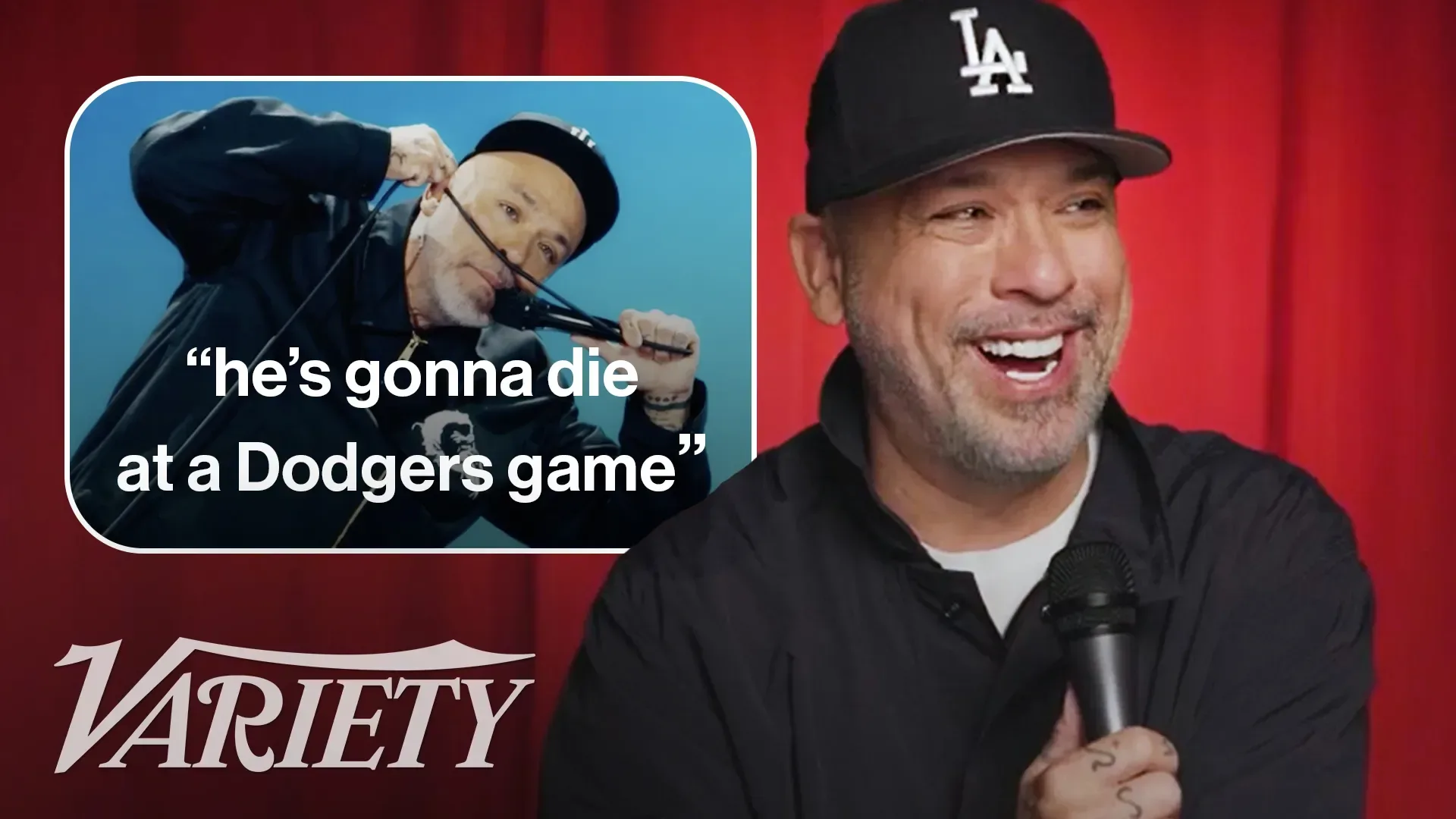
The game went to extra innings. Koy’s memory of watching Harrison grow exhausted became the setup for an escalation that audiences have widely shared from the special: “He served two tours of Vietnam, and he’s going to die in a fucking Dodgers game!” The line is deliberately blunt, but the account behind it is more intimate than a one-line sports gripe. Koy has described the material as a recollection of a real day, shaped onstage with small added jokes rather than constructed as a conventional written gag.
That distinction helps explain why the bit has landed beyond the isolated punchline. Its subject is a beloved relative whose health was declining; its setting is a sporting event familiar enough to create immediate stakes; and its comic engine is the ridiculous mismatch between a lengthy baseball game and the urgent concern of getting a tired, ill fan home. The laughter is not presented as an alternative to the seriousness of the situation. It is Koy’s way of allowing the audience to feel both at once.
A story performed, not merely told
Koy’s approach was not to give the audience a detached report of what happened at the stadium. He acted out Harrison’s mannerisms and recreated sounds associated with the oxygen equipment that had become part of Koy’s everyday reality. At one point, he used the microphone cord near his nose to evoke the oxygen mask Harrison wore.
That choice is central to the shape of the routine. In stand-up, act-out is the term commonly used for a performer physically embodying a person, action, or reaction instead of only describing it. It can compress a large amount of information into a few seconds: posture can suggest fatigue, a repeated motion can establish an object, and a change in voice can establish a different person in the memory. Koy’s act-out turns the story from a summary of his stepfather into an attempt to show the audience how he remembers him.
He has framed that goal in especially direct terms: he did not want simply to talk about Fred; he wanted to “bring Fred to life.” That is an important ethical and creative line for material involving someone who has died. The comic tension does not depend only on Harrison being sick at a baseball game. It depends on Koy presenting him as a specific person with loyalties, habits and a presence substantial enough to fill the room years later.
The Dodgers allegiance is doing useful narrative work, too. A devoted fan enduring an overlong game is instantly legible. Extra innings supply a natural escalation: an ordinary outing lasts longer than expected, concern rises, and the comedian’s mind reaches for an increasingly disproportionate way to say it. The line’s force comes from the collision between real affection and comic overstatement—not from a claim that the underlying circumstances were invented.
Why conversational delivery matters to Koy
Koy has said he prefers allowing a joke to develop in performance rather than treating the page as its final form. His concern is that writing can make material feel overly structured, whereas trying it in front of people allows the story to sound conversational.
That does not mean the work is effortless or unshaped. In practical terms, a conversational routine still has decisions behind it: where to pause, which detail establishes the scene, when to switch into an impression, and where the first small laugh should arrive. What Koy is describing is a preference for discovering those decisions through live telling instead of locking them into a rigid script before the story has been spoken aloud.
For a personal anecdote, that method can preserve the uneven rhythm of memory. People recalling family do not always move in clean setup-and-punchline units. They circle back, imitate someone’s voice, notice a detail, then remember why it mattered. Koy’s stated approach makes room for that. The result can feel less like a carefully diagrammed joke and more like a comic telling of an event to friends—while still being delivered with the timing and character work required by a stand-up stage.
He tested the emotional range of the Harrison material especially deeply in his stepfather’s West Virginia hometown, where he recalled spending roughly 30 minutes speaking about him and revisiting shared memories. That detail suggests the Dodgers section belongs to a larger body of material about a relationship, rather than functioning as a standalone shock line.
The craft behind the escalation
At the center of the routine is escalation: the comic practice of making a situation feel progressively bigger, stranger, or more urgent. Here, the starting point is plain enough. Someone with limited energy is stuck at a game that refuses to end. The next step is Koy’s heightened internal reaction, culminating in the image of a decorated veteran surviving wartime tours only to be defeated by extra innings.
The exaggeration is pointed, but it remains anchored to the real situation Koy recounts. That anchor matters. If the routine only contained the final line, its tone could seem needlessly severe. With the surrounding impersonation, the oxygen-mask reference, and the framing of Harrison as a lifelong Dodgers supporter, it instead functions as a compressed expression of panic, love and helpless amusement.
There is also a reversal in the premise. Harrison’s military record signals endurance and gravity. Baseball, by contrast, is positioned as a mundane ordeal that keeps stretching past its expected endpoint. Putting those two scales beside each other produces the joke’s absurdity. Koy does not need to undermine Harrison’s history; the structure depends on recognizing it as significant before pivoting to the far smaller, yet immediately pressing, problem of a game that will not finish.
Koy has characterized the incident as essentially verbatim, beginning with a straight explanation of what happened and accumulating tiny jokes along the way. That description is useful for viewers because it separates two ideas that are often flattened together: factual memory and exact stage presentation. A comedian can base a routine on a real sequence of events while selecting details, re-creating behavior and heightening reactions to make the story clear in a theater. The fact that Koy calls out the small inserted jokes does not erase the personal foundation of the memory; it describes how the memory became performance.
Character work is the emotional center
Koy has long admired comics who inhabit characters and perform encounters rather than merely narrate them. In Blue in the Face, that influence surfaces in the decision to make Harrison visibly present through performance. The approach changes what the audience receives. Instead of only being told that an oxygen tank was there, viewers get an evocation of its sound. Instead of only being told that Harrison was tired, viewers are offered a physical interpretation of that exhaustion.
That can be a powerful technique, though it also asks a performer to be precise. An imitation of a loved one can become caricature if it chases an easy laugh at the person’s expense. Koy’s explanation places the emphasis elsewhere: the goal is to invite audiences into what he saw as a child and to make Fred recognizable through memory. In that framing, the act-out is a form of remembrance as much as a comic device.
The broader special arrived on Netflix in September, placing this family story in a platform built for a wide audience beyond the room in which it was first developed. Readers tracking Netflix’s broader scripted slate can also see how the service is positioning other upcoming projects, including the political thriller Trinity. But Koy’s material serves a very different kind of viewing experience: one rooted in a performer translating a private family memory into a shared response.
What audiences can take from the bit
The Dodgers story is a reminder that autobiographical stand-up is not necessarily confession stripped of craft, nor is it necessarily fiction shaped into a persona. It can occupy a middle space in which a comedian protects the emotional truth of a memory while finding the clearest theatrical form for it.
- Specificity creates connection: Harrison’s fandom, illness, service history and oxygen equipment make the situation concrete rather than generic.
- Performance can carry exposition: Koy’s character work communicates context without stopping to explain every element.
- Humor and grief can coexist: the joke’s tension arises from affection and worry, not from denying either.
- Live development affects tone: Koy’s preference for conversational delivery helps the story retain the texture of recollection.
For Koy, the viral passage is therefore not simply a particularly efficient punchline about baseball running long. It is a compact version of the larger artistic interest he has described: taking people he knew, listening to the rhythms of how they spoke or moved, and letting an audience encounter them through his point of view. The extra-inning Dodgers game gives that approach a sharp comic finish, but Harrison remains the reason the routine has weight.