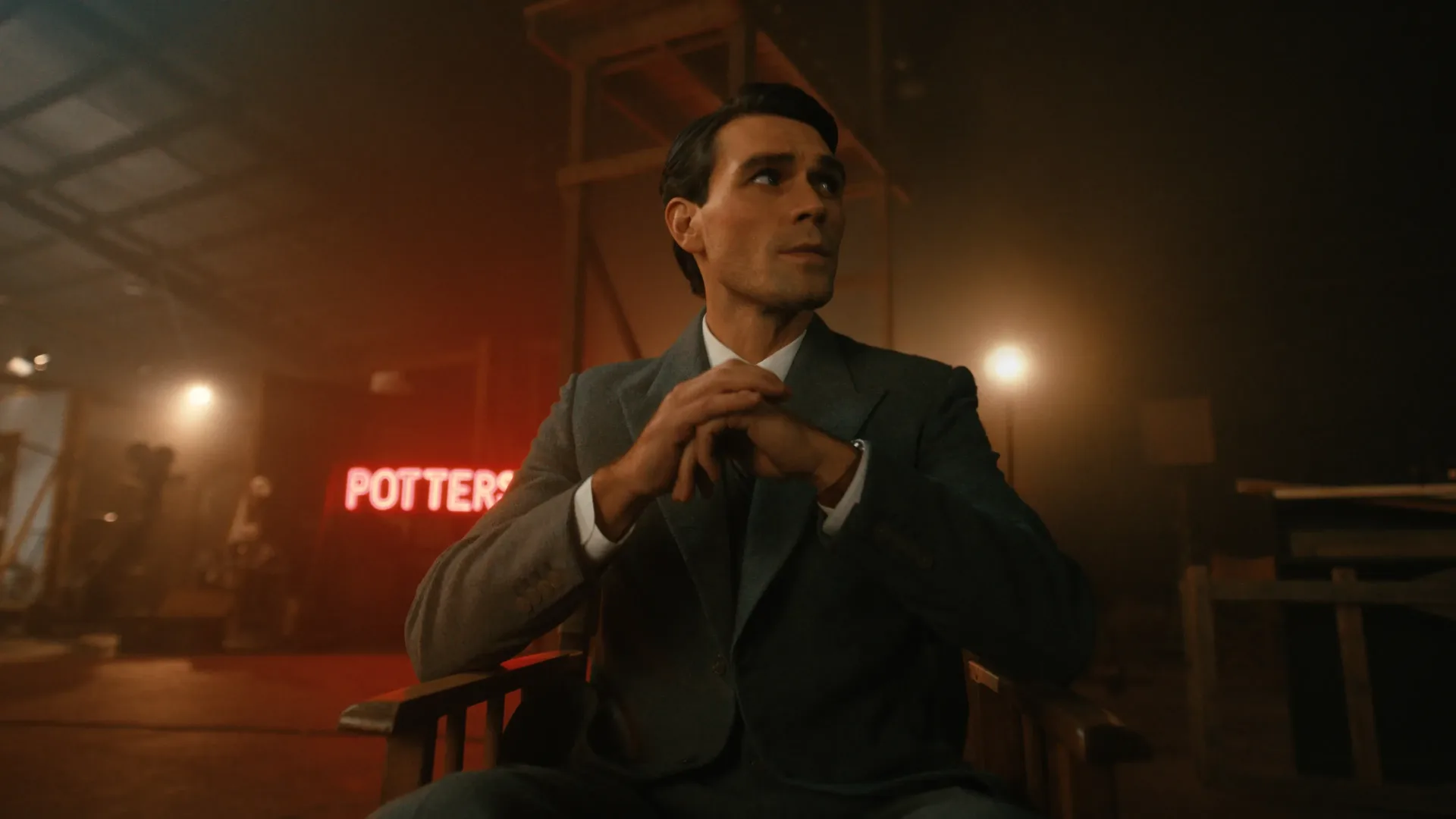
Jimmy has an immediately legible assignment: turn James Stewart’s public image into a movie. The actor was celebrated as an approachable, decent, distinctly American screen presence, and the film follows the period in which that image collided with military duty. KJ Apa plays Stewart in Aaron Burns’ 120-minute, PG-13 biopic, which moves between postwar Hollywood and the Second World War.
The problem is not that the film chooses Stewart’s service as its central subject. It is a meaningful hinge in the story it wants to tell, separating his Academy Award success for The Philadelphia Story from his eventual return to the set of It’s a Wonderful Life. The issue is that the movie’s reverence appears to flatten the person at its center. Apa works hard to capture Stewart’s recognizable drawl and modest, aw-shucks manner, but the performance and screenplay give the character limited room to become more than a symbol of uncomplicated virtue.
A story built around service and return
The film opens after the war, as Frank Capra, played by Max Casella, pitches Stewart on It’s a Wonderful Life. Capra insists the picture will endure for generations, a prediction that may be accurate but also announces the film’s view of its own material with little subtlety. From there, Jimmy turns back five years to 1941, when Stewart has received a U.S. Army draft letter after winning an Oscar for The Philadelphia Story.
Hollywood’s competing pressures are established quickly. Louis B. Mayer, played by Jason Alexander, wants the newly honored star to remain on screen and build on his momentum. Gossip columnist Hedda Hopper, portrayed by Sarah Drew, reports that Stewart has evaded the draft. His father, played by Neal McDonough, is skeptical of his military ambitions. Stewart’s determination to enlist becomes the movie’s primary declaration of character.
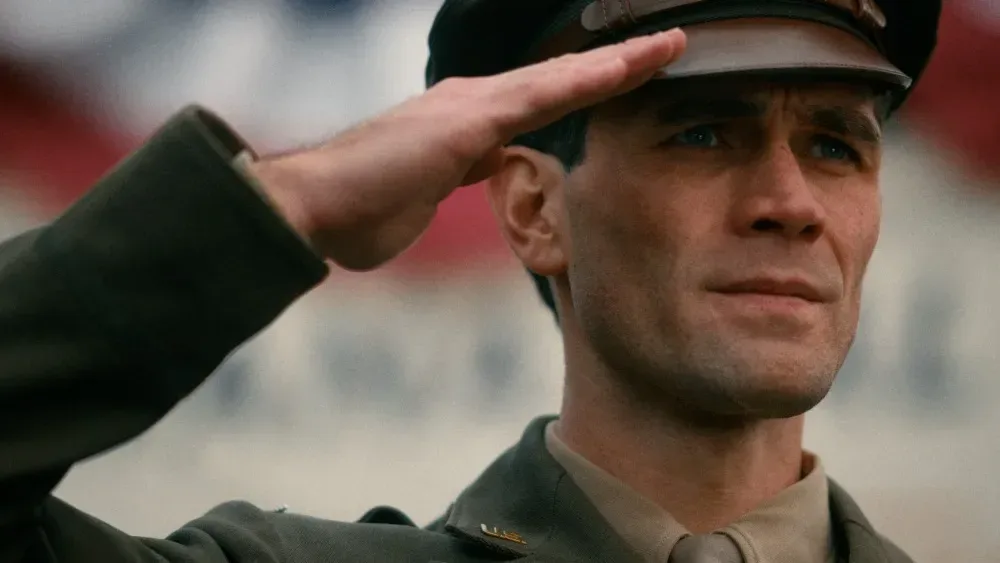
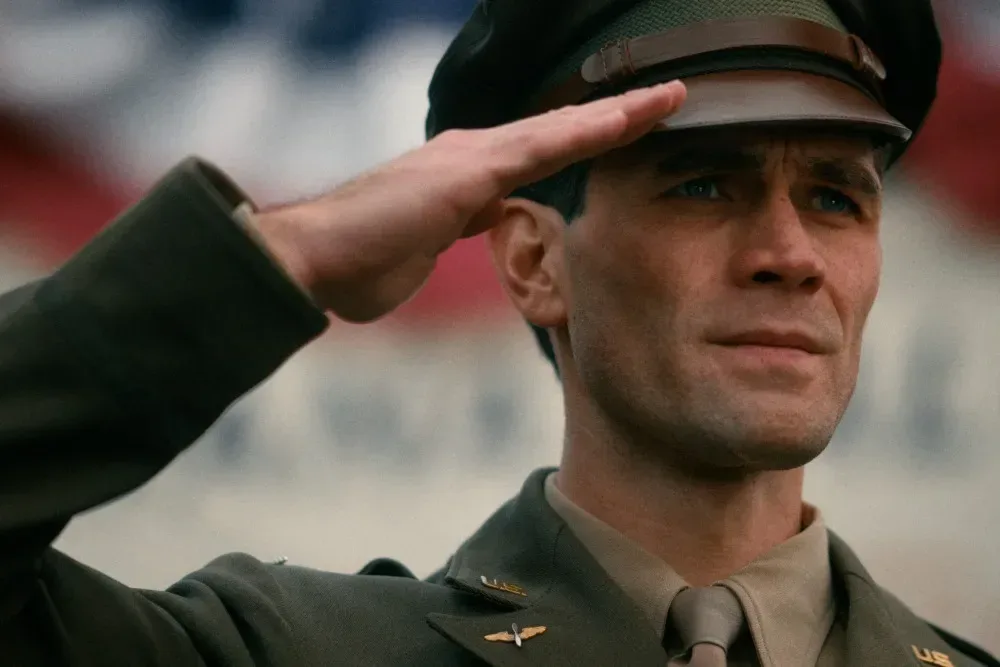
He ultimately joins the Air Force and steps away from movies for five years as the United States enters the war. Stationed in England, Stewart serves as a bomber pilot with the 453rd Bombardment Group, leads men who lack his fame, and faces aerial combat. A fictional romance with an English aristocrat named Julia, played by Kara Killmer, is added to that wartime narrative.
Those plot points offer a potentially rich dramatic tension. Stewart is a major Hollywood name attempting to take on the obligations of a serviceman; he is also a public emblem of normalcy placed in extraordinary circumstances. But the film reportedly does not dig deeply into the conflict among celebrity, military role and civilian self. Its Stewart tends to state his convictions in broad, polished declarations rather than reveal them through complicated choices or contradictions.
Faith, patriotism and an overly smooth portrait
Jimmy is not described as an explicitly faith-based film, though it gives Stewart’s Presbyterian upbringing considerable emphasis and includes religious moments of reckoning. Burns previously directed two features produced by the streaming arm of Christian studio Affirm Films, and this project’s faith-adjacent sensibility is apparent in the attention it gives to spiritual certainty and moral purpose.
That focus is understandable for a story about a performer publicly associated with family values, patriotic duty and an aversion to Hollywood excess. Yet a biopic needs more than agreement with its subject’s values to make a compelling portrait. In this case, the treatment seems to turn those values into a ready-made answer to every question about Stewart. Rather than investigate how decency might coexist with doubt, fear, ambition, professional pressure or wartime trauma, the movie presents virtue as a fixed trait.
Related coverage includes Jimmy Review: James Stewart Biopic Finds the Voice, Not the Depth.
When Jimmy moves closer to psychological distress, it touches on Second World War-related PTSD in a way that is described as generic. PTSD, or post-traumatic stress disorder, is a mental-health condition connected to experiencing or witnessing trauma; in storytelling, its depiction carries particular weight because it can shape memory, behavior and relationships long after a conflict ends. Here, the material appears to function more as a shorthand for damage than as a sustained exploration of what Stewart endured.
The production style reinforces the distance. James Mather’s photography reportedly gives both Hollywood scenes and wartime sequences the same bright, polished finish. Such visual continuity can be purposeful, but it weakens the contrast between studio artifice and the danger of combat when both worlds look similarly controlled. The aerial action, meanwhile, is presented in a synthetic style likened to a video game, an approach that further risks reducing the stakes of the bombing missions.
Revisiting a defining screen moment
The clearest connection between the film’s spiritual themes and Stewart’s screen legacy is its reconstruction of the bridge prayer scene from It’s a Wonderful Life. Stewart reportedly identified that scene as his favorite among his films. It is a sensible choice for a biopic interested in faith, fear and the performer’s return from war, and it gives Apa an opportunity to invoke one of the actor’s most enduring roles.
Still, recreating an iconic scene is not the same as illuminating it. The film frames Stewart’s work on It’s a Wonderful Life as a return to emotional truth after trauma, including a moment when he is encouraged to give the audience truth. That sentiment is direct, but the broader account suggests Jimmy cannot quite meet its own standard. It recognizes that Stewart’s appeal involved something raw beneath the gentleness, then repeatedly settles for surface-level reassurance.
That distinction matters because Stewart’s legacy is not only tied to the sound of his voice or the familiar persona audiences associated with him. A drama about a public figure has to make the audience feel why the image mattered, what it concealed, and how the individual navigated the gap between reputation and private experience. Jimmy reportedly captures the external markers—the drawl, humility and steadfastness—more successfully than the inner life.
A capable cast around a narrow characterization
Apa’s committed performance is the film’s strongest asset, even if the role does not offer sufficient complexity. Casella appears as Capra, while Alexander brings a broad edge to Mayer and McDonough plays Stewart’s stern father. The ensemble also includes Rob Riggle, Julian Works, Christopher McDonald, Jen Lilley and Jemma Donovan.
Justin Strawhand wrote the screenplay, with Stephen O’Connell editing and Grant Fonda composing the music. Burns directs and is among the producers. The production’s strongest dramatic material appears to be the idea that Stewart had to move between the manufactured image-making of Hollywood and a real war. Yet the film’s dialogue is frequently said to favor heavy-handed statements of principle, which can make an already idealized protagonist feel remote rather than human.
For viewers interested in Hollywood history, the sections involving The Philadelphia Story, Capra and It’s a Wonderful Life provide recognizable landmarks. For those seeking a searching account of Stewart himself, the film sounds considerably less satisfying. It honors an image of the actor without sufficiently questioning, complicating or inhabiting it.
That challenge also applies whenever modern projects revisit cherished screen legacies. The preservation of old Hollywood stories depends on more than repeating their most famous moments; as seen in the wider conversation around entertainers’ estates and stewardship, including the legacy of The Three Stooges, the people behind durable cultural images deserve attention beyond the image itself. Jimmy has the raw ingredients for that fuller account, but its devotion to uplift seems to keep it from arriving there.
What viewers should expect
- Rating: PG-13
- Running time: 120 minutes
- Director: Aaron Burns
- Screenwriter: Justin Strawhand
- Lead: KJ Apa as James Stewart
- Focus: Stewart’s wartime service, Presbyterian background and return to Hollywood for It’s a Wonderful Life
Jimmy may appeal most to audiences looking for a straightforward tribute to Stewart’s service and traditional public image. Its premise has genuine dramatic potential, and Apa’s effort to reproduce the performer’s manner is evident. But the portrait is ultimately constrained by its own admiration: it finds a version of James Stewart that is easy to salute, not a person it is willing to understand.