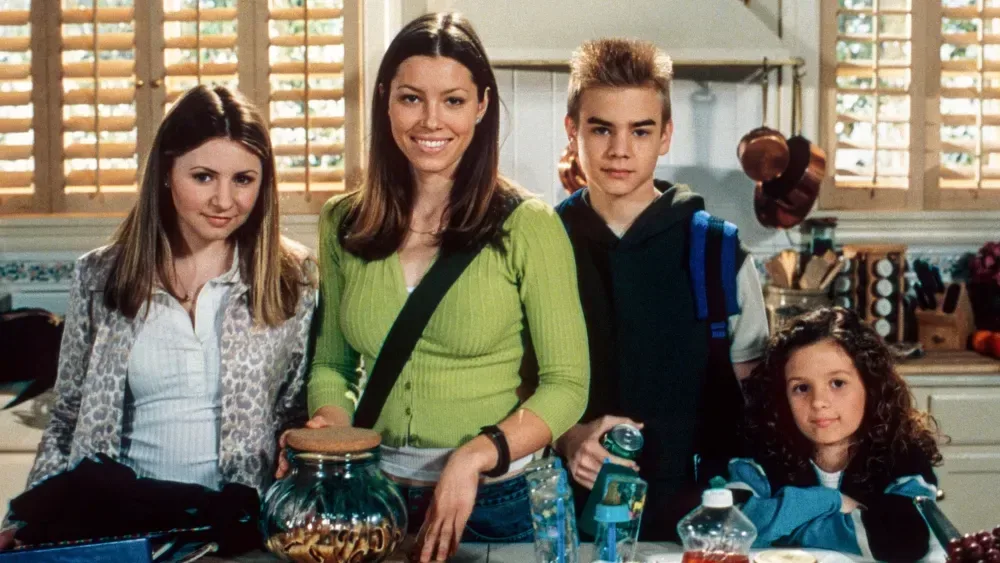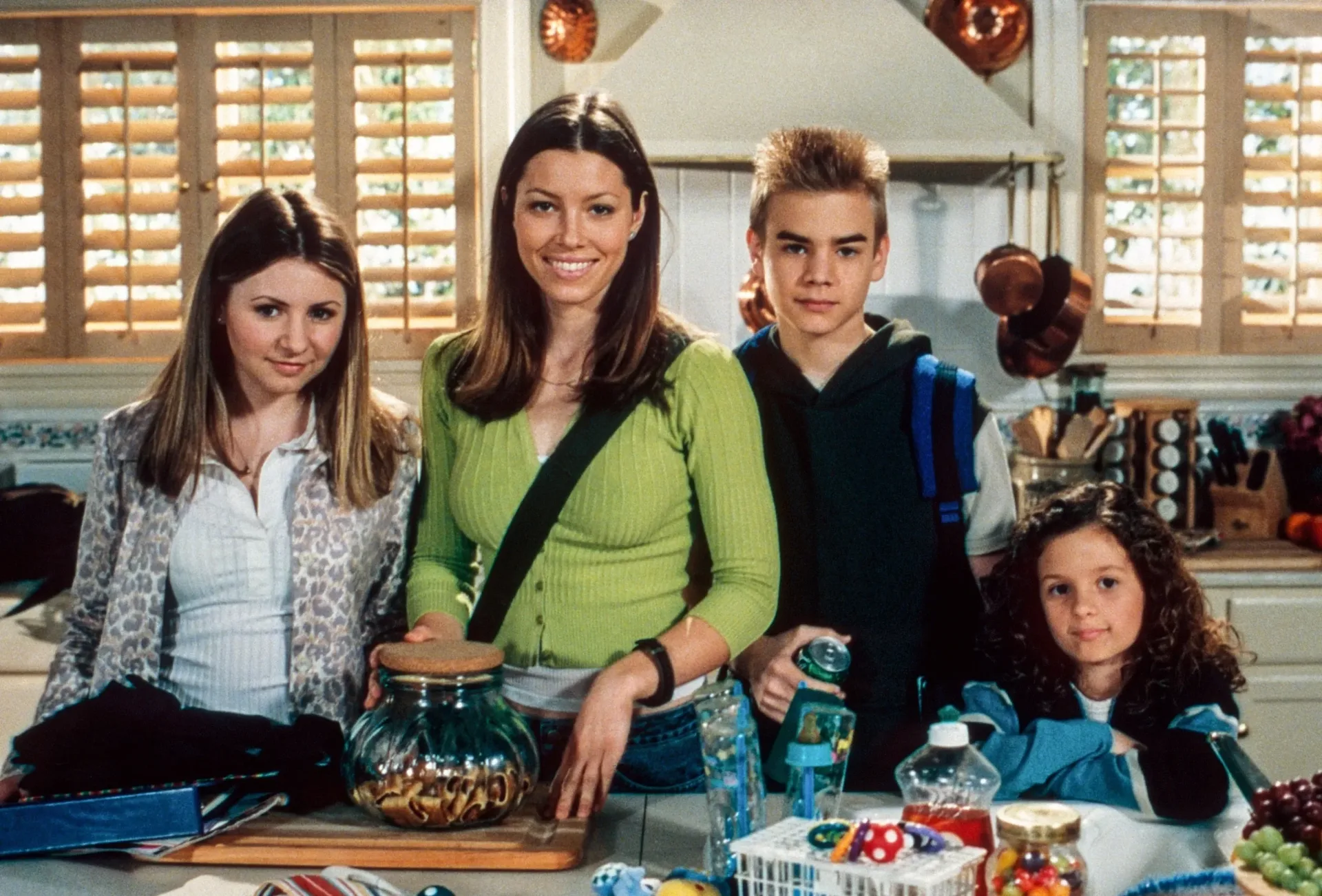
Jessica Biel has outlined the creative direction behind the planned 7th Heaven reboot: a new family drama meant to engage directly with the pressures facing children, teenagers and parents now. The actor, who appeared in the original series, is also involved as a producer on the new iteration.
Her description makes one thing clear: this is not being framed as a simple trip back to Glen Oak. The reboot is expected to center on a diverse family rather than the original Camden household, and no original cast members were expected to appear when the project was first reported in May 2025. No release date, platform, casting details or production timetable have been provided in the available information.
Instead, Biel’s comments point to a familiar television format being reconsidered for a different set of family conversations. Technology-related conflict, school issues, bullying, drugs and alcohol are among the subjects she identified as areas the project wants to address in a more direct and realistic manner. The update on Biel’s approach also emphasizes that the intended tone is not simply cheerful or sanitized; the goal, as she presents it, is realism alongside a less cynical outlook.
A family-drama reboot with a new set of pressures
The original 7th Heaven arrived in 1996 on The WB, a network later associated with The CW, and ended in 2007. Created by Brenda Hampton and produced by Aaron Spelling, it ran for 11 seasons and nearly 250 episodes. The show followed the Camden family, including seven children, in the fictional California town of Glen Oak. Eric Camden was a Protestant minister, a premise that put family life, belief and community at the center of the series.
For more context, explore IPv6 Won’t Boost Your Wi-Fi, but It Could Make Life Easier for Console Multiplayer.
Biel’s update suggests that the revival sees value in those broad themes, rather than in reproducing the original characters or setting. She has pointed to family as the enduring part of the show’s appeal, while also describing a need for programming that parents can share with their children. That matters because a project can retain a genre’s central concern without retaining its exact plot machinery. In this case, the inherited framework is a multigenerational household working through difficult issues; the new material would be expected to come from contemporary circumstances.
“Modernize” can be an imprecise word in reboot talk. Here, Biel gave it a relatively concrete meaning. The issues she named sit across several parts of young people’s lives: technology, school, peer relationships, substance use and family communication. A show can mention those subjects in passing, but a drama that treats them seriously has to consider how each one changes the others. Bullying can be connected to school and digital spaces; technology can reshape privacy and parent-child boundaries; alcohol and drugs can create concerns that involve trust, supervision and social pressure. Biel’s emphasis was on portraying such concerns in a real way.
That does not establish precisely what stories, characters or age ranges will be used. It does establish an intended lane: the reboot is being positioned as a family series willing to approach tough subjects without abandoning accessibility for a household audience.
What Biel appears to mean by “realistic”
Biel contrasted the proposed approach with the restrictions she believes constrained the original series. Her remarks do not spell out a rating, a network standard, or a particular storyline that would have been impossible in the earlier program. So it would be premature to assume a darker format, a specific target demographic or a particular distribution model.
What can reasonably be taken from her comments is that the creative team sees more room to deal with difficult material openly. “Realistic,” in this context, appears to mean acknowledging subjects that teenagers and families already encounter instead of treating them as too uncomfortable for a family-oriented drama. It does not necessarily mean making every situation bleak, shocking or adult-focused.
That distinction is important. Biel has also said she is looking for shows she can watch with her own children, and she described the available options in that space as limited. Her stated ambition is therefore not an anti-family revision of 7th Heaven. It is a version that recognizes family viewing does not have to mean avoiding every hard subject. The challenge for the project will be balance: a show can be candid about bullying or substance use while still making its relationships, language and emotional framing appropriate for the audience it hopes to serve.
Faith, community and a less jaded tone
Another major part of Biel’s pitch is the place of faith and community. She did not describe a single prescribed belief system for the reboot. Rather, she spoke about the importance of making room for faith in television, whatever form a family’s faith may take. That is a notable evolution from a series whose central household was led by a Protestant minister: the new project is described in more broadly inclusive terms, matching the fact that it is expected to follow a different, diverse family.
For viewers, “community” in a family drama can mean more than a neighborhood backdrop. It can be the network of people who help, challenge or misunderstand a household: friends, classmates, schools, religious communities and other social circles. Biel’s comments connect that idea to an outlook that is more hopeful than jaded. She has been careful, however, not to equate optimism with softness. A story can have a positive emotional center and still allow consequences, disagreement and pain to feel genuine.
That is likely the key creative tension the reboot will have to navigate. The original series was built around family, religion and moral questions. A contemporary successor that wants to feel relevant must make those subjects credible in the lives of its new characters, rather than treating them as relics or easy answers. Biel’s comments suggest the team understands that a hopeful tone only works if the problems on screen are taken seriously first.
The producer role Biel says she wants to play
Biel’s update was not limited to subject matter. She also discussed the kind of working environment she wants to help establish as a producer. Her focus was on a “safety net” on set, open communication among actors and crew, and a space where people can be creative and emotionally vulnerable.
In practical terms, a producer’s role can vary widely from project to project. Producers may be involved in creative development, staffing, schedules, budgets, problem-solving and the broader working culture. Biel did not detail her contractual responsibilities or day-to-day authority on this show. But her stated priority is clear: she wants the production environment to support performers and crew as they work on emotional material.
That focus fits the kind of stories she says the reboot wants to tell. Family drama often relies on performances involving conflict, shame, grief, fear, affection and reconciliation. Actors may be asked to portray deeply personal situations even when the plot remains suitable for a broad audience. Biel’s view is that people need a protected and communicative workplace to do that work well.
It is also worth separating an aspiration from a completed result. Biel is describing the set culture she intends to foster, not making a claim that the project has already entered production or achieved that goal. Still, the comments offer a useful clue about the production values she wants attached to the reboot: emotional material should be handled with care both within the story and behind the camera.
What is confirmed, and what remains unknown
There is a meaningful difference between a project’s stated creative ambitions and information audiences can use to plan a viewing date. At present, the available details are limited. The reboot has been reported as a new take on 7th Heaven centered on a diverse family. Biel is discussing its modernization and her producer approach. The original cast is not expected to appear, based on the earlier report.
Beyond that, many major questions are open. There is no confirmed premiere date, distributor or platform in the supplied details. There is no announced cast, no character list, no indication of whether Glen Oak will be used, and no outlined episode stories. There is also no confirmation of how prominently faith will operate in the weekly premise beyond Biel’s broad comments about its importance.
For now, the clearest expectation to set is that the reboot aims to preserve the family-and-community foundation associated with 7th Heaven while giving a new household conflicts shaped by current adolescence. Whether it can make that mix feel candid, hopeful and distinct will depend on the specifics that have yet to be announced.