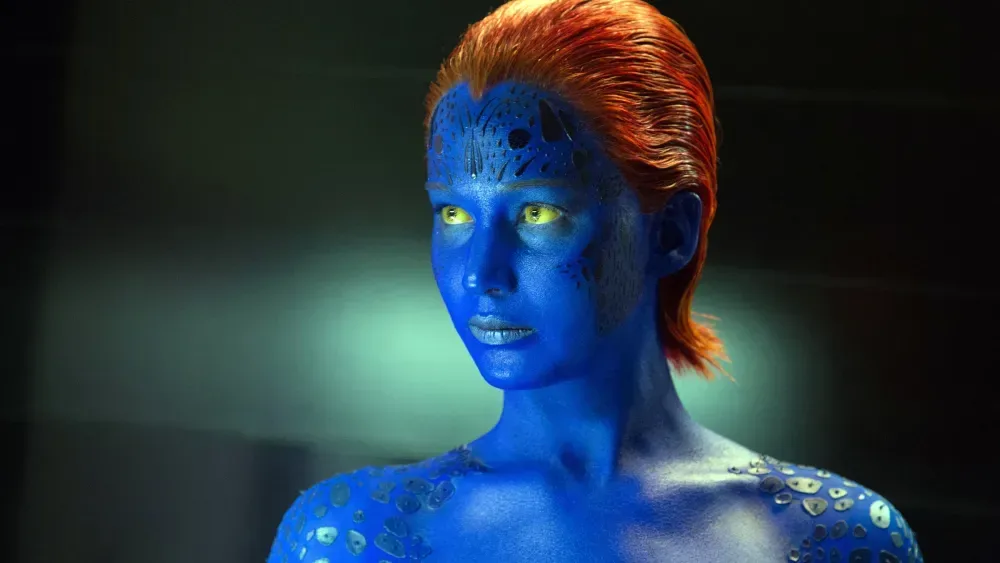
Jennifer Lawrence has made the division of labor in her Mystique memories extremely clear: the stunts were the reward; the blue paint was the boss battle.
Lawrence played the shape-shifting mutant in four X-Men films between 2011 and 2019. Looking back on the role, she said she loved the opportunity to train, learn how to move differently and perform stunt-driven work. But when the question turned to whether she might take on another heavy makeup or prosthetics transformation, her answer was emphatic: “Never say never, but absolutely fucking not.”
That is not a rejection of physical acting. It is a very specific rejection of the hours of preparation that can arrive before a performer ever reaches the set.
The Mystique experience was equal parts movement and makeup
Mystique is a character whose visual identity is inseparable from her blue skin, sculpted texture and unusual movement. Lawrence said her favorite element was the stunt work, including the process of training for it and learning how to inhabit the character physically.
She also spoke warmly about working with stunt double Renee Moneymaker, who doubled Lawrence on The Hunger Games as Katniss Everdeen and is one of her best friends. That continuity matters. A stunt performer and an actor need to create a shared physical language so that the action reads as one character on screen. The actor may perform selected movement, fighting, reactions and close shots, while the double handles or assists with demanding work. The collaboration is not merely logistical; it helps sell the illusion that the character’s body remains consistent through every cut.
For Lawrence, that side of Mystique offered an active, skill-based challenge. The paint, by contrast, meant endurance.
She identified cold airbrushing as a particular source of misery because she is ticklish. Airbrushing is a makeup-application method in which compressed air delivers color in a fine spray. It can create an even finish across large areas, which is plainly useful for a character whose design involves extensive body coverage. But the technical advantage does not make the sensation pleasant—especially when the application is prolonged and repeated over much of a performer’s body.
Lawrence’s summary of the experience was candid: she learned how little sleep she could function on, what can happen when a person reaches a breaking point, and the importance of patience. Her point is not that the work was mysterious or glamorous. It was labor-intensive, cold and exhausting.
Eight hours in the chair changes the calculation
Lawrence has previously recalled that the original process for X-Men: First Class, her Mystique debut, involved body paint and glue and took eight hours each time. In another interview, she described the feeling as having two tiny, cold, compressed-air brushes moving across her body.
Eight hours is not simply an inconvenient prelude to a workday. It can determine the rhythm of the entire day. Before an actor shoots a scene, attends a rehearsal or performs a stunt, they may already have spent the equivalent of a conventional workday being prepared to look like the character. If removal, touch-ups, wardrobe and the production’s normal shooting schedule are added afterward, the total demand becomes easier to understand.
That context sharpens Lawrence’s answer. A public image of a transformation often begins and ends with the finished frame: blue skin, yellow eyes, altered silhouette, a character instantly recognizable to audiences. The performer’s experience includes the unseen hours required to reach that image and maintain it.
There is also a meaningful difference between conventional screen makeup and an extreme transformation. Ordinary makeup can still require early call times and detail work, but full-body paint, adhesives and prosthetic components can introduce more time, more sensation, more restrictions and more maintenance. Lawrence’s comments put the focus on the human cost of that process rather than the novelty of the final look.
What Lawrence is—and is not—ruling out
Her phrasing leaves a narrow technical opening. “Never say never” is not a formal declaration that she will never play Mystique again, or that she will never accept any role involving altered appearance. But “absolutely fucking not” makes her present preference unmistakable: she does not want to submit to a Mystique-scale transformation involving intensive body paint or similarly heavy prosthetic work.
That distinction is important for fans inclined to turn a performer’s retrospective complaint into definitive franchise news. Lawrence did not announce a new project, a return, a negotiation or a final retirement from any character. She explained why a particular kind of preparation is deeply unappealing after having lived through it.
It is equally clear that she does not regret every part of the job. Her affection for the stunt training and for Moneymaker complicates any simplistic reading that the role was wholly negative. Lawrence is drawing a boundary around the part of the experience she would not choose again, while recognizing what she did enjoy.
The screen test came with its own damage
Lawrence also described a difficult experience before she had even won the part. For her Mystique screen test, she said her hair was dyed multiple colors in one day: red, brown, black and blonde. The process permanently damaged her hair.
A screen test is an audition filmed to evaluate how a performer reads on camera in a role or a particular production context. The point is usually to resolve uncertainty: whether the actor fits the part, how they interact with the creative choices around the character, or how the look translates through a camera lens. In this case, Lawrence’s recollection shows that the visual experimentation associated with Mystique started before the role itself was secured.
It also helps explain why her comments go beyond a joke about being ticklish. The cumulative story she tells includes invasive-feeling airbrush application, lengthy chair time, fatigue, demands on patience, glue and hair damage. Each element is manageable in isolation; together, they describe why another extreme makeover does not sound remotely enticing.
Why this matters beyond one superhero role
Stories about dramatic transformations often celebrate the apparent disappearance of the actor: the more unrecognizable a performer becomes, the more the result is treated as a remarkable feat. Lawrence’s account is a useful corrective to the idea that transformation is automatically a creative prize. It can be artistically effective and physically miserable at the same time.
Her comments also separate two types of work that are frequently bundled together under the broad label of “movie magic.” Stunts and movement training ask performers to build physical capabilities and communicate character through action. Extensive makeup and prosthetics work asks them to tolerate a lengthy process that produces a visual result. Both can serve the same character, but they do not make the same demand or offer the same satisfaction.
For audiences, that distinction can change how Mystique scenes are viewed. The character’s surface is not just a digital or costume-department detail in Lawrence’s memory; it is connected to long mornings, cold air and the difficult discipline of waiting. Meanwhile, the character’s athleticism is tied to training and to a trusted collaborator who helped make that action believable.
That behind-the-scenes reality is also part of a broader film-production conversation. Creative choices have practical consequences for schedules, labor and the kinds of preparation performers can reasonably be asked to undertake. Those production questions sit alongside other industry discussions, including the push for a federal film and television production tax credit, though Lawrence’s remarks are specifically about the personal demands of body paint and prosthetic-heavy character work.
A blunt boundary, not a dismissal of Mystique
Lawrence’s answer is memorable because it is direct, funny and rooted in concrete details. The cold spray made her ticklish. The sessions could take eight hours. The early hair-color changes caused permanent damage. Those are not vague complaints about a difficult job; they are specific reasons a repeat sounds unappealing.
At the same time, her favorite memory points in the opposite direction: training for the action and learning a new way to move. That contrast is the real takeaway. Lawrence can value the physical craft that helped bring Mystique to life without volunteering for another marathon of blue paint and glue.
For a character associated with transformation, that is a fittingly human line to draw. The audience may remember Mystique’s finished look. Lawrence remembers the process required to become her—and has little interest in doing it all over again.