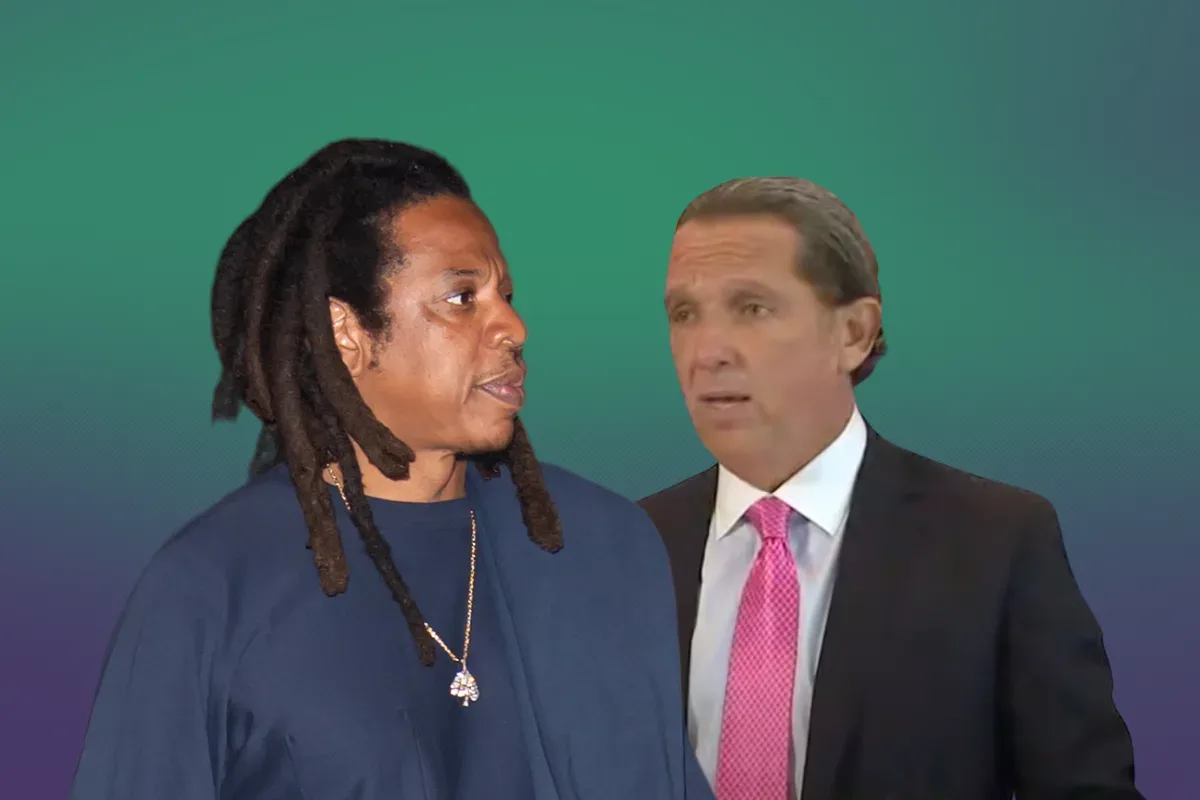
Jay-Z has asked a California appeals court to reconsider its decision affirming the dismissal of his extortion and defamation claims against attorney Tony Buzbee and Buzbee’s law firm. The new request follows a sworn declaration from the woman previously identified in litigation as Jane Doe, who now says her allegation against Jay-Z was untrue and that she never met him.
The filing places a major factual reversal at the center of a procedural question: whether an appellate court should reopen a case it has already decided in light of material that was not part of the earlier record. Jay-Z’s lawyers characterize Doe’s declaration as significant new evidence and seek a rehearing, with a request that the matter be returned to Los Angeles County Superior Court for limited discovery.
That request does not itself resolve the underlying accusations, establish liability by Buzbee, or guarantee that the dismissal will be undone. It asks the court to decide whether the recantation changes the legal analysis enough to justify another look.
What Jane Doe’s declaration says
Doe submitted her declaration in Jay-Z’s separate malicious-prosecution case in New York. In it, she says she never met Jay-Z, the founder of Roc Nation, and that the allegation she made against him was false. She also says she had begun voicing doubts about her account before the original sexual-assault lawsuit was withdrawn in February 2025.
Doe has denied receiving payment from Jay-Z in connection with the recantation. That denial is notable because Buzbee’s side has challenged the new declaration: one attorney for Buzbee described the recantation as “bought-and-paid-for,” but the supplied court-related account does not identify evidence supporting that assertion.
Buzbee has separately maintained that several lawyers heard the same allegations from Doe before she met him. His prior declarations described investigation that, in his view, gave his firm reason to believe her account at the time. Those competing positions matter because Jay-Z’s California claims turn in part on what Buzbee and his firm knew, believed, or should have understood when the accusations were advanced publicly.
The California appeal had already gone against Jay-Z
Earlier this month, California’s Second District Court of Appeal upheld the lower court’s dismissal of Jay-Z’s extortion and defamation claims. The panel concluded that private-investigator recordings had properly been excluded and that California’s anti-SLAPP law had been correctly applied.
Anti-SLAPP is shorthand for laws designed to prevent lawsuits from being used to chill protected speech and petitioning activity. In California, these disputes often involve an early procedural test. A defendant can seek to strike a claim arising from protected activity, after which the plaintiff generally must show enough merit to move forward. The exact mechanics depend on the claims and record before the court, but the immediate practical effect can be substantial: a case may end before full-scale discovery and trial.
Related coverage includes Jay-Z Seeks Rehearing in California Case After Accuser’s Recantation.
In this case, the appellate panel found that the existing record did not demonstrate that Buzbee knowingly advanced a false rape allegation or acted with reckless disregard for its truth. In defamation law, reckless disregard is not simply a mistake, a disputed investigation, or a later change in a witness’s account. It concerns a defendant’s state of mind and whether the person proceeded while seriously doubting the truth of a statement or deliberately avoided information that would reveal falsity.
Jay-Z’s new petition argues that Doe’s declaration materially undermines the prior rationale for accepting Buzbee’s asserted good-faith belief. The central argument is not merely that Doe has changed her position; it is that her account may warrant a closer examination of what Buzbee knew before Jay-Z was publicly identified.
Why “limited discovery” is a key part of the request
Discovery is the formal process through which parties obtain evidence from one another, including documents, communications, testimony and other material that may be relevant to the dispute. Jay-Z’s filing seeks limited discovery, meaning targeted fact-gathering rather than an unrestricted investigation of every issue in the litigation.
That distinction is important in an anti-SLAPP context. These statutes are intended to provide an early check against claims that cannot meet the required legal threshold, which can narrow the opportunity for evidence gathering. Jay-Z’s lawyers are arguing that the subsequent sworn recantation justifies a narrow reopening so a trial court can examine the question of knowledge with a more complete factual record.
Whether the court agrees will depend on its assessment of the declaration’s relevance and legal significance, not simply on the fact that it exists. Courts must also consider the procedural posture of the case: the appeal has already been decided, and a petition for rehearing is a request to revisit that outcome rather than a fresh lawsuit.
Recantation and legal proof are not the same question
A recantation can be consequential, particularly where it is sworn and directly contradicts an earlier accusation. But it does not automatically settle every legal question in related civil cases. A court may need to consider timing, corroboration, prior statements, potential motivations, the circumstances surrounding both the original allegation and the later reversal, and the knowledge of the people being sued at the relevant time.
That last point is especially important to Jay-Z’s California claims. Even if a later declaration is accepted as truthful, the legal question involving Buzbee may still focus on what information was available to him and his firm when they acted. Conversely, Jay-Z argues that the declaration is so substantial that it should permit inquiry into whether the prior account of the firm’s knowledge can withstand scrutiny.
The opposing accounts remain sharply different. Doe says the allegation was false, denies being paid to recant, and says she never met Jay-Z. Buzbee contests the reliability of the recantation and says lawyers had heard the allegations before Doe encountered him. Neither side’s position in these filings should be read as a final judicial finding.
How the California and New York matters connect
The declaration was filed in a New York malicious-prosecution matter, while the rehearing request concerns dismissed California extortion and defamation claims. They are separate proceedings, but Doe’s new statement has become the bridge between them because Jay-Z’s legal team contends it bears directly on issues considered in the California appeal.
That crossover explains why the latest move has drawn attention despite the California appellate decision having already been issued. New evidence emerging in one case can become relevant in another, but the receiving court must still determine what procedural weight, if any, it deserves.
For Jay-Z, the immediate objective is relatively defined: obtain rehearing and a remand for limited discovery. For Buzbee and his firm, the prior appellate ruling remains a major advantage, and their response disputes the implication that Doe’s latest statement should rewrite the earlier case.
What happens next
The appeals court must decide whether to grant rehearing. If it declines, the earlier decision upholding dismissal remains in place unless another procedural avenue is pursued. If it grants rehearing, that would not mean Jay-Z has won his extortion or defamation claims. It would mean the court is willing to reassess the case, potentially including whether a return to the trial court for narrowly tailored discovery is appropriate.
The matter also illustrates why high-profile civil disputes can remain active even after an appellate ruling: later filings, changed testimony and new declarations may create separate arguments about the fairness of relying solely on the original record. Still, such developments are tested through court procedure, not by the volume or intensity of public debate.
Jay-Z’s petition frames Doe’s declaration as a reason to reopen that process. Buzbee’s side challenges the declaration’s credibility. The court’s next action will determine whether the California litigation receives another evidentiary look or whether the dismissal stands as previously affirmed.
The dispute arrives amid a wider run of music-business legal reporting, including a separate account of Finesse2tymes’ allegations over a Mob Ties exit, though that matter is unrelated to Jay-Z’s cases.