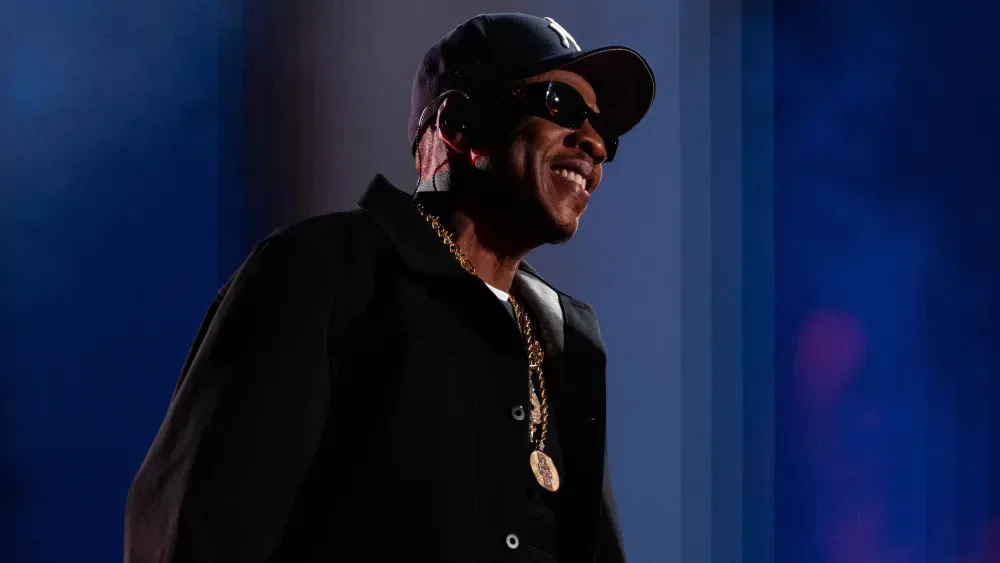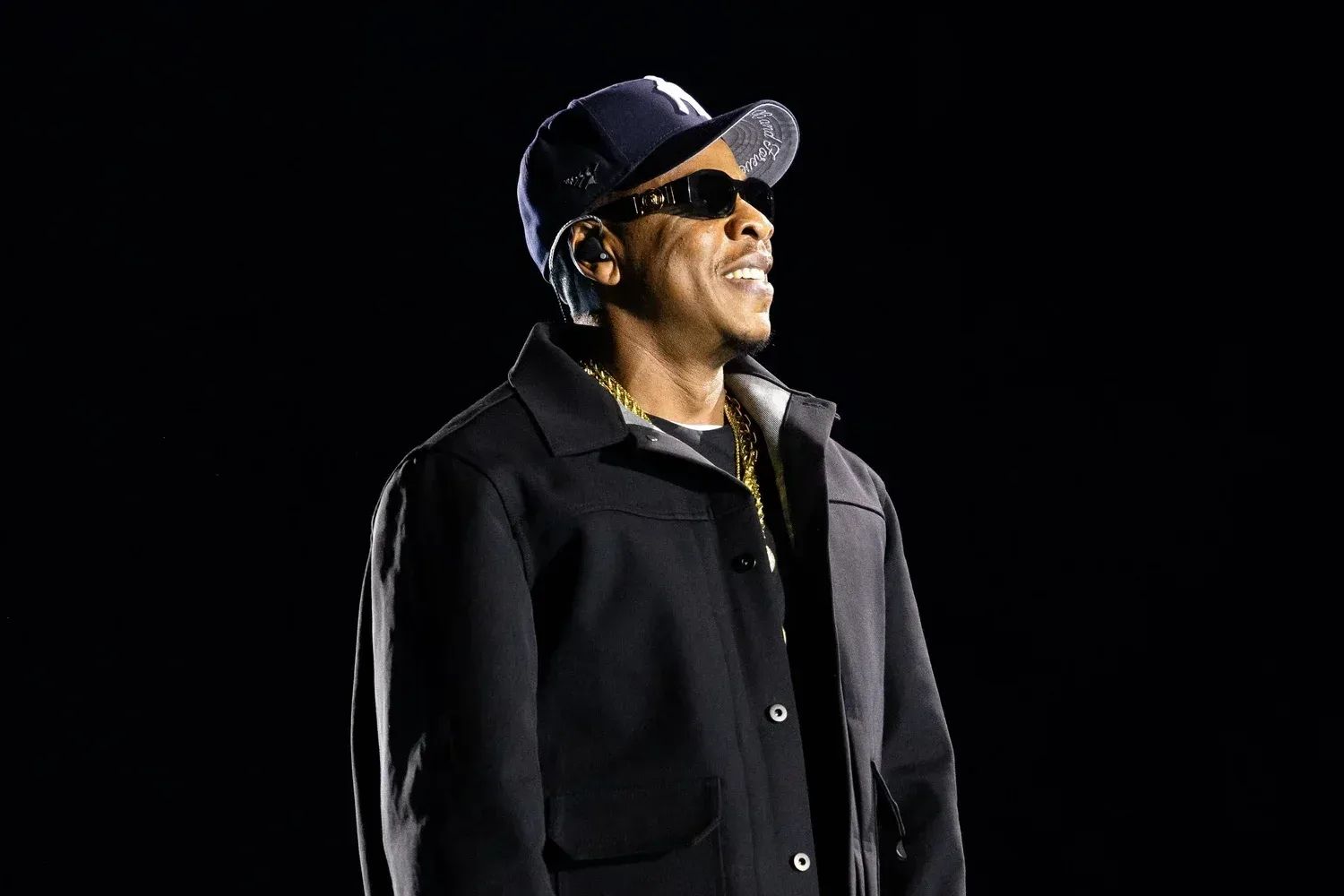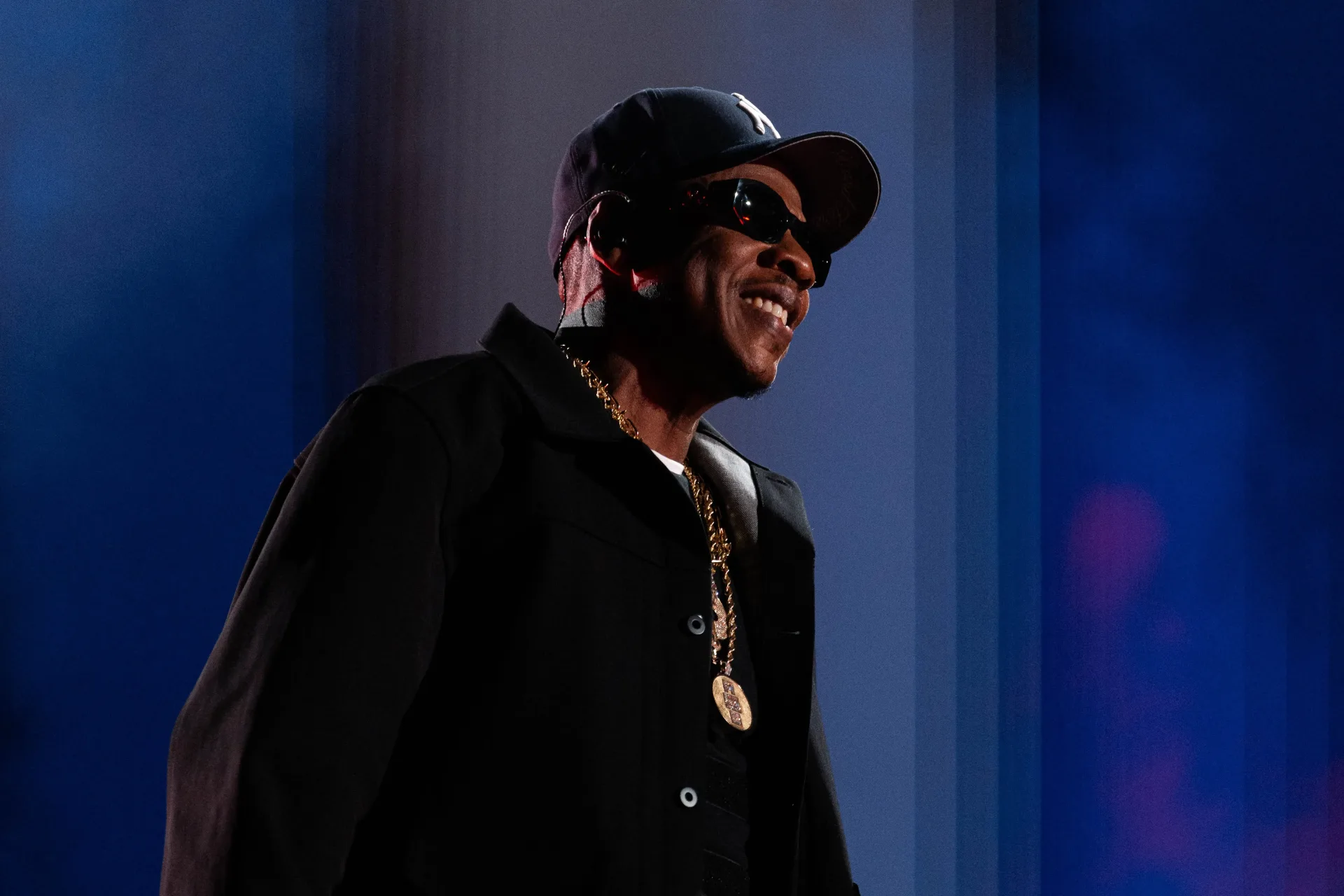
Jay-Z brought the final SoFi Stadium night of his “Jay-Z 30” celebration to a close with a show built less around surprise for surprise’s sake than a full-scale argument for the size of his catalog. The Inglewood performance was the second of two nights at the venue and capped a yearlong program that began with a Roots Picnic headlining appearance in late May.
The most visible special guests arrived for a West Coast-centered stretch: Dr. Dre and Snoop Dogg joined the evening for a medley that included “The Next Episode,” “California Love,” “Nuthin’ but a ‘G’ Thang,” and “Still D.R.E.” Too $hort also appeared for “Blow the Whistle,” giving the show a Bay Area connection before the Dre and Snoop segment broadened that regional salute into a run of foundational rap hits.
But the night’s central design was Jay-Z moving through his own material. “Izzo (H.O.V.A.),” “U Don’t Know,” “Dirt Off Your Shoulder,” “Song Cry,” “Dead Presidents,” “Hard Knock Life (Ghetto Anthem),” “99 Problems,” “Empire State of Mind,” and “Encore” were among the songs used to trace different eras of his output. Rather than treating the anniversary branding as a museum tour, the show framed the songs as an active body of work—one that can still carry a stadium without requiring a constant parade of cameos.
A finale constructed around the catalog
“Jay-Z 30” has been a retrospective in the most literal useful sense: a chance to revisit music across a lengthy career and to show how songs associated with distinct phases can coexist in a single set. The SoFi setlist moved from “The Watcher 2” into Too $hort’s “Blow the Whistle,” then into Jay-Z staples including “Izzo (H.O.V.A.)” and “Beach Is Better.” Later passages made room for introspective records such as “Never Change,” “Song Cry,” and “D’Evils,” before returning to the massive crowd-facing material.
That sequencing matters. A career-spanning concert can easily become a list of famous titles with little sense of rhythm. Here, the program connected songs through medleys and transitions: “Girls, Girls, Girls” flowed into “Excuse Me Miss,” “La-La-La (Excuse Me Miss Again),” and “Change the Game,” while “N----s in Paris” was paired with “Big Pimpin’.” Those combinations compress time, placing songs from different periods in direct conversation instead of isolating every hit in its original release-era box.
There was also a clear balance between solo identity and collaboration. “Run This Town,” “Clique,” “No Church in the Wild,” and “N----s in Paris” acknowledge the collaborative strands of Jay-Z’s discography, while the guest segment gave Dre and Snoop room to perform their own landmark material. Yet the overall presentation remained Jay-Z’s show. The guests were major moments, not substitutes for a headliner’s set.
Why the West Coast guests fit the room
SoFi Stadium’s Los Angeles-area setting gave the Dre and Snoop appearance an obvious thematic fit. Their four-song run included records that are closely tied to their musical partnership and to the broader cultural footprint of West Coast rap. It also created a clean tonal contrast with the Jay-Z material around it: the show could briefly shift its center of gravity without losing the sense that the evening was a celebration of hip-hop lineages and regional connections.
Too $hort’s appearance carried that logic further. Performing “Blow the Whistle” made the Bay Area nod explicit, and it showed the value of a guest spot that has a specific connection to the song, rather than simply adding a celebrity entrance. In a stadium show, a well-placed guest can work like a change of level in a game: not a detour from the main campaign, but a purposeful new environment that refreshes the pace before the player returns to the core path.
Related coverage includes Jay-Z Closes ‘Jay-Z 30’ at SoFi Stadium With Dr. Dre and Snoop Dogg.
The SoFi guest count was comparatively restrained when set against other dates in the celebration. Previous stops featured city-specific appearances: Philadelphia brought Jazmine Sullivan, Bilal, Freeway, Beanie Sigel, and Peedi Crakk into the fold, while Jay-Z’s three-night Yankee Stadium run included Alicia Keys, Fat Joe, and Jadakiss. Those choices localized each performance. At SoFi, Dre, Snoop, and Too $hort served a similarly place-aware function while leaving more space for Jay-Z to cover the ground himself.
That approach is worth underlining because stadium retrospectives can sometimes make the supporting cast feel like the attraction. This set instead used guests as punctuation. The headline was the ability to go from “Where I’m From” and “Public Service Announcement (Interlude)” to “Heart of the City (Ain’t No Love)” and “Encore” with the same performer at the center.
Jay-Z addresses online claims and AI-era confusion
During “Encore,” Jay-Z directly pushed back on social-media claims concerning the attendance and ticketing at SoFi. He encouraged the crowd to trust what they could see and hear rather than accept online posts at face value, tying that point to a wider warning about deception in an era increasingly shaped by AI tools.
His reference to “propaganda” and technology was not a technical presentation about artificial intelligence. It was a broader point about verification: digital systems can accelerate the spread of claims, but volume and velocity do not establish that a claim is true. The practical takeaway is simple, particularly around live events. A viral post, a cropped image, or a confident account of ticket distribution does not automatically provide reliable evidence about an arena-sized room.
It was a fitting subject for an event focused on legacy. Legacy is often discussed as if it is a fixed scoreboard—album counts, hit records, business achievements, or a one-line summary repeated online. A performance like this argues for a more tangible measure: the body of songs, the ability to arrange them into a coherent live narrative, and the continued response they generate in a room.
That is not the same as declaring every online criticism invalid. It is instead a reminder that the experience of a concert and the digital conversation around it are different things. The former is immediate and sensory; the latter is fragmented, often stripped of context, and vulnerable to distortion. Jay-Z’s closing remarks explicitly asked attendees to distinguish between them.
The setlist’s bigger story: eras, not nostalgia
The show’s strongest throughline was range. “Dead Presidents,” “Where I’m From,” and “D’Evils” represented the earlier material; “Hard Knock Life (Ghetto Anthem)” and “Big Pimpin’” brought in records associated with a later commercial ascent; “Dirt Off Your Shoulder,” “Run This Town,” and “On to the Next One” extended the path forward. “Family Feud,” “FWMN,” and “Beach Is Better” ensured the set did not stop at the most familiar older milestones.
That breadth helps explain why the “30” concept works as more than anniversary branding. The point is not merely that 30 years have passed. It is that a large selection of songs from those years can be made to feel connected in one night. The concert’s structure placed hard-edged material, reflective tracks, radio-scale singles, collaborations, and deep-catalog signifiers beside one another.
“Heart of the City (Ain’t No Love),” performed near the end, gave the night a particularly apt late-show statement. Its lyric about having “held you down 30 summers” directly matches the anniversary premise, turning a familiar song into a line of dialogue with the audience. “Empire State of Mind” then maintained the grand scale before “Public Service Announcement (Interlude)” and “Encore” supplied the final stretch.
For readers following how major music events use regional guests and catalog storytelling, another recent live-music example can be found in this report on Macklemore’s Red Rocks return. The circumstances are different, but both shows illustrate how an artist’s onstage remarks and local setting can become part of the event’s larger meaning.
What comes after ‘Jay-Z 30’ remains unresolved
The SoFi finale necessarily invites questions about what Jay-Z will do next, but the available picture remains uncertain. Rumors of a new album have circulated, though collaborators connected to those reports subsequently walked back their comments. A possible Super Bowl Halftime Show appearance has also been discussed, without a firm resolution established here.
For now, the meaningful fact is the completed run itself: a yearlong celebration that reached SoFi Stadium, drew on a career-length setlist, and made room for Too $hort, Dr. Dre, and Snoop Dogg without surrendering the spotlight. The finale’s scale was substantial, but its thesis was straightforward. The songs were the evidence, and Jay-Z spent the night presenting them in sequence.
Selected SoFi Stadium setlist highlights
- “The Watcher 2”
- “Blow the Whistle” with Too $hort
- “Izzo (H.O.V.A.)”
- “Run This Town”
- “Song Cry”
- “Dead Presidents”
- “Hard Knock Life (Ghetto Anthem)”
- “Murder Was the Case” with Snoop Dogg
- “The Next Episode” with Dr. Dre and Snoop Dogg
- “California Love” with Dr. Dre and Snoop Dogg
- “Nuthin’ but a ‘G’ Thang” with Dr. Dre and Snoop Dogg
- “Still D.R.E.” with Dr. Dre and Snoop Dogg
- “99 Problems”
- “Empire State of Mind”
- “N----s in Paris / Big Pimpin’”
- “Public Service Announcement (Interlude)”
- “Encore”