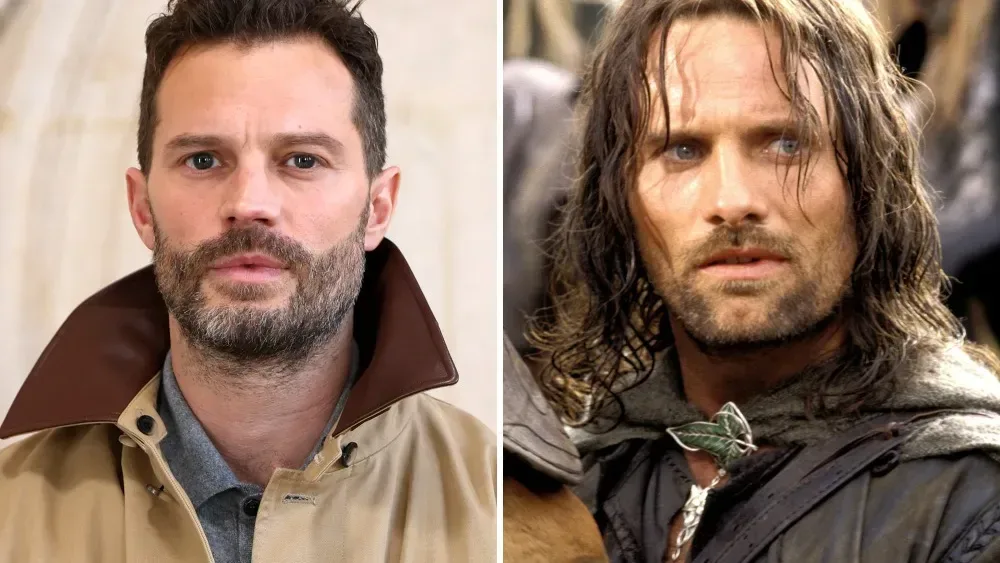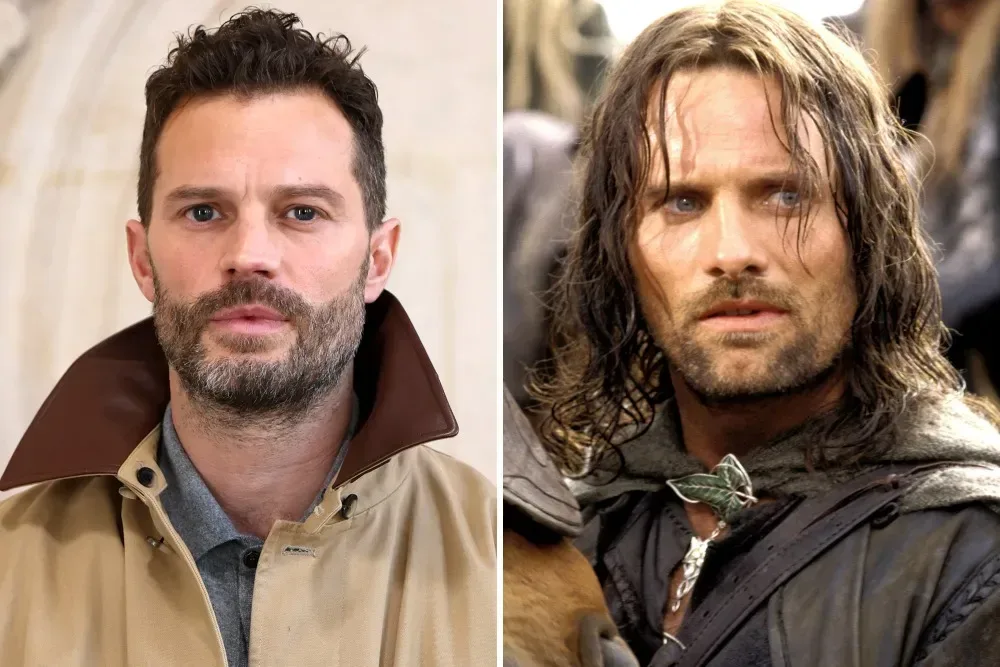
Jamie Dornan knows exactly how formidable the job is. In The Lord of the Rings: The Hunt for Gollum, he will play a younger Aragorn, a character permanently associated for many viewers with Viggo Mortensen’s performance in the original film trilogy. Dornan’s approach, however, is not to treat the role as a competition with what came before.
“There’s pressure when you’re trying to follow in those footsteps,” Dornan said while discussing the part. He called Aragorn an iconic role and described Mortensen’s work as one of his own favourite performances. Rather than attempting to surpass it, Dornan said he hopes to capture some of the energy Mortensen brought to the character.
“There’s no part of me that’s trying to outdo him,” Dornan said of Mortensen.
That distinction matters for a film built around a recognisable era, familiar characters and a story that places Aragorn before the public identity he develops in the earlier films. The new movie is described as a standalone feature told from Gollum’s perspective, with Gandalf sending the younger Aragorn to track down the corrupted hobbit.
For Dornan’s character, that means the story is not simply revisiting the king-in-waiting audiences remember. Aragorn is still known as Strider: a solitary hunter, before his eventual renown as the heir to Gondor’s throne. The premise gives the film room to focus on a different stage of the character’s life, while also making the weight of a recasting impossible to ignore.
A younger Strider, not a replacement Aragorn
Recasting a beloved character can create two competing expectations. Audiences may want continuity in the character’s personality, manner and moral centre, but they also expect the performer to bring something personal to the role. Dornan’s comments suggest he understands that balance as the central task.
His stated respect for Mortensen is not an indication that the two versions must be identical. A prequel setting inherently asks a performer to portray a version of the character who has not yet reached the point audiences know best. In practical storytelling terms, that gives The Hunt for Gollum a defined dramatic lane: Strider may carry qualities associated with Aragorn, but he is operating at a prior moment in his journey and under a different identity.
The word prequel is important here. It does not mean a remake of the original trilogy’s Aragorn arc. Instead, it places a new narrative before it. The reported setup centres on a hunt for Gollum, not on replaying the events that made Aragorn famous. Dornan can therefore acknowledge the original performance while approaching a character who is framed as younger, more isolated and working as a hunter.
That does not eliminate the challenge. Mortensen’s Aragorn remains a major cultural reference point, and Dornan openly calls the role intimidating. But it does clarify the standard he has set for himself: honouring an established interpretation rather than positioning his work against it.
Andy Serkis moves behind and in front of the camera
The Hunt for Gollum also brings Andy Serkis back to the character with which he is closely connected. Serkis will direct and star in the standalone film, returning as Gollum after having provided the voice and motion-capture performance for the character in the original trilogy.
Motion capture, often shortened to mo-cap, is a performance technique in which an actor’s movements are recorded and used to drive a digital character. Gollum’s screen presence combined Serkis’s physical performance and voice with computer-generated imagery. That connection makes Serkis’s role especially notable: he is not only reprising Gollum, but directing a story structured around Gollum’s point of view.
The movie will be Serkis’s first time as the primary director of a feature in this fantasy franchise. He previously served as second-unit director on Peter Jackson’s The Hobbit trilogy. A second unit generally handles material separate from the main unit’s day-to-day shoot, often including supplementary sequences, though the supplied details do not specify what scenes Serkis directed on those films.
Serkis has directed features including Mowgli: Legend of the Jungle and Venom: Let There Be Carnage. His return as both director and performer creates an unusually direct bridge between this new project and the earlier screen interpretation of Gollum.
The returning and new Middle-earth ensemble
Dornan and Serkis will be joined by familiar faces from the previous films. Ian McKellen is returning as Gandalf, while Elijah Wood is back as Frodo. Their inclusion signals that the film’s story will connect with established characters even as it shifts its central perspective toward Gollum and sends Aragorn on the hunt.
The incoming cast includes Kate Winslet, Leo Woodall, Lee Pace and Anya Taylor-Joy. No character information for those performers has been provided, so their roles should remain an open question rather than a source of speculation.
The blend of returning performers and new casting makes the film’s central creative question especially clear. It is seeking continuity with the cinematic Middle-earth audiences know, but it is doing so through a story whose lead focus is neither Frodo nor the later, fully realised Aragorn. Instead, Gollum’s perspective frames the narrative, and a younger Strider becomes the figure pursuing him.
That structure potentially makes the title more than a straightforward tracking story. Gollum is a corrupted figure, and the hunt puts him at the centre of the film rather than merely making him an obstacle in another hero’s journey. Meanwhile, Aragorn’s role as a lone hunter can show the character in a less publicly defined phase than the heir-to-the-throne image attached to him later.
Why Dornan’s framing is the sensible one
Dornan’s refusal to “outdo” Mortensen is a measured response to the kind of franchise role where comparison is unavoidable. The objective is not to erase the audience’s memory of a previous portrayal; it is to give the earlier version of the character a credible place within a new story.
There is a useful distinction between imitation and continuity. Imitation would imply reproducing surface details for their own sake. Continuity means recognising the character’s established screen identity while identifying what a different moment in his life requires. Dornan’s emphasis on recapturing some of Mortensen’s energy points toward the latter.
It is also an approach suited to a standalone film. “Standalone” means the feature is being presented as its own narrative rather than as one installment in an announced multi-film arc. The film can tell a self-contained hunt while drawing meaning from its place in the broader Middle-earth setting. As with other projects that explore separate stories alongside a larger screen universe—such as the separately positioned Blade Runner 2099 board game—the challenge is making the new work feel connected without relying entirely on familiar material.
For The Hunt for Gollum, that challenge lands most visibly on its Aragorn. Dornan will play a hero audiences already know, in a period before the character’s better-known legend is fully established. His comments make clear he is approaching Mortensen’s legacy with admiration rather than rivalry. Whether the younger Strider feels like a persuasive earlier chapter of Aragorn’s life will be one of the film’s most closely watched questions.