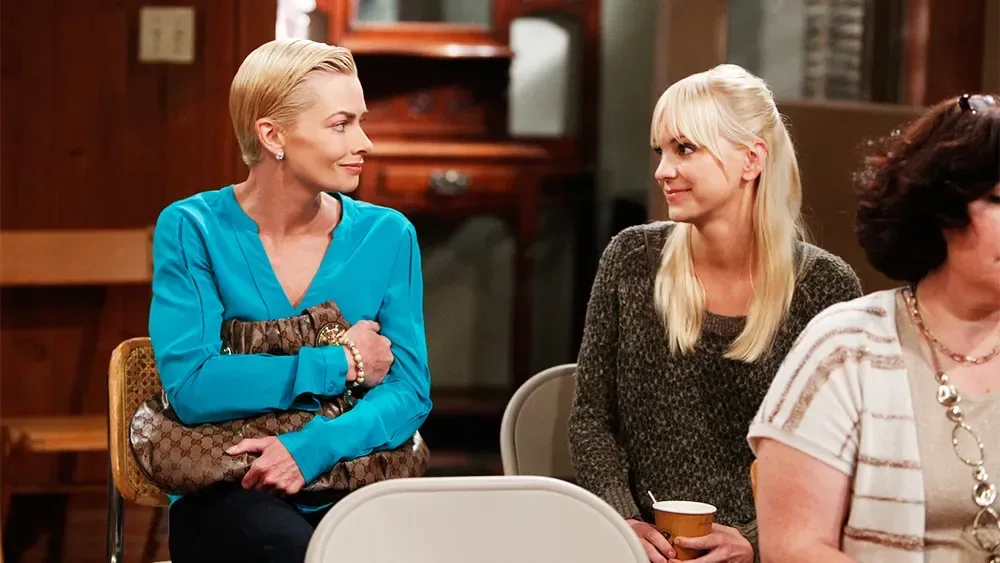
Jaime Pressly has publicly celebrated the cast and crew behind Mom following comments from series co-creator Chuck Lorre about former lead Anna Faris in his memoir, Sitcom. Pressly, who played Jill Kendall for seven years after joining in the second season, described the workplace as a rewarding one shaped by an “incredible” group of women and a strong crew.
The response comes after Lorre wrote that he had initially doubted whether Faris was suitable for the role of Christy Plunkett, the sitcom’s central character. He said that, over time, he came to believe his initial reluctance had been justified, pointing to Faris’ departure before the comedy’s final season. Faris subsequently said the passage hurt, while stressing her pride in the show and gratitude for the years she spent making it.
Pressly focuses on the people who made the show
Pressly’s remarks do not try to litigate the circumstances of Faris’ exit. Instead, they put the emphasis on her own seven-year experience on the CBS comedy, which ran for eight seasons. She said it was a pleasure to arrive at work each day alongside her female colleagues and praised both the production crew and the ensemble.
That distinction matters. Lorre’s memoir offers his personal assessment of the Faris casting and her eventual exit. Pressly, meanwhile, is discussing what she directly valued about the production: the people she worked with, the creative environment, and the opportunity to play an imperfect woman in an ensemble comedy.
“Beautifully flawed” is an apt phrase for the world of Mom. Pressly played Jill Kendall, a recovering addict, on a series whose characters wrestled with recovery, family pressures, friendships and difficult decisions. The show’s comedy depended not on presenting its characters as models of perfection, but on letting them be inconsistent, funny, hurt, supportive and capable of change. Pressly’s defense of the cast frames that collective work as the lasting reality of her time there.
She also noted the value of collaborating with “girlfriends” every day, describing the atmosphere as refreshing for women of a similar age. In an industry where public accounts of a show’s history can easily become centered on tensions between prominent figures, her comments redirect attention to the wider group that made the series work across its run.
What Lorre wrote about Anna Faris
In Sitcom, Lorre said he had been unsure Faris was right for the material when she was being considered for Christy Plunkett. He connected that hesitation to his prior working relationship with Charlie Sheen, whose public clash with Lorre near the end of Two and a Half Men resulted in Sheen’s firing in 2011.
Lorre further wrote that his concerns about Faris had proved correct, characterizing her reasons for leaving as something the people on the show understood. The memoir excerpt does not provide specific details about what he meant. It is therefore important not to treat his phrasing as a verified explanation of Faris’ departure.
Faris left Mom in 2020 ahead of the final season. At that time, she said she wanted to pursue other opportunities. That remains the stated explanation included in the record here. Lorre’s later characterization and Faris’ original statement are separate accounts, and the supplied information does not establish additional facts that would resolve the gap between them.
There is also a difference in how the timeline is described. Lorre wrote that Faris left after six years, while Faris referred to seven years in her response, and Pressly explained that she worked on an eight-season show for seven years after arriving in season two. Those varying descriptions may reflect different ways of counting a production’s span, but no further explanation is provided. The careful takeaway is simply that Faris led the show for its earlier run before leaving ahead of the final season.
Faris says the memoir passage hurt
Faris addressed the remarks in an Instagram post dated Oct. 15. Her response did not deny that she was hurt. But it also resisted turning her time on Mom into a wholly negative story. She said Lorre had given her a job she loved, said she never took that work for granted, and said she remained proud of what the team made together.
That is a notably layered answer to criticism from a former collaborator. Faris acknowledged the emotional impact of reading Lorre’s words while preserving the importance of the work, the colleagues and the period of her life associated with the series. Her response does not ask audiences to discard the show because of the dispute; rather, it separates the pain caused by the memoir passage from her appreciation for the experience itself.
She also shared that she has been sober for a year and a half, reflecting on the personal resonance of having starred in a comedy about recovery and then living through recovery herself. Faris said she is healthy, working and happier than she has been in a long time.
Recovery is central to this part of Faris’ statement, but it should be handled precisely. She disclosed her sobriety and spoke about how it relates to the themes of Mom. The available information does not establish a connection between that disclosure and Lorre’s claims about her departure. Conflating the two would go beyond what either Faris or the reported facts say.
The final season moved the ensemble forward
After Faris’ exit, Pressly took on a leading role in Mom’s final season. Allison Janney, Mimi Kennedy, Beth Hall and Kristen Johnston were also part of the show’s cast. That continuation is significant because it reflects the ensemble structure Pressly is defending: although Christy was the original lead, the series had developed a broader group of characters with enough weight to carry the closing season.
For viewers, cast transitions can change a show’s tone and center of gravity. A lead actor’s departure is not merely a behind-the-scenes personnel matter; it can alter the relationships, stories and expectations audiences bring to each episode. Yet Pressly’s comments underline another side of that reality: a long-running production is made by many people, and its identity can extend beyond one performer or one disputed account of its history.
That wider view also applies to television labor generally. A sitcom’s public image often becomes attached to its creator and its most recognizable stars. But actors in recurring and ensemble roles, writers, directors, crew members and other collaborators contribute to its day-to-day culture. Pressly’s praise gives the production’s shared experience a place in a conversation that could otherwise be reduced to Lorre and Faris alone.
For more on the way performers discuss the craft and professional demands of television work, see this look at LL Cool J’s reflections on stunt work as Sam Hanna.
A dispute with no need for invented answers
There is a temptation, especially when a memoir uses loaded phrasing, to fill in every blank around a departure from a popular series. The facts available here call for more restraint. Lorre has expressed regret over casting Faris and suggested her reasons for leaving were widely understood among the people involved. Faris says those remarks hurt, says she loved the job, and has reaffirmed her pride in the show. Pressly has chosen to defend the women who worked together and to remember her years on set as wonderful.
All three perspectives can be reported without pretending they provide a complete account of every behind-the-scenes issue. What is clear is that Mom remains meaningful to the people speaking about it: Faris recognizes its importance in her career and personal life, while Pressly remembers a supportive collective of colleagues who portrayed characters allowed to be complicated.
Pressly’s remarks are not a detailed rebuttal of every line in Lorre’s memoir. They are something more specific: a defense of the value, talent and humanity of the cast around her. In the context of Faris’ response, that support reinforces a point that can get lost in retrospective criticism—whatever disagreements existed, the series was also years of shared work for an ensemble that included Faris, Pressly, Janney, Kennedy, Hall and Johnston.