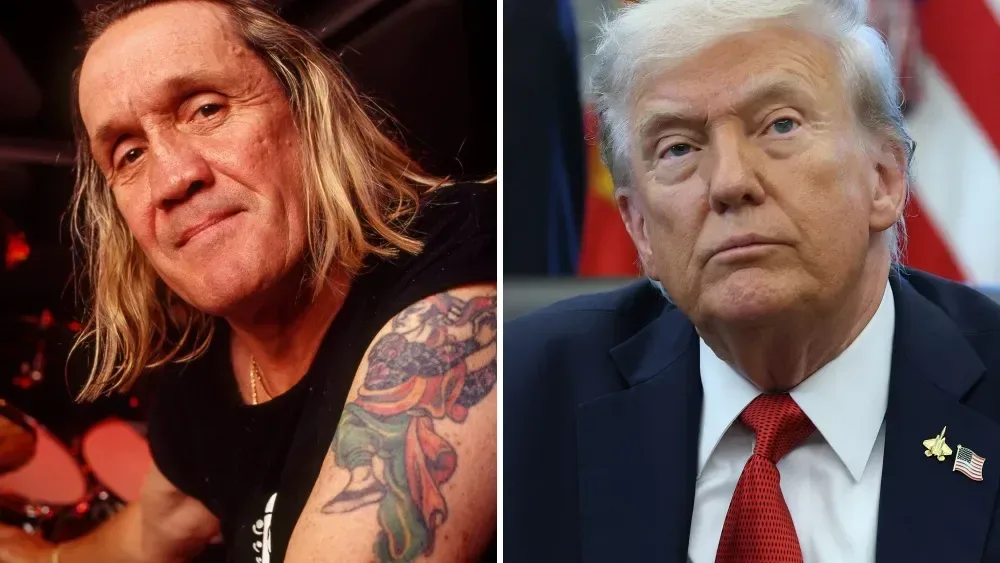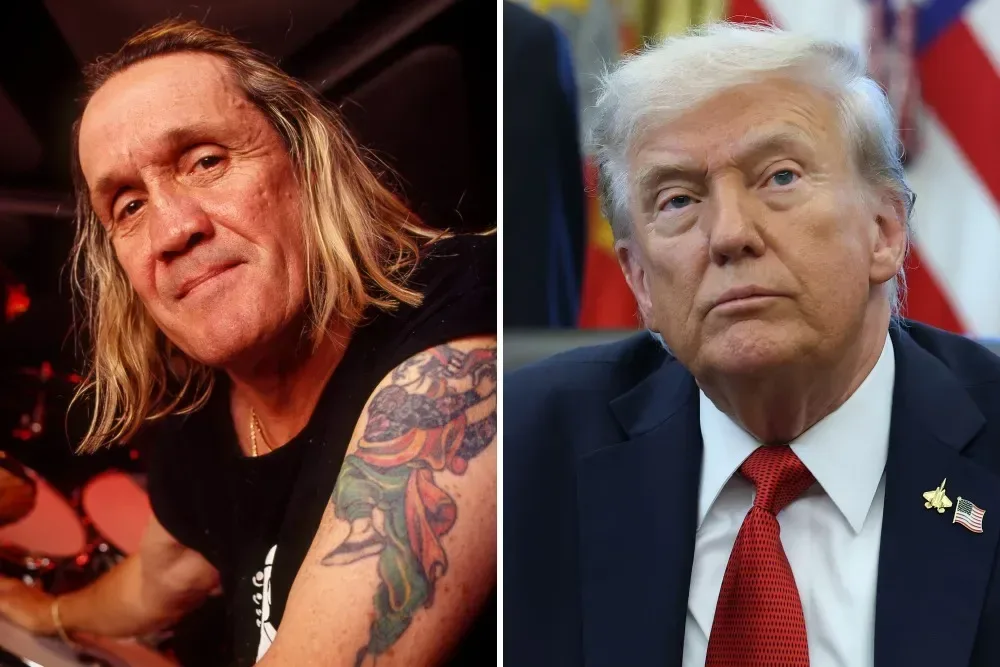
Iron Maiden drummer Nicko McBrain says he was invited to join a round of golf involving Donald Trump—and that he declined without hesitation.
McBrain, who lives in Florida as Trump does, described being approached by a friend he characterized as a committed Republican. The invitation was presented as a chance to golf with the president. McBrain’s response, as he recounted it, was a firm no.
The exchange is a small story on its face: a private social invitation that never turned into a public event. But McBrain did not leave the reason ambiguous. He used the anecdote to state strong personal opposition to Trump and to people around him, framing the refusal as a matter of conviction rather than scheduling, celebrity optics, or a lack of interest in the sport.
McBrain’s remarks were political, even as he rejects the label
McBrain said he does not consider himself politically inclined, while also acknowledging that his views on Trump make that distinction difficult to sustain. That tension is familiar in public conversations about politics. Someone may not identify with a party, campaign, or ideology, yet still hold forceful opinions about a political leader’s conduct and decisions.
In this case, McBrain criticized what he called narcissism and referenced concerns including the Epstein files and the war in Iran. He also voiced the opinion that Trump and his associates should face jail. Those are McBrain’s political statements and judgments, not findings established by the account of the interview. His comments about Pete Hegseth similarly represent his own prediction and opinion, rather than a reported legal outcome.
That distinction matters, particularly when a musician’s blunt language becomes the headline. A performer can offer a personal assessment of public figures; that does not turn the assessment into a verified account of a crime, an imminent prosecution, or a court decision. The concrete report here is that McBrain says he was invited to golf and chose not to go, then explained his thinking in unusually direct terms.
What “MAGA” means in this context
McBrain’s opposition was described as anti-MAGA. MAGA is shorthand for “Make America Great Again,” the political slogan strongly associated with Trump and a broader movement of supporters. In everyday use, “anti-MAGA” generally signals opposition to that movement or to its political priorities—not necessarily membership in any particular opposing party.
It is an important bit of shorthand because it explains why an invitation that could otherwise read as a casual Florida golfing opportunity became charged. McBrain was not describing a disagreement over music, sports, or hospitality. He was drawing a boundary around political association.
That boundary is also more specific than an artist simply avoiding an endorsement. Playing a round of golf is not, by itself, a formal political act. Yet a social appearance with a president can be interpreted publicly as friendly access, approval, or at minimum a willingness to be seen in that setting. McBrain’s refusal avoids those interpretations and ensures that the meeting remains hypothetical.
A candid moment during a major Iron Maiden year
The remarks arrive while Iron Maiden is in the middle of a landmark period. The band was inducted into the Rock & Roll Hall of Fame as part of its 2026 class in April, with the official induction ceremony scheduled for November 14 at the Peacock Theater in Los Angeles.
Iron Maiden has also announced the third and final leg of its 50th-anniversary Run for Your Lives tour. That run is set to begin in April and conclude in May, ending with festival-headlining appearances at Sonic Temple and Boardwalk Rock.
For a band of Iron Maiden’s scale, those events put multiple versions of its story into circulation at once. There is the institutional recognition of a Hall of Fame induction, the immediate work of putting on another major run of shows, and the more personal perspective offered by McBrain’s memoir. The golf anecdote belongs squarely in that personal lane: it is not a band announcement or a policy statement from Iron Maiden, but an individual musician explaining where he draws a line.
McBrain’s autobiography, Hello Boys and Girls!, is due Thursday. Its publisher describes the book as a personal, humorous look behind the scenes of one of Britain’s largest bands, with an emphasis on music, brotherhood, faith, and a career that has retained an audience across decades. A memoir creates room for the kinds of candid recollections and opinions that would not necessarily appear in a tour bulletin or a formal band biography.
There is a useful contrast there. A concert itinerary deals in dates, venues, and appearances. An autobiography is built to deal in voice: memories, character, judgments, and the stories an artist believes are worth preserving. McBrain’s account of declining the golf invitation is likely to attract attention because of who Trump is, but it also fits the broader premise of an artist speaking more personally during a period of career reflection.
Why a refusal can become news
There is no indication that McBrain sought the invitation or that a golf outing was ever arranged. The story instead centers on a refusal. That still carries public weight because McBrain is not an anonymous local golfer; he is the longtime drummer of a globally known heavy metal band whose 50th anniversary is being publicly celebrated.
Celebrity political stories often turn on endorsement, attendance, donations, or formal campaigning. This one is less formal but easily understood. McBrain was offered proximity to a powerful political figure, rejected it, and gave an explicit political rationale. The clarity of that rationale is what changes the episode from trivia into a public statement.
It also underlines a practical reality for public figures: opting out can communicate as much as opting in. Had McBrain accepted, observers could have read the outing in many ways, fairly or unfairly. Turning it down left less room for ambiguity. His explanation went further still, making clear that he did not want an association with Trump’s political orbit.
That does not mean every member of a long-running band, every fan, or every person connected to its touring operation shares the same position. The supplied account concerns McBrain’s own remarks. Separating an individual member’s comments from an entire group’s official position is especially important with a band whose identity and audience extend far beyond one person.
Music, personality, and the limits of the band statement
Iron Maiden’s present schedule offers plenty for fans to focus on without treating this political exchange as a substitute for music news: the upcoming anniversary tour dates, the two festival-closing slots, the Hall of Fame ceremony, and McBrain’s book all stand as distinct developments.
At the same time, artists do not stop being individuals when a tour cycle begins. McBrain’s account adds a contemporary, personal wrinkle to a year otherwise shaped by celebration and legacy. It is not an account of an onstage dispute, a canceled performance, or a change to the band’s plans. Nothing in the information provided indicates that the political remarks affect the tour, the festivals, the Hall of Fame ceremony, or the memoir’s release.
For readers tracking the larger pop-culture conversation around musicians and public life, the central takeaway is narrower than the most provocative fragments of McBrain’s comments. He says an invitation was made. He says he rejected it. And he chose to explain that decision in political terms rather than softening it into a neutral scheduling conflict.
Iron Maiden’s story this year remains a story of endurance: a 50th-anniversary tour, major festival appearances, an incoming memoir, and Rock & Roll Hall of Fame recognition. McBrain’s golf refusal does not redefine that legacy. It does, however, show that a musician marking a huge career milestone is still willing to make an unmistakably personal call in public.
For another recent example of an artist discussing the afterlife of a song beyond its original intent, see Pusha T’s comments on how “The Birds Don’t Sing” became a funeral song for listeners.