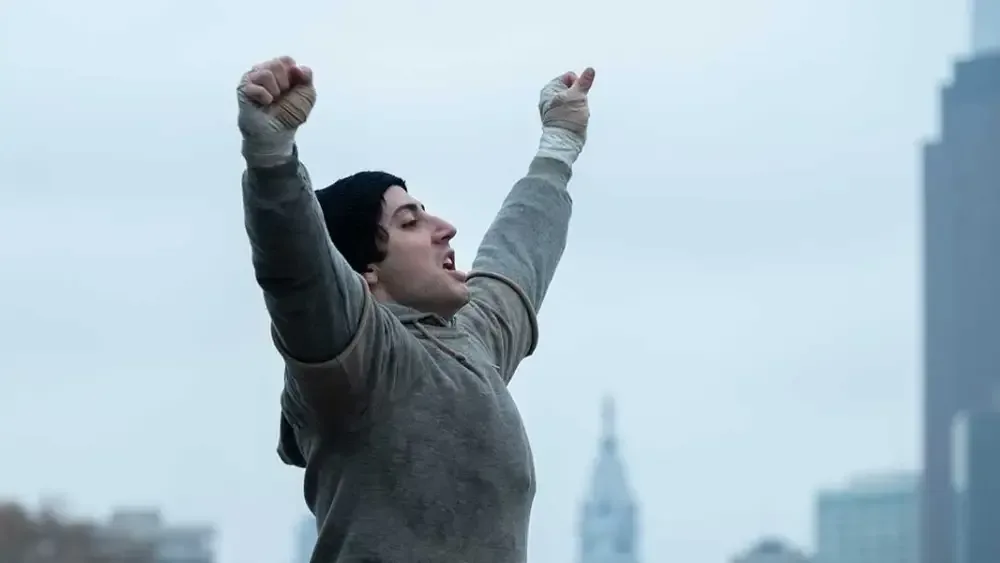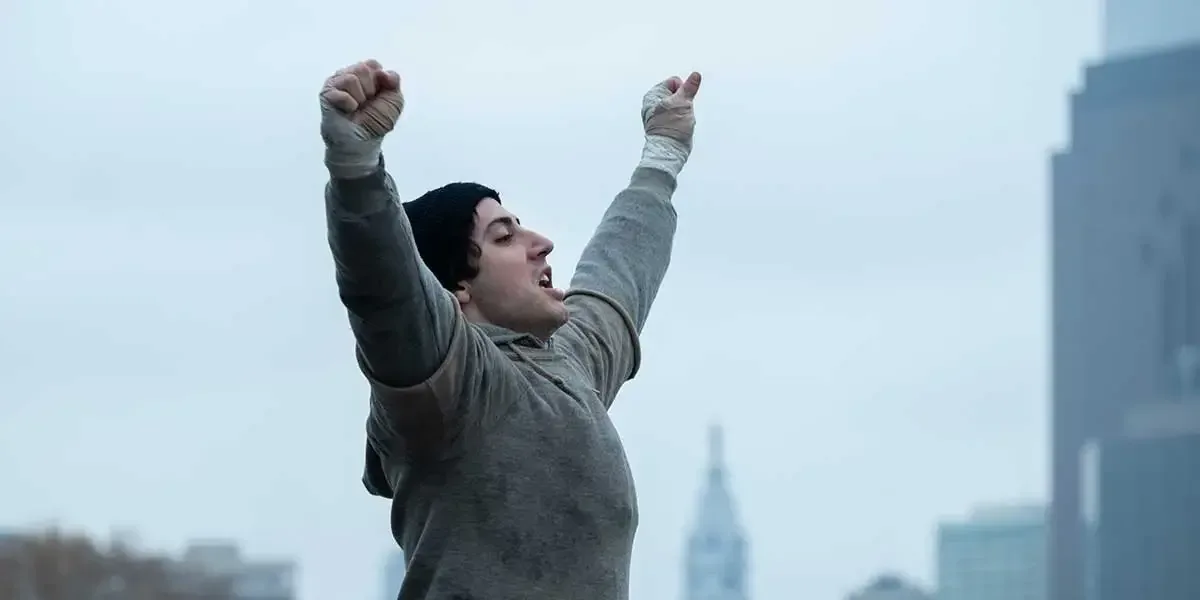
There are movie roles where a little interpretive distance is healthy. Then there is Sylvester Stallone in a film about the birth of Rocky, where the actor has to walk into the ring carrying one of cinema’s most recognizable faces, voices and underdog myths. Anthony Ippolito has that assignment in Peter Farrelly’s I Play Rocky, a 127-minute, PG-13 drama about Stallone’s fight to make himself the star of the 1976 phenomenon he wrote.
The premise has an immediate, almost wonderfully stubborn hook. A then-struggling Stallone writes a screenplay about Philadelphia club fighter Rocky Balboa. Producers want the script, but not necessarily its author in the lead. Stallone’s answer is the movie’s entire engine: he will sell the story only if he gets to play Rocky. It is a Hollywood negotiation that already sounds like a Rocky plot: one guy, very little leverage on paper, refusing to accept the sensible defeat everyone else is offering him.
I Play Rocky was shown in the Special Presentations program at the Toronto Film Festival on September 12, 2026. It arrives with an especially difficult task beyond recounting production history. The original Rocky reaches its 50th anniversary in November 2026, and its title character, theme, training montage and Philadelphia steps are cultural fixtures. A movie about making it cannot depend on viewers forgetting what happened. Its chance is to show why the outcome was never assured.
Ippolito’s Stallone has to be more than an impression
Ippolito’s resemblance to the young Stallone is central to the film’s credibility. The performance captures the heavy-lidded look, distinctive mouth and gravelly, deliberate delivery associated with Stallone, but the more valuable element is the character work underneath the surface. This Stallone is portrayed as warm, hardheaded and determined enough to be exasperating. The voice and physical likeness provide the doorway; the persistence makes the dramatic stakes matter.
That distinction is vital in a biographical drama. A precision impersonation can be a neat party trick, but I Play Rocky needs the audience to see a man whose defining trait is not simply sounding like Stallone. He is an actor repeatedly offered scraps of work, a writer trying to manufacture his own opening, and a prospective leading man whom studio decision-makers regard as a huge risk. The movie’s version of the young Sly must persuade viewers that refusing enormous money for a screenplay was not irrational vanity, but the only way he saw to escape the margins.
The setting begins in 1974 New York, with Stallone residing in a rough Times Square hotel and pursuing minor auditions, including parts with names on the level of “Thug #2.” He is short of cash, loses his room and encounters the pug that becomes his pet. The movie also includes an audition for a soft-core porn production, while the real Stallone had appeared in such a film years earlier, in 1970. The point is not glamorous origin-story polish. The character is cornered, and the stakes behind every bad job or failed audition are plainly material.
Sasha, scripts and the road west
AnnaSophia Robb plays Sasha, the theater ticket seller Stallone meets after taking a job at a movie house. Their relationship supplies encouragement without turning into automatic cheerleading. Sasha pushes him toward the practical idea at the heart of his career pivot: if casting directors will not give him the parts he wants, he should create one on the page. The pair marry, relocate to Los Angeles, and Stallone continues writing while working as a parking attendant.
The screenplay is by Peter Gamble, and it structures the journey as a collision between an intensely personal ambition and a business that is trained to reduce risk. Before Rocky, Stallone has pitched Paradise Alley to producers Irwin Winkler and Robert Chartoff, played by P.J. Byrne and Toby Kebbell. Then he brings them the boxing story. They see something in it, and a studio executive named Sandy Maddox—played by Tracy Letts and described as a composite character—becomes part of the machinery deciding whether it can happen.
Related coverage includes ‘I Play Rocky’ Review: Anthony Ippolito Carries a Winning Story of Stallone’s Gamble.
That helps make the film a show-business pressure cooker, a territory also explored in this look at a Hollywood comeback story under pressure. In I Play Rocky, however, the pressure centers on authorship and embodiment. The producers can buy the screenplay for $50,000, but Stallone’s condition changes the equation completely. They want a bankable star. He wants the chance to prove that the unknown writer is Rocky.
A negotiation with an underdog at its center
The money escalates. After a proposed $2 million budget is secured for Rocky, the producers offer Stallone increasingly large sums to walk away from the role, ultimately reaching $350,000. In 1975, that represented a staggering alternative to the uncertainty of starring in a low-budget film. Yet the movie treats his refusal as the real-life counterpart to Rocky Balboa’s own insistence on being more than a disposable opponent.
The historical material carries one notable wrinkle. The film dramatizes Stallone watching Muhammad Ali fight Chuck Wepner on March 24, 1975, with Wepner lasting all 15 rounds and landing meaningful shots despite being viewed as an overwhelming underdog. It presents the contest as the spark for Rocky. Stallone has said that the bout did not inspire him to write the film, so viewers should understand that the movie adopts one version of that debated origin story rather than settling it definitively.
The producers eventually agree that Stallone can star, but only in exchange for a reduced $1 million budget. That restriction does more than provide a final hurdle. It is depicted as part of the creative recipe. The film’s production becomes a fast, improvisational problem-solving exercise, turning apparent limitations into the texture that audiences would later associate with Rocky.
Making the original look like a controlled accident
Jay Duplass plays director John G. Avildsen, hired because he can work quickly and cheaply. Philadelphia becomes the chosen location in part because shooting there avoids unions, while the then-new Steadicam is used for the memorable climb up the steps of the Philadelphia Museum of Art. The movie portrays the shoot as unusually precarious: Stallone injures tendons and knuckles while working with frozen meat, but the schedule leaves no room to recover because delays could allow Maddox to remove him.
Stephan James plays Carl Weathers, Stallone’s co-star as Apollo Creed. The film emphasizes that neither actor begins with much boxing expertise. Trevor St. John appears as a veteran Hollywood fight choreographer, credited within the story with work on 14 classic boxing films. But Stallone dislikes the standardized look of the staged fights and presses for a rougher, more individual feeling. In the movie’s telling, he and Weathers must find their way toward that approach together—another example of creative necessity doing what money and polish cannot.
Farrelly’s film also leans into the comedy of artistic choices that later become sacred. Bill Conti’s now-iconic theme initially meets skepticism for being too grand. The people building a classic cannot know which detail future audiences will treat as untouchable; they are just trying to get through the day, protect the budget, and avoid being replaced. That tension gives the behind-the-scenes material movement rather than trapping it in reverence.
Matt Dillon plays Stallone’s father, and the film connects the emotional force behind Rocky’s confrontation with Mickey—played in the original by Burgess Meredith—to Stallone’s own unresolved anger. The approach is consistent with the broader thesis of I Play Rocky: the eventual film worked because its writer-star was not merely executing a commercial formula. He kept pulling material out of a life marked by rejection, insecurity and a refusal to settle for a supporting place in someone else’s story.
The legacy that the making-of story cannot fully contain
I Play Rocky is most energized by its depiction of a shoestring production defying common sense, and by Ippolito’s ability to make the young Stallone feel like an active human being rather than a museum exhibit. Its broader challenge is measuring the cultural shadow of the original. Rocky was not simply a successful sports drama. Its gritty but uplifting tone helped make a massive audience hungry for hopeful, old-fashioned feeling after an era often associated with bleaker American films.
That effect is difficult to recreate in a film that already knows every punch will land, every stair will be climbed, and Stallone will become Stallone. Still, the production’s bargain is clear: go back before the poster, franchise and legend, when the central demand was not a slogan but a career-altering condition. One unknown actor had written the role he believed he was born to play, and he declined the safer exit until everyone around him accepted the gamble.
Alongside Ippolito, Robb, Kebbell, Byrne, Duplass, James, Letts and Dillon, the cast includes Kiki Seto. Sean Porter serves as cinematographer, Sam Seig edits, and Dave Palmer provides the music. Produced by Baha Productions and Fireside Films, I Play Rocky is an Amazon MGM Studios release.