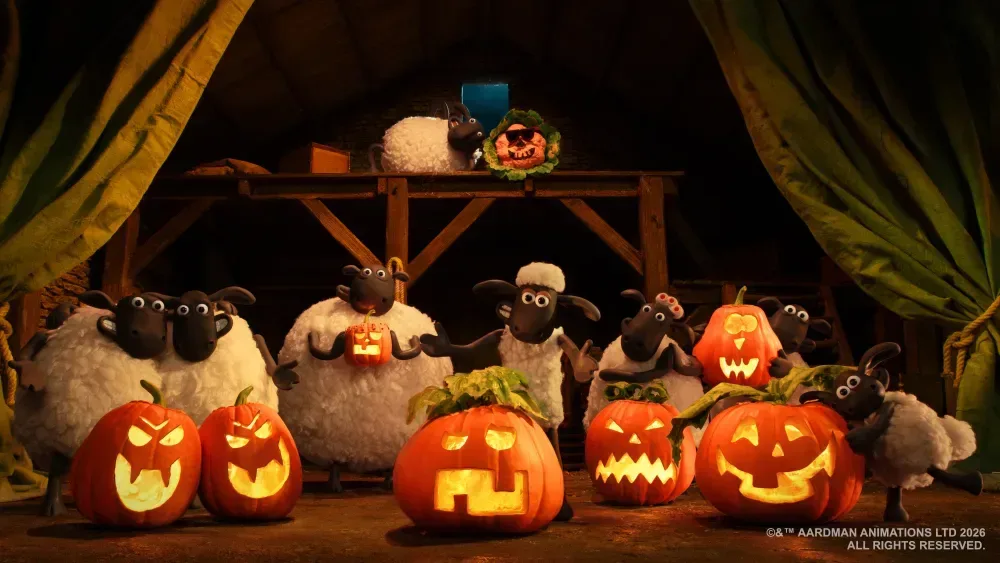
Shaun the Sheep: The Beast of Mossy Bottom takes its flock into Halloween territory with a mad-scientist Shaun, a ruined pumpkin patch, a hairy Farmer mistaken for Bigfoot and an opening built around an affectionate “Thriller” dance homage. Behind that deliberately playful premise is a useful reminder of what makes stop-motion such a distinctive filmmaking craft: even a brief gag, dance move or silhouette can require extensive planning, physical engineering and careful visual continuity.
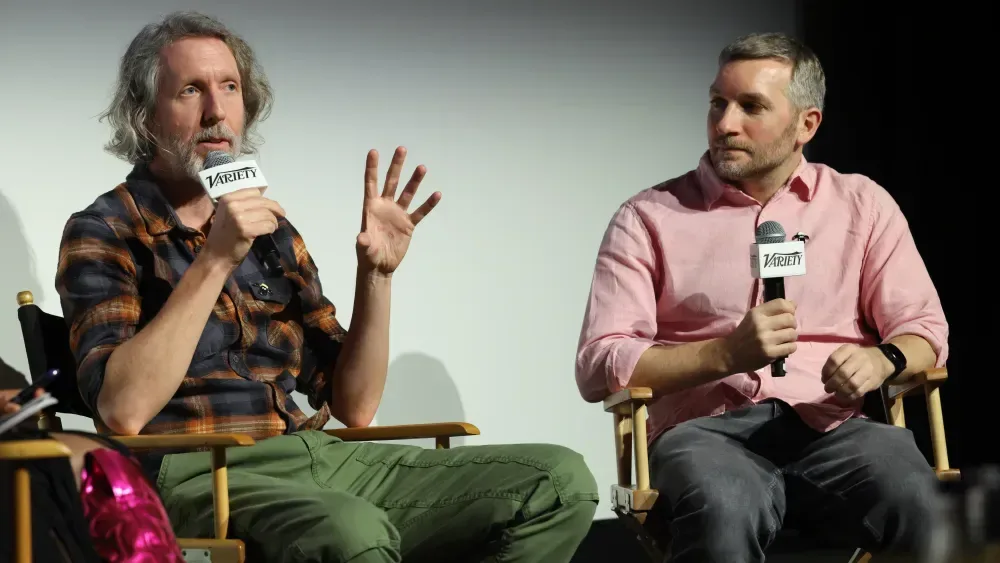
Directors Steve Cox and Matthew Walker have described a production that repeatedly looked for the sweet spot between spooky genre imagery and approachable comedy. The result was conceived explicitly as a Halloween film rather than a horror film. That distinction shaped the film’s visual choices, its monster design and even the rhythm of its scares: familiar horror signals can create anticipation, but the payoff should release tension with a joke rather than overwhelm its young audience.
It is a notably flexible direction for the franchise. The film follows Shaun after the Farmer destroys the flock’s pumpkin patch on the night before Halloween, placing Shaun in a mad-scientist role. Yet the project did not begin there. It started life as a proposed half-hour Valentine’s Day special about the Farmer meeting a new character, The Vet, and their developing relationship. As the idea grew, the team shifted toward Halloween, which opened the door to bolder colours, monster-movie visual language and a fresh palette for Mossy Bottom.
A dance number is not just a dance number in stop-motion
The initial opening under consideration was more overtly monstrous: a jump to a cargo ship at sea, where a creature escapes from its hold. Cox and Walker decided it was both too intense and too costly. Replacing it with the “Thriller” homage did not mean choosing an easy alternative. A dance sequence demands an unusual amount of precision in a medium where every pose must be physically placed and photographed.
For the sequence, the puppets were arranged on the set and put through staging run-throughs that could occupy several days. Animator Chris Sadler then created an early, simplified pass of the action in sections, timed to the music. Cox called that version “blocky,” an apt description of a planning stage focused on major poses, spacing and timing rather than final nuance.
What that means in practice: blocking is the process of determining where characters are, how they move through a space and when key actions happen. In a dance scene, blocking is especially important because the viewer instinctively reads synchronization. If one performer turns too soon, if spacing changes between poses, or if the group’s energy does not land with the soundtrack, the sequence can feel wrong even if individual movements are technically smooth.
Building that rough pass first gave the crew room to refine the performance before committing to the more detailed stages of stop-motion. It is the physical-animation counterpart to solving a scene’s underlying structure before polishing it. The approach also matters for a franchise such as Shaun the Sheep, where so much storytelling is visual. The flock may not rely on extended dialogue, so posture, timing and group movement carry unusual narrative weight.
There was also a straightforward mechanical obstacle. Puppet feet are ordinarily nailed into the floor to keep figures stable frame to frame. Dancing requires mobility, so the team instead used rods that could later be removed from the finished image. The area in front of the barn could not physically hold the entire flock at once, either. The scene had to be filmed in three passes.
Related coverage includes How ‘Shaun the Sheep: The Beast of Mossy Bottom’ Built Its ‘Thriller’ Dance and Bigfoot-Style Beast.
Technical note: a pass is a separately photographed layer or version of an image that can be combined with others. Here, splitting the flock across three passes allowed the filmmakers to make the barnyard appear more crowded than the set could accommodate in a single arrangement. It is a practical workaround, but it makes consistency vital: lighting, positioning, perspective and puppet scale all have to remain convincing when those elements are brought together.
The dance therefore combines two different kinds of illusion. The audience sees a spontaneous musical opener; the crew had to solve choreography, rigging, limited stage space and removable supports. That contrast is central to stop-motion’s charm. The medium often makes painstaking labour feel unusually tactile and casual on screen.
Halloween genre language, redirected toward comedy
The filmmakers’ stated goal was not to remove all menace from the material. Rather, it was to use horror tropes as comic tools. A monster looming over a hill, ominous footsteps and intensified music can establish the shape of a scary scene. But the moment is redirected: when the beast first climbs over the mountain, a music change and a shot of the flock rushing into the house break the building dread.
That is a meaningful storytelling choice. Horror often extends suspense by delaying release; comedy often uses the audience’s expectation of one outcome to produce a different, smaller or sillier one. In this case, the visual vocabulary of monster cinema remains useful because it is immediately legible. A large shape on a ridge needs little exposition. The comedy comes from the characters’ response and the decision not to let the sequence remain frightening for long.
The same balancing act informs Shaun’s altered appearance. He has a lab coat, goggles, wild mad-scientist hair and a five-fingered human glove despite his hoof-like design. The team initially considered using the costume throughout the film but ultimately restricted it to scenes in Shaun’s windmill laboratory. The lab itself drew inspiration from Frankenstein. Restricting the costume helps preserve its comic impact: it marks Shaun’s plotting mode rather than becoming visual background noise.
There is also room for a particularly sparse spoken reference. Though the series is known for minimal dialogue, “Hodor,” associated with Game of Thrones, appears as a one-word pop-culture nod. Cox said he laughed when reading it because he was a fan of that series. Its inclusion illustrates how the franchise can slip a quick reference into its visual and sound-driven comedy without changing its fundamentally accessible style.
Making the Farmer recognizable beneath the fur
The Farmer’s transformation into a hairy beast was one of the production’s more elaborate design challenges. The team began with sketches and clay sculptures from the puppet department, then explored differing shapes and computer-generated versions with alternate hairstyles. At one point, a prototype was made with layers of teddy-bear fur.
The brief was deceptively demanding: the creature needed enough bulk and a clear silhouette to be mistaken for Bigfoot, while still reading as the Farmer beneath all that hair. A silhouette is the recognizable outer contour of a character or object. It is a fundamental visual-design tool because it can communicate identity before the audience sees fine facial detail. For a monster that appears in low-light Halloween imagery or at a distance, a strong outline does much of the work.
The final beast’s horn-like hair shape was informed by the Farmer’s receding hairline. That is a very Shaun the Sheep solution: the monster transformation is heightened, but it stems from a recognizable trait of the familiar character. It helps make the creature feel like an extension of the Farmer rather than an unrelated horror guest.
Underneath, the final puppet used a detailed maquette, a 3D-printed core and control points for animation. A maquette is a small-scale physical model used to establish a character’s form and design. The 3D-printed internal core offered a sturdy, repeatable foundation, while the control points gave animators specific places to manipulate movement. The head was mounted on a winder so it could move vertically.
The puppet department made 11 versions of the beast. That number speaks to a core stop-motion production problem: a character can need multiple physical versions for different shots, poses or functional requirements. Yet all versions must appear to be the same screen character. Cox highlighted the difficulty of reproducing the beast’s distinctive strands of hair so they matched from puppet to puppet. Continuity is not merely a matter of maintaining a costume; it is the audience’s sense that one creature has moved naturally through a single uninterrupted world.
Ambition at model scale
The production’s physical scale extended beyond character work. The windmill laboratory supported Shaun’s Frankenstein-inspired identity, while a ship became the largest single prop ever built for a Shaun the Sheep project. Cox and Walker initially intended to follow an economical strategy and construct only half of it. But when a shot of the vessel leaving the dock revealed the unfinished side, the team had to build the other half in three days.
The anecdote is amusing, but it captures a real constraint of practical miniature filmmaking: camera placement can turn an invisible compromise into an immediate production issue. A prop need only be complete from the angles the camera will see—until a new or altered shot sees more than expected. Unlike a purely digital object, the physical set does not automatically contain the unseen side.
The giant jack-o’-lantern posed a different scale problem. It was created through 3D printing, but its dimensions exceeded what the studio’s printers could produce, requiring outside assistance. The pumpkin is another example of a simple Halloween symbol becoming a large practical task when it has to exist as a detailed, filmable object within a miniature world.
The Vet gives the Halloween story an emotional anchor
Although the season and monster premise moved to the foreground, the original romantic thread survived through the Farmer and The Vet. The Vet is a new addition to the franchise, and the filmmakers wanted to shape her carefully enough that she could potentially return in later projects. Her presence also offered an opportunity to bring a more emotional register to the established cast.
For the flock, her profession initially makes her an unwitting antagonist: veterinarians can be alarming from the perspective of animals worried about treatment. But she shares a connection with the Farmer. He is described as slow and lazy; she is energetic and proactive. Their contrast gives the pairing a clear comic shape, while their mutual shyness around other people gives them common ground.
That character dynamic matters because it prevents the film from being only a collection of Halloween set pieces. The monster, laboratory, ship and oversized pumpkin supply the spectacle, but the Farmer and Vet relationship gives the story another strand of gentle vulnerability. It also fits a franchise built around expressive action: a shy connection between two people can be communicated through behaviour and timing as effectively as through lengthy dialogue.
For more film and animation coverage, see our report on the 2026 SFFILM Honors lineup.
Shaun the Sheep: The Beast of Mossy Bottom ultimately sounds like a compact lesson in turning limitations into personality. A too-costly cargo-ship opening became a carefully engineered dance. A frightening monster introduction was softened into a comic beat. A Bigfoot-like beast retained the Farmer’s own silhouette cues. And props large enough to challenge the workshop’s resources became part of the film’s Halloween scale. The finished effect depends on viewers seeing only the flock, the fun and the fright-sized-for-comedy adventure—not the rods, multiple passes, matching hair fronds and rapidly completed reverse side of a ship that made it possible.