High Value Target: The Hunt for Saddam arrives with weighty material that does not need manufactured urgency. The eight-episode TNT limited series is inspired by former CIA analyst John Nixon’s 2016 memoir Debriefing the President, placing the 2003 invasion of Iraq, the search for Saddam Hussein, and the unraveling of the war’s weapons-of-mass-destruction rationale at the center of its story.
That history is inseparable from the drama’s appeal and its difficulty. Saddam Hussein’s dictatorship was brutally repressive, yet the U.S. invasion was built around claims of weapons of mass destruction that did not pan out. A series attempting to hold those realities together has a demanding task: it must acknowledge the terror inflicted under Hussein while confronting the immense civilian and military cost of the invasion, along with the disastrous political case used to sell it.
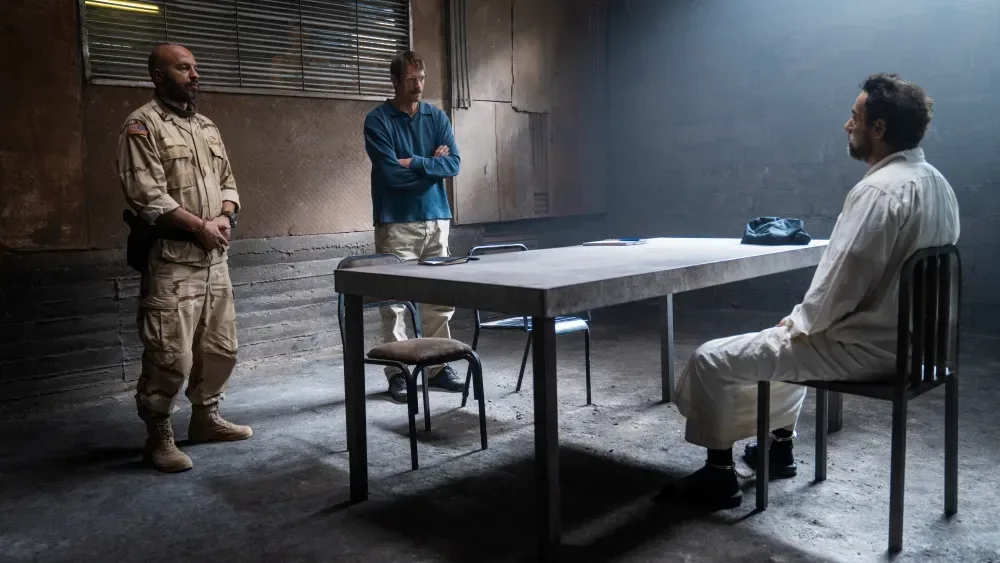
High Value Target has flashes of a compelling answer to that challenge. Its best scenes narrow the lens to Nixon’s conversations with Hussein after the former Iraqi president is captured. Waleed Zuaiter’s Saddam is presented as a figure who can be personable, evasive, unsettling and menacing in rapid succession. Those exchanges bring tension from uncertainty and observation rather than battlefield spectacle. They also give the show its clearest human stakes, particularly when Dar Salim’s translator Samir is in the room.
But the series repeatedly moves away from that unusually potent dramatic core. Long stretches are given over to familiar images of the conflict, institutional infighting and dialogue that can feel more like exposition from an intelligence briefing than conversations between people under immense pressure. The resulting structure makes a harrowing historical subject feel protracted rather than consistently illuminating.
A story that begins before the invasion
The drama opens on March 17, 2003, following John Nixon as he moves through Washington, D.C. Nixon’s narration reaches backward to frame U.S. policy and the Bush family’s history in the region before shifting toward President George W. Bush’s decision to invade Iraq. Paul Ryan portrays George W. Bush, while the show positions the coming military operation around the pursuit of Hussein, the asserted WMD threat, and a wider ambition to reshape the region.
Its timeline then contrasts a relatively still Washington with Baghdad’s chaos two years after the September 11 attacks. Archival conflict footage and clips from Bush administration press appearances are incorporated into the dramatized narrative. The series depicts the invasion’s disorder, deaths among Iraqi civilians and American service members, and the later deaths of Hussein’s sons. It is material with no shortage of gravity, and the show does not try to minimize the scale of the catastrophe.
The issue is less whether the series recognizes the horrors of war than how often it restates them. There is a difference between confronting an audience with violence and creating a dramatic rhythm that reveals something new through it. Here, repeated war montage can flatten the impact. The images are serious, but their accumulation sometimes delays the specific, character-driven story that the series is far better equipped to tell.
John Nixon is written as confident, but the performance cannot settle the contradiction
Joel Kinnaman plays Nixon, an analyst who has spent years studying Hussein and believes the CIA is following poor leads. Nixon’s professional certainty is an essential part of the premise: he thinks his accumulated knowledge of Iraq and its deposed leader gives him insight his colleagues lack. Yet the character is also condescending, lacks field experience, and finds that intellectual confidence is not the same thing as readiness for a war zone.
That contradiction should supply the drama’s engine. Nixon is neither a simple hero nor merely an outsider ignored by a bureaucracy. His conviction has merit, but his manner alienates people; his academic expertise is substantial, but the realities around him outpace his preparation. Unfortunately, Kinnaman does not make all those competing traits cohere. The role calls for an analyst whose self-assurance, frustration and vulnerability can exist at once. Instead, the characterization often lands as stiffly self-important, making it harder to engage with a man the series needs viewers to follow closely.
Within the CIA storyline, Talia Balsam plays senior official Angela Jenkins and Matthew Wolf plays Richard Stillwell. Nixon’s warnings about the direction of the hunt receive little traction with the agency’s hierarchy. Eventually, he is permitted to travel into Iraq alongside Polly Stevens, played by Lena Góra, and Jerry Munro, played by Ewan Miller.
Once Nixon reaches the country, the series makes clear that being knowledgeable about Hussein from afar does not make him operationally competent. He encounters frightened civilians and the immediate hazards of bombs, weapons and a destabilized country. The sequence of events eventually puts him on Operation Red Dawn, the mission in which Hussein is found in an underground hiding place on a farm. This is a useful corrective to Nixon’s early arrogance, though the show spends so much time getting there that the momentum can sag.
Where High Value Target finds its purpose
The capture sets up the material that most justifies the adaptation. Nixon’s interrogation of Hussein offers a contained setting in which history, ideology, power and personality can collide. Nixon comes to believe Hussein is truthful about the absence of the weapons that had been used to justify the invasion. He also concludes that Western attention should be directed toward Iran, a view he struggles to get accepted by the Bush administration.
Zuaiter’s work makes these scenes memorable. He does not reduce Hussein to an easy monster, which would be inaccurate to the strange interpersonal dynamic an interrogation drama requires. The performance allows charm to appear without removing threat, and intelligence to emerge without excusing systematic state terror. That balance is difficult, especially in a drama dealing with a leader responsible for enormous suffering.
Salim is equally important as Samir, whose family has been devastated by Hussein’s rule. Samir ensures that the scenes are not simply a contest of wills between an American analyst and a fallen dictator. Translation itself becomes part of the tension, while Samir’s personal losses anchor the conversations in Iraqi experience. These moments show how much richer the series can become when it slows down and allows the people in the room to define the stakes.
The show also depicts abuse at Abu Ghraib, including beatings and torture of prisoners, while emphasizing the broader impossibility of daily life for many Iraqis amid dictatorship, invasion and occupation. Its Washington scenes expand the personal frame further: Tom Berenger plays Nixon’s father Charles, and Rebecca Night plays his wife Rebecca, both waiting for news while Nixon is abroad. Christopher McDonald and Matt Barr are also among the supporting cast.
The limits of turning catastrophe into prestige drama
There is nothing inherently wrong with dramatizing a memoir about a consequential failure of intelligence and policy. In fact, the record deserves ongoing scrutiny, especially as television can reach viewers who may never pick up Nixon’s book. But dramatization has responsibilities beyond assembling recognizable events, vintage broadcasts and grim historical markers.
High Value Target is most valuable when it asks viewers to sit with the fallout of certainty: the certainty of officials who insisted they had a case for war, the certainty of an analyst who believes he alone understands his target, and the certainty of a dictator who once controlled a nation through fear. The series is weaker when it treats the Iraq War’s devastation as an all-purpose backdrop for procedural motion.
That gap makes the show feel divided between a searching interrogation drama and a broad war chronicle. One is tense, morally complicated and led by an excellent portrayal of Hussein. The other is often laborious, with information-heavy dialogue and a reliance on repetition that blunts the intended force. The tension may be central to why the series is so frustrating: its strongest passages demonstrate exactly what the surrounding episodes could have been.
For viewers interested in screen stories that wrestle with labor, institutions and real-world pressures rather than offering tidy escapism, there is a useful adjacent read in this look at Barbara Kopple’s labor-documentary legacy. The subjects are vastly different, but both raise a related question about how nonfiction realities are translated for audiences.
Release details and creative team
The first two episodes of High Value Target: The Hunt for Saddam premiere on TNT on September 13. The remaining episodes are scheduled to air weekly on Sundays and Mondays.
Daniel Stiepleman and Jonathan Wakeham created the series, which is written by Leslie Greif, Graham Sack, Stiepleman and Wakeham. Executive producers include Alexander Rodnyansky, Jason Sarlanis, Sam Linsky, Stuart Manashil, Michael Kupisk, Tamer Mortada and Greif. AR Content, Big Dreams Entertainment and Aroma Studios produce in association with WatchIt.