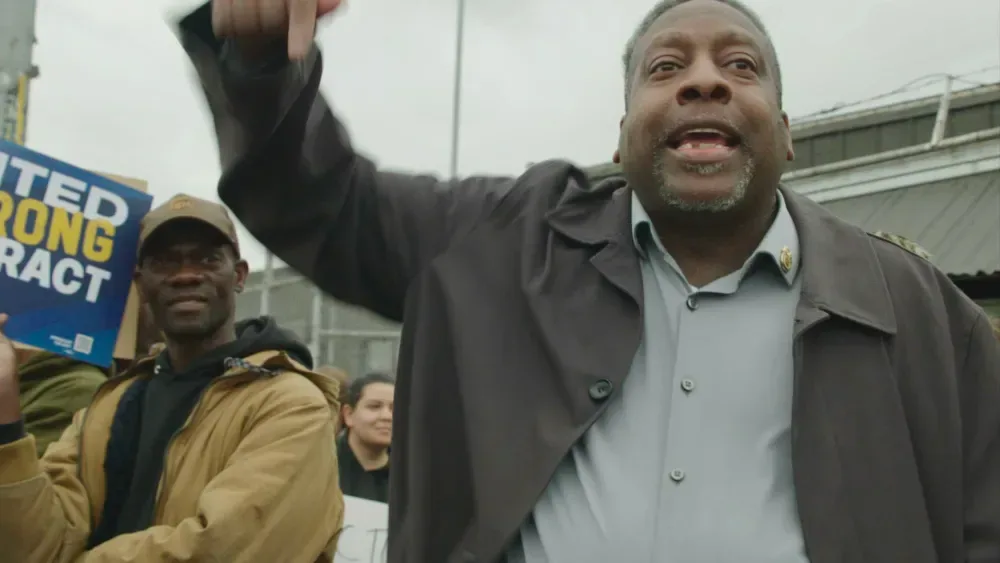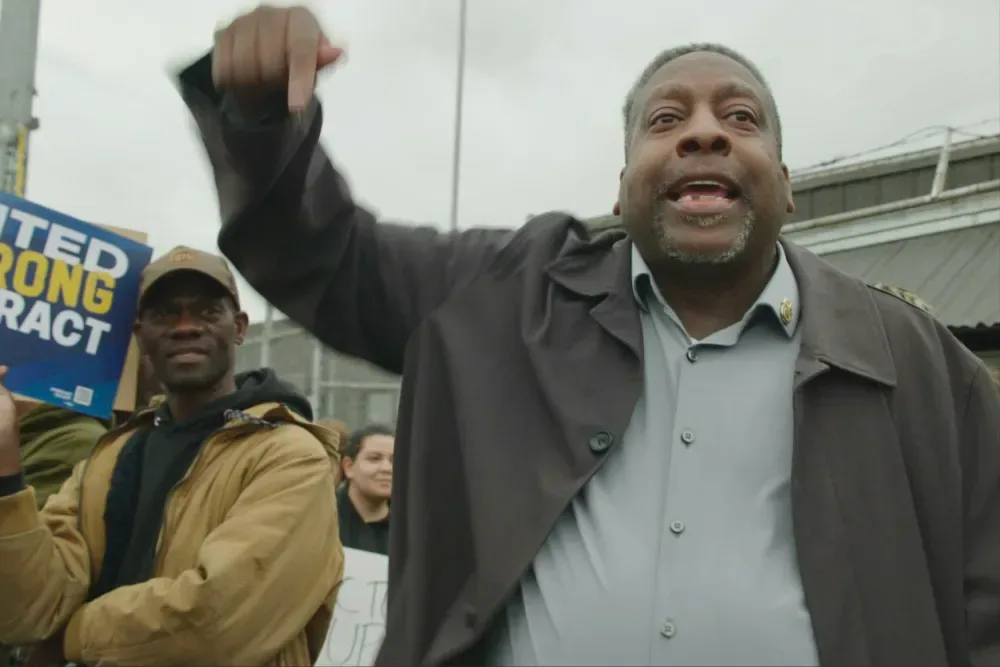
Barbara Kopple has spent decades making documentaries that put working people at the center of the frame, and Union Town brings that commitment into the delivery economy of contemporary New York. The 106-minute film follows the labor fights surrounding app-based food couriers, Amazon delivery personnel, UPS drivers, Teamsters and organizers as they attempt to win safer conditions, greater security and meaningful representation.
The result is an openly pro-worker documentary, but not a simple victory lap for organizing. Union Town is concerned with the difficult mechanics of collective action: who bears the immediate financial risk, what compromises are acceptable, which promises can be trusted and how workers keep going while the systems they are confronting continue to demand their labor every day. The film is set amid legal and organizing battles that intensified in New York after the summer of 2023, a period when the people transporting meals and packages were increasingly visible—and still too often treated as disposable.
New York is more than a backdrop. Early figures in the documentary state that approximately 2.5 million packages and 500,000 meals move across the city’s five boroughs each day. That immense logistical machine depends on people navigating traffic, unpredictable weather, strict delivery targets and the fragile economics of hourly or app-mediated work. Kopple’s film turns those enormous totals back into individual lives.
A new chapter in a career-long labor focus
Union Town sits naturally beside Kopple’s earlier work. Her 1976 film Harlan County U.S.A., which examined a Kentucky coal miners’ strike, earned an Academy Award. She received a second Oscar for 1990’s American Dream, focused on food-industry workers in Minnesota. Taken together, the three films form an unofficial trilogy spanning different workplaces and eras while returning to a persistent question: what happens when the people who make an industry run have little control over the conditions of their employment?
The industries have changed. Coal mines and food plants carry a different cultural image than phone apps, warehouse routes and parcel logistics. Yet the film emphasizes a continuity in the imbalance between corporate wealth and workers who handle the day-to-day demands of an operation. In this setting, the “gig economy” is not an abstract business term. It is a structure that can leave a courier dependent on an app account, an algorithm and a vehicle or bicycle that may be essential to earning anything at all.
That concern should also resonate beyond documentary audiences. Games and tech culture often celebrate frictionless delivery, on-demand convenience and automation, while discussions of the labor behind those conveniences can fade quickly from view. The workplace conditions described in Union Town echo a wider reckoning with labor practices across entertainment and technology, including accounts of punishing schedules in game development. Reports of extreme crunch tied to major game productions underscore how different sectors can share a habit of treating human endurance as an endlessly renewable resource.
Several struggles, one interconnected city
Kopple and editors Hannes Hosp, Francisco Bello and Deborah Peretz braid together several campaigns rather than confining the film to a single workplace. The central groups include UPS drivers, Amazon delivery workers and food-app couriers—often called deliveristas—working through services such as Grubhub and DoorDash. Many of the workers shown are immigrants, and the film recognizes how immigration, family obligations, unstable income and workplace vulnerability are inseparable pressures rather than separate issues.
COVID-era rhetoric celebrated essential workers, but Union Town revisits what followed that praise. The workers who kept food and packages moving faced risks while public life was disrupted, and the film argues that symbolic gratitude did not translate reliably into better pay, job protections or influence over workplace rules. The distance between applause and material change is one of the documentary’s sharpest targets.
Related coverage includes ‘Union Town’ Review: Barbara Kopple Maps New York Delivery Workers’ Fight for Dignity.
Crucially, the film does not allow the scale of its subject to turn its people into statistics. It follows app workers who rely on government assistance despite their labor, workers fearing theft of the bikes needed to do their jobs, and drivers sleeping in trucks in pursuit of delivery numbers. These moments establish the stakes of the organizing efforts before any negotiating table or legal case enters the picture.
One of the film’s most painful stories concerns a 24-year-old delivery worker who was killed in 2024 after an emergency vehicle struck him. Kopple approaches his funeral without sensationalizing the loss, placing the focus on the grief carried by his family. Elsewhere, the documentary shows workers who say they were terminated under unfair circumstances, including someone unable to work while hospitalized and left with no meaningful route to appeal or restore an account.
Those stories clarify why a delivery-platform login can mean much more than software access. When work is managed through a platform, losing access can mean losing income with little warning and limited recourse. The film treats that precariousness as central to the labor conflict rather than a minor flaw in an otherwise efficient service.
Organizing without pretending it is easy
The anger in Union Town is directed in large part at corporate resistance to unionization. The documentary raises the contrast between money spent fighting organizing drives and the potential cost of improving wages and conditions. Teamster organizer Antonio Rosario appears among the figures questioning why companies with substantial resources do not choose to create more humane workplaces.
At one point, Amazon workers in Queens question whether a flood that arrived during a pro-union campaign could have been intentional. The film presents their suspicion as part of the workers’ experience and concern, not as a settled factual determination. That distinction matters: the documentary’s strength is its attention to what it feels like to organize in an environment where trust has already been badly damaged.
Kopple also makes room for disagreement among people ostensibly on the same side. Some activists favor accepting tentative company offers to avoid a strike; others argue that limited concessions risk leaving the deeper problems intact. Those tensions are not played as a failure of solidarity. Instead, they show how difficult it is to choose a path when delaying action can hurt workers now, while settling too early may weaken the possibility of lasting gains later.
The film also touches on fractures around Teamsters politics near the opening of Donald Trump’s second term. Some Teamsters figures support Trump, while others are left confronting leaders whose political choices appear misaligned with workers’ interests. By including this conflict, Union Town avoids portraying organized labor as a perfectly unified institution. It presents the movement as made up of people with competing strategies, loyalties and calculations.
Human stakes in an automated future
For all its frustration, the documentary does not remain locked in despair. Its closing stretch includes meaningful wins for workers and a sense of communal momentum. That optimism is earned through the film’s attention to sustained organizing, not through the suggestion that a single court case, protest or contract can solve every problem.
It also points toward the next confrontation. If delivery work and many other jobs are increasingly threatened by robots and artificial intelligence, the questions at the film’s core may grow even more urgent. Who benefits from efficiency? Who gets to decide when technology replaces people? And what protections exist for workers when the business model changes faster than public policy or labor agreements can respond?
Union Town does not treat automation as a futuristic gimmick. In the context of the workers it follows, AI and robotics become another potential tool for widening the gap between corporate decision-makers and the people whose livelihoods depend on the work. Kopple’s perspective remains steadfastly human: economic systems are ultimately judged by the lives they allow people to build, not merely by the volume of meals, packages or data they can move.
Festival and production details
Union Town was reviewed online on September 1, 2026. It is listed for Venice Film Festival’s Venice Open program and the Toronto International Film Festival’s TIFF Docs program. The documentary runs 106 minutes and includes English, Spanish and Bengali dialogue.
The film is a Cabin Creek Films presentation. Barbara Kopple directs and produces alongside Hannes Hosp and Peter Palandjian. Glenn Rigberg and Palandjian are executive producers. Cinematography is credited to Timothy Grucza, Hosp and Rachel Beth Anderson; Hosp, Francisco Bello and Deborah Peretz edited the film; and Jongnic Bontemps composed the music. Autlook Filmsales, based in Vienna, is handling world sales.