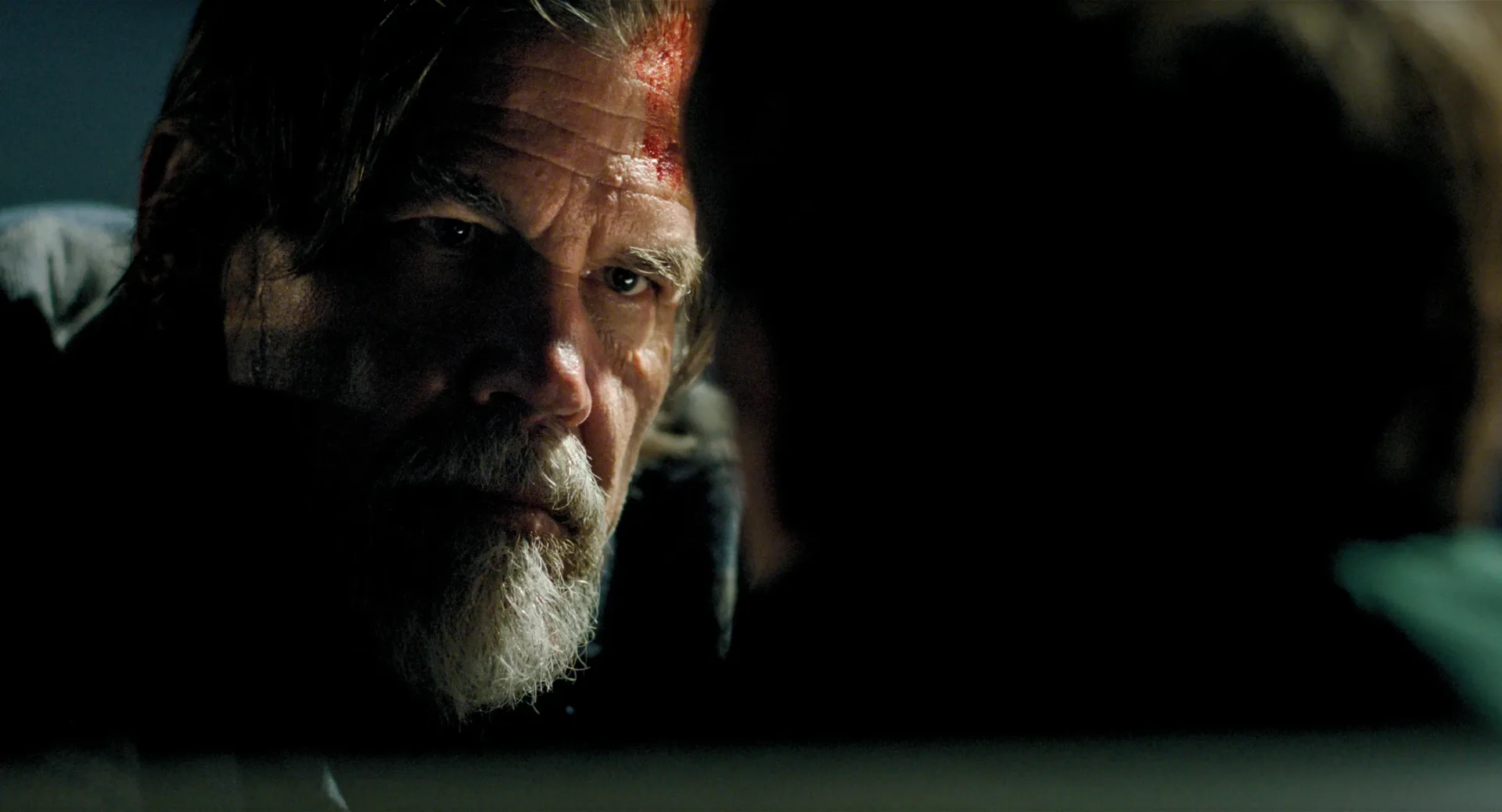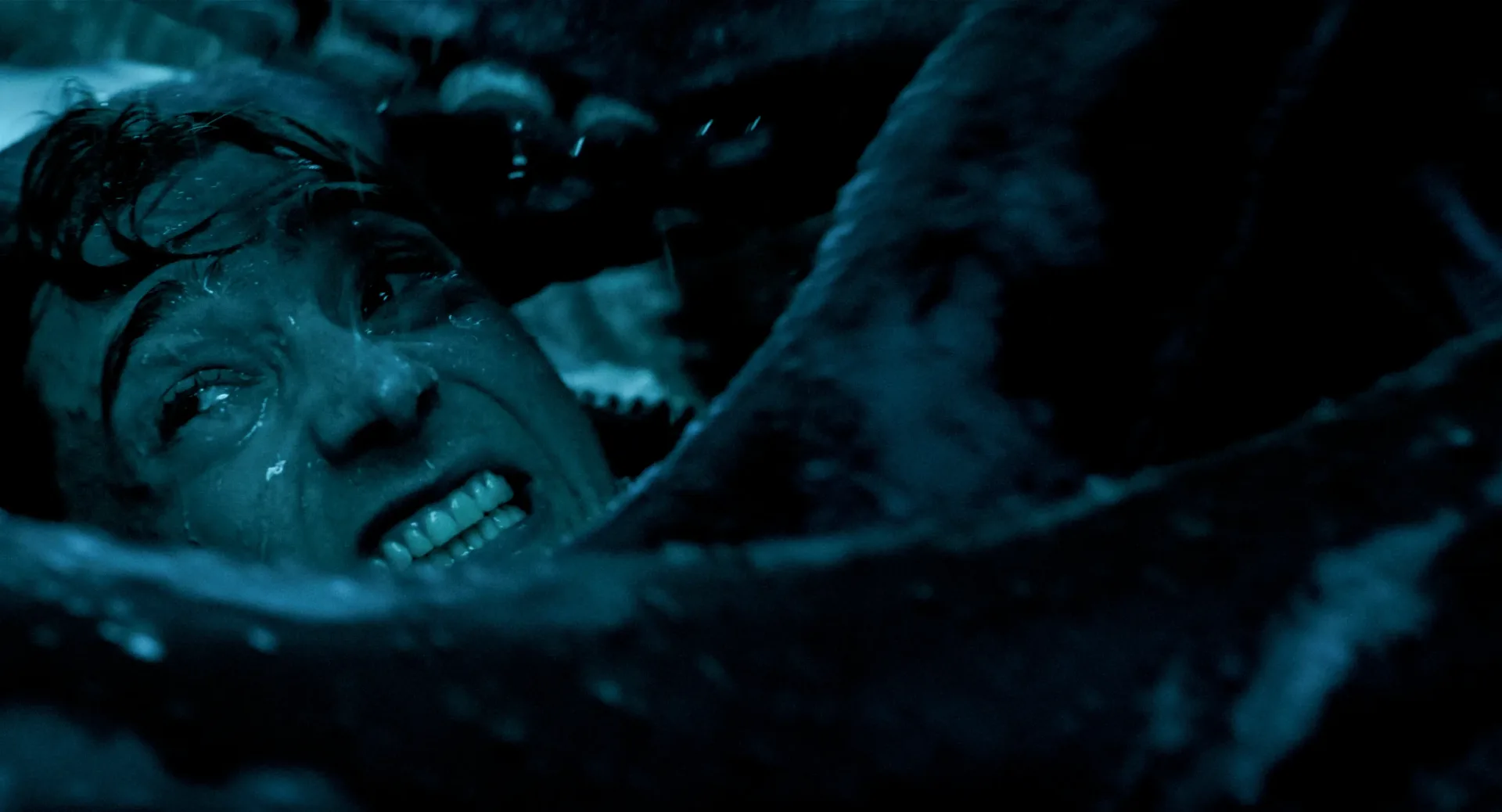
Hideo Kojima has shared an enthusiastic, distinctly stomach-turning response to Whalefall, the new survival horror film in which Austin Abrams’ character attempts to escape the belly of a sperm whale. Kojima praised the movie’s ideas as much as its effects, describing it as a literary work concerned with the relationship between whales and people, the wider ecosystem, and a father-son bond.
There was one personal side effect: after watching the film’s depiction of the whale’s interior, Kojima said he does not expect to be eating squid again any time soon.
That reaction is a concise endorsement of what the film appears built to do. A story about being trapped inside an enormous animal is already an extreme premise, but Whalefall is not framed merely as a creature-feature challenge. Kojima’s comments point to a movie attempting to balance biological horror with family drama and broader questions about humanity’s place in an ecosystem. The squid aversion is, in its own grisly way, evidence that the imagery landed.
A survival premise with more than one kind of pressure
At the center of Whalefall is Abrams’ struggle to fight his way out from inside a sperm whale. The setup naturally carries a powerful physical threat: confinement, darkness and the terrifying imbalance between a human body and a vast marine animal. But the themes Kojima highlighted suggest the film’s ambitions extend beyond simply asking whether its protagonist can find a route to safety.
He described the movie as “literary” and “somewhat metafictional,” while comparing its whale-and-human relationship to something Steinbeck-like. Those are interpretive labels rather than a plot synopsis, but they help clarify the lens through which he viewed the movie. “Literary” here suggests an emphasis on themes and character relationships, not only the mechanics of escape. The reference to John Steinbeck evokes an interest in human lives being connected to work, nature, family and larger social or environmental forces.
Metafictional generally refers to a work that draws attention to its own storytelling, form or constructed nature. Kojima’s use of the term does not establish exactly how Whalefall uses that approach, and viewers should not read it as confirmation of a particular narrative twist. It does indicate that he found layers in the film beyond its immediate, visceral predicament.
The ecosystem element matters especially in a premise built around a whale. A whale can easily become just a monster-shaped location in a survival story. Kojima instead saw the film engaging with the relationship between people and whales as participants in a shared ecological system. That does not make the situation any less frightening for the person inside the animal, but it potentially complicates the usual predator-versus-prey framing. The whale is not simply an antagonist with a convenient set of internal corridors; it is an animal whose body, behavior and place in the world shape the story.
Why the film’s interior reportedly feels so unpleasant
Writer-director Brian Duffield has described an unusually direct research process for constructing the film’s whale interior. The production watched autopsies of beached sperm whales, as well as endoscopic footage involving beluga whales and dolphins, then consulted experts about what material could be used and what would differ in a sperm whale.
An endoscopy is a medical examination in which a camera is used to look inside a body. In this context, the footage was part of research into what internal anatomy can look like from a perspective conventional filmmaking rarely needs to show. An autopsy is an examination conducted after death. Neither term is glamorous, and that is likely the point: anatomical reference can give fictional body horror a concrete, uncomfortable texture that a wholly invented environment might not have.
Duffield described the period as bizarre and graphic, with much of his viewing consisting of endoscopies and autopsies. He recalled closing a laptop when his wife entered the room, only for her to recognize that the material was work-related rather than something more conventionally embarrassing. It is a darkly funny production anecdote, but it also explains why the movie’s imagery could provoke Kojima’s food-related response.
Squid are not whales, of course, and the movie’s subject is a sperm whale rather than a squid. Kojima’s remark should be understood as a personal reaction to the film’s marine-organ imagery, not as a scientific claim about either animal. Horror frequently works through association: once a film connects a familiar food or object with an especially vivid bodily image, the brain may keep making that connection long after the credits roll.
Research is reference, not a guarantee of realism
The research details are useful because they show a desire for anatomical grounding, but they should not be mistaken for a claim that every image in the film is a documentary-accurate simulation. Duffield explicitly said the team considered what could be used from the footage and what would need to be different for a sperm whale. Film production is an act of selection and interpretation. In a horror scenario, realism serves the drama: it can make a location feel tangible, communicate danger quickly and make audiences question where the line sits between authentic biological detail and heightened nightmare.
That distinction is particularly relevant to visual effects. Kojima singled out the effects as outstanding, while Duffield’s account reveals the reference work beneath them. Effects are not only about making a spectacular exterior shot of a whale believable. In this kind of story, they must sell scale, texture and a setting the camera cannot practically visit. The effect work also has to support an actor’s peril without making the environment feel like a generic cave with a more unpleasant color palette.
For viewers, the practical implication is simple: anyone sensitive to graphic medical imagery, body horror, animal anatomy or intensely claustrophobic survival scenarios should approach the film with that expectation. The premise is not being presented as light fantasy adventure. Its tension is rooted in the very things that make the situation hard to shake: bodily vulnerability, a hostile enclosed environment and the uneasy realization that the surrounding space belongs to a living creature.
Predator, prey and the fear of losing control
The film has been characterized as an intensely frightening, gross and panic-inducing experience that taps into primal fears about being predator or prey. That phrase gets to the core appeal of the premise. People often imagine danger from a position of agency: running away, fighting back, finding a weapon, reading a map, or at least seeing the threat. A person trapped inside a whale has almost none of those comforts. There is no open horizon, no reliable sense of distance and no easy way to separate the danger from the place that surrounds them.
It is also a scenario that reverses the usual human relationship with nature in entertainment. The human is not the explorer, observer or rescuer. They are profoundly small, trapped within an animal far larger than themselves, and subject to conditions they cannot control. That reversal helps explain why Kojima found an ecosystem-focused reading alongside the film’s immediate horror. The whale is part of a natural world, but the human experience of being caught in that world is horrifyingly intimate.
The reported father-son element adds another source of emotional pressure. Survival thrillers can become mechanical if every scene is only about the next obstacle. A family bond can give the escape an emotional history and a reason for the protagonist’s decisions to matter beyond the physical ordeal. Kojima’s reaction does not reveal how that relationship unfolds, and there is no need to spoil it to understand why it might be central: the story is not only about getting out of a whale, but about what the character carries into that impossible situation.
Why Kojima’s response is a useful read on the movie
Kojima is best known to game audiences as the creator of Metal Gear Solid, but his comments here are focused squarely on filmmaking: thematic interpretation, effects craft and the emotional aftertaste of a particularly revolting image. That combination makes the reaction more revealing than a simple thumbs-up. He did not isolate the visual spectacle from the movie’s ideas. Instead, he connected the biological disgust to the film’s ecological and familial concerns.
For game players, that is also a reminder that memorable horror spaces are rarely defined by geometry alone. An effective setting has rules, texture, history and an emotional role in the narrative. In Whalefall, research into animal anatomy appears to give the setting physical specificity, while the whale-human ecosystem theme gives it conceptual weight. The result, if Kojima’s reaction is representative, is a movie where the gross-out factor is not detachable from the story’s larger concerns.
That does not mean every viewer will respond to it in the same way. Some will be drawn most strongly to the survival mechanics of the premise; others may be more interested in the family drama or the ecological perspective. Some may simply decide that a film capable of making a famous game creator swear off squid temporarily is too visceral for their tastes. All are reasonable reactions to a movie designed around an inherently uncomfortable location.
Whalefall is currently playing in theaters. Its combination of confined-space terror, anatomical research and thematic ambition makes it a notably unusual horror proposition: a movie about surviving inside a whale that is also interested in what whales mean to humans, and what happens when humans are forced to confront nature from its least flattering possible vantage point.
For more pop-culture viewing and home-screen context, see our look at Apple TV 4K support for four-HomePod surround sound.